Agnes and Ernie and the Great War
I thought I’d write a piece about the Ponte Vecchio – not the one in Florence – the one across the Brenta River in Bassano del Grappa, in the Veneto. Andrea Palladio designed it back in the 16th century, and it’s very photogenic; so off we went.
I didn’t know that the bridge would turn out to be partially dismantled and half-covered with scaffolding, with the river dammed into a narrow channel at one end of the span, leaving a muddy makeshift island underneath the other, where two of the old piers were being repaired. I left Patricia looking for camera angles, and decided to drown my disappointment at the Taverna al Ponte, at the western end of the bridge.

Palladio’s bridge over the Brenta, under repair
I ordered a beer and asked the barman how long the bridge had been under reconstruction, and when the work would be finished. “Forever,” he said. After some thought, he added “Never”. He didn’t seem eager for conversation. In a dark corner, I saw a doorway with stairs leading down. I thought they led to the loo but an old-fashioned sign said Museo degli Alpini, with an arrow pointing to the door. I edged my way down the narrow staircase, into the tavern’s cellar.
I found two underground levels full of the relics, reminders and trophies of war: Austrian WWI pickelhaube helmets, mannequins in Italian battle fatigues, machine guns next to mountaineering gear, and gas-masks hanging on hooks. Display cases were filled with Austrian sabres, German hand grenades, Italian field cookware, and a Chaplain’s portable altar for saying mass. The walnut stocks and black steel barrels of ancient Carcano rifles recalled the scent of linseed oil and cordite. Yards of cork-boarded walls were covered by yellowed battle dispatches, newspapers, photographs and beribboned medals of the famous local infantrymen called the Alpini. I climbed the stairs, thinking of the bitterness of their sacrifices and the sweetness of their victories, preserved like wine in a tavern’s cellar.
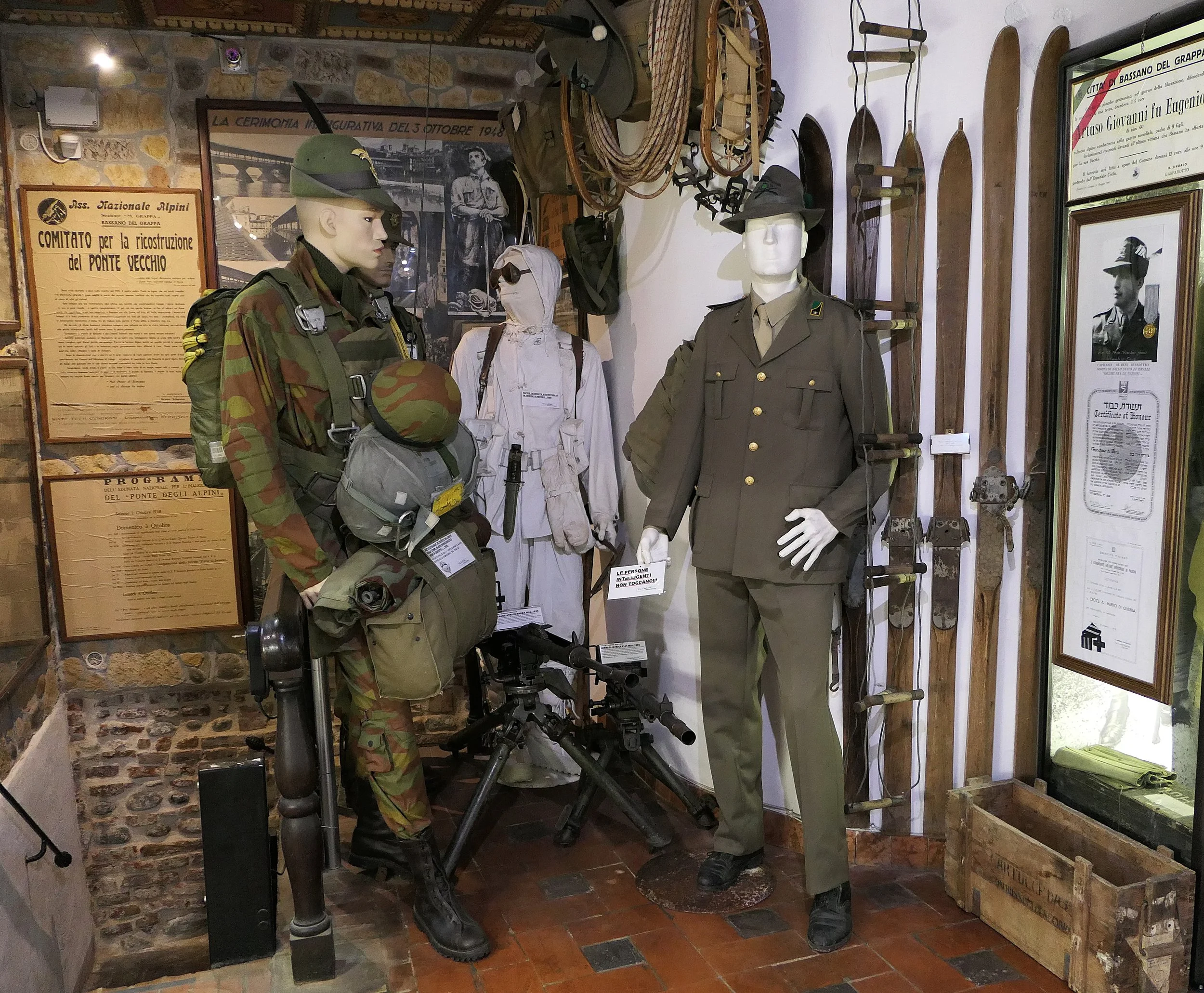
Alpini uniforms 1914 - 1945. The small mitragliatrice (machine gun) was made by Fiat for WW1; the larger by Breda for WWII.
Even the town’s name evokes the Great War: Bassano Veneto became Bassano del Grappa in 1928, to honour those who died in the icy trenches of Monte Grappa, just to the north. Our B&B, too, had a war-story to tell. It was in Villa Ca’ Erizzo Luca, a 15th century palace on the eastern bank of the Brenta, north of Bassano’s centre. The villa housed volunteer American ambulance drivers during the war. One was Ernest Hemingway, eighteen years old and looking for adventure.

Villa Ca’ Erizzo Luca, from the garden. In Hemingway’s day, ambulances were parked in front of the arcaded loggia.
Villa Ca’ Erizzo Luca has been lovingly restored and maintained by the late industrialist Dr. Renato Luca and his two sons. Dr. Luca combined his passion for the history of the villa and his love of Hemingway’s work in a unique museum called the Museo Hemingway e della Grande Guerra. Here the final years of WWI, and America’s participation in it, are documented; and an extensive “Hemingway Collection” chronicles the writer’s long-lasting fascination with Italy, and especially his life-changing early experiences there.

Entrance to the Museo Hemingway e della Grande Guerra
Hemingway was one of the first Americans to be injured in the war, when an Austrian mortar shell exploded as he was visiting Italian troops near Fossalta, on the Piave River. Two Italian soldiers beside him were killed. Hemingway’s legs were riddled with shrapnel while machine-gun fire shattered his right knee. In some accounts, he carried a wounded Italian soldier to safety before losing consciousness. He was transported to the American Red Cross Hospital in Milan for treatment, and later received a Medaglia d'Argento Al Valor Militare – the Italian “Silver Medal of Military Valour”.

Hemingway in an American Red Cross ambulance
Meanwhile, in Washington, D.C., a young woman named Agnes von Kurowsky, a recently minted nurse, applied for an overseas posting. She soon found herself in Milan – at the American Red Cross Hospital. A pretty and vivacious nurse, and a darkly handsome young patient who was something of a war hero – what could possibly happen? Though she was six years older than he was, they had a seven-month wartime romance. Agnes was certainly Hemingway’s inspiration for the nurse, Catherine Barkley, in “A Farewell to Arms”.
You can see photos of Agnes and Ernest in Dr. Luca’s museum: Agnes, backlit on a hospital balcony; Ernest, a dashing figure in uniform, with his cane. After the war, Hemingway returned to his parent’s home in Illinois, expecting Agnes to arrive soon for the marriage they’d planned.

Agnes and Ernie at a Milan Racetrack, 1918
“I am writing this late at night after a long think by myself and I am afraid it is going to hurt you, but I'm sure it won't harm you permanently …” began one of the most famous “Dear John” letters in all literature. Who knows whether she was right?
Her letters to Hemingway have survived, and so has a diary she kept during the war. The letters suggest that Agnes did love Ernest Hemingway; but she was a woman with her own plans. Although an anticipated marriage to an Italian aristocrat fell through (his mother disapproved), she had a successful nursing career and a late but happy fifty-year marriage. She died at ninety-two, without ever seeing Hemingway again.
As for Hemingway: he spent some time with the “Lost Generation” in Paris, was a war correspondent (and occasional spy) during the Spanish Civil War and WWII, tried his hand at bull-fighting, survived two plane crashes, married four women (one at a time, of course), invented a new prose style, wrote brilliant novels, and when depression and memory loss made writing impossible, killed himself. Agnes, the girl he loved and lost in Italy, was his first love; but writing, it seems, was his greatest love. He couldn’t live without it.
© Text © 2022 by Joe Gartman; Photographs © 2022 by Patricia Gartman. First published in Italia! Magazine, August/September 2022