The Antikythera Shipwreck
She set sail from Delos, perhaps, or Pergamon, or Ephesus, bound for the Bay of Naples. A large ship for her time, she was about 50 metres in length, with a cargo capacity of 300 tons or more. She was a sturdy vessel, but quite old, having been built two centuries before this, her final voyage. She was fully laden with marble and bronze statuary, gold, jewellery, elegant glassware and ceramics.

Marble Horse, from the Antikythera Shipwreck, Athens Archaeological Museum
It is not clear whether the cargo was loot from Roman military action in the Eastern Mediterranean, or trade goods sold by Greek merchants to Roman middlemen. In those days, early in the 1st century BC, the Roman Republic, though torn by civil strife at home, was nevertheless expanding into the Greek world. And wealthy Roman aristocrats were mad for Greek luxury goods. They were mad for Greek culture, as well; and this mania continued well into the Imperial era. Virgil modelled his Aeneid on Homer's epics. Wealthy Romans imported Greek tutors for their children. The major Roman gods were the Greek Olympian deities with Latin names. The Romans took Greek technology, improved it, and with their characteristic technical brilliance, created marvels of architecture and engineering.

The Antikythera Hercules, Athens Archaeological Museum
But the old freighter was not destined to deliver her cargo. Off the Aegean island of Antikythera, in a storm, she broke up and sank, coming to rest on an underwater shelf 40 to 50 metres deep. There the ship and its cargo remained, for nearly 2000 years.
In 1900, another vessel sought shelter from a storm, in the lee of Antikythera; this ship carried sponge-divers on their way home from the African coast. Anchored in a protected spot, they waited out the storm by practising their trade, and found, rather than sponges, the arm of a marble statue.

The Farnese Hercules, Naples Archaeological Museum
The site has been sporadically explored and excavated in the 115 years since the wreck was discovered. Many of the items recovered are displayed in the Archaeological Museum of Athens. The ship originally carried at least 36 marble statues, many bronzes, and other treasures of antiquity. One startling sight, for me, was what seemed to be the familiar figure of the Farnese Hercules, currently in the Naples Archaeological Museum. It turned out to be an almost identical sculpture, but 3 centuries older than the Farnese giant, which was made for the Baths of Caracalla in about 217 AD. The hero's traditional pose dates back perhaps to a lost 4th century BC bronze original by Lysippos.

Apples of the Hesperides, clutched in the hand of the Naples Archaeological Museum’s Hercules statue
Something else from the wreck was almost overlooked: a lump of bronze, badly corroded. When it was cleaned and analysed, it turned out to be a finely geared, highly sophisticated machine for calculating the position of celestial bodies on any selected date, displaying the phases of the moon, predicting eclipses, and correlating between different calendars. Nothing even remotely like it has survived from antiquity. This is the famous “Antikythera Device”, the world's first analogue computer. What marvels of invention might it have inspired in the Romans, if it had not spent two millennia at the bottom of the sea?
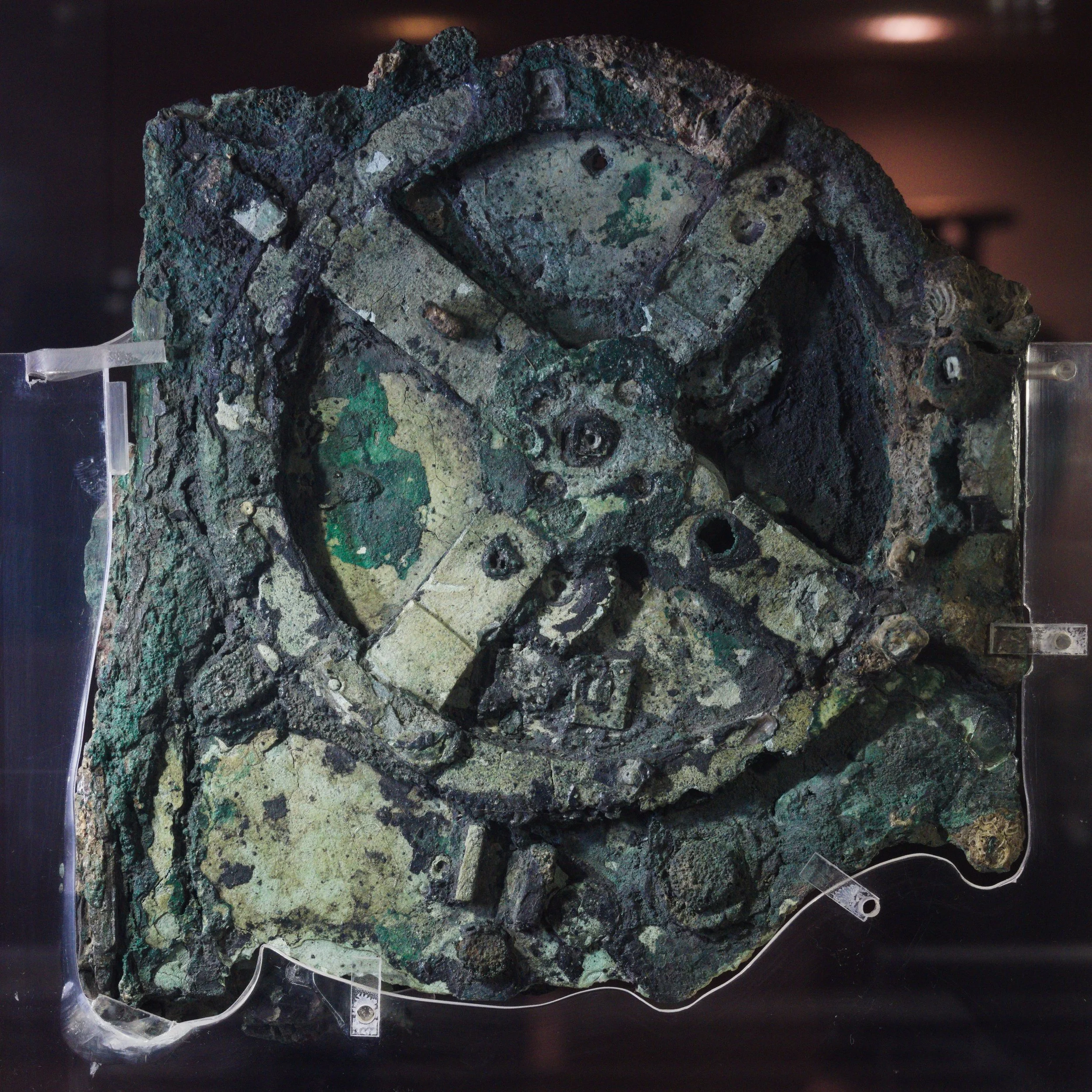
The Antikythera Device, Fragment A (Front)
(Logg Tandy, CC BY-SA 4.0, via Wikimedia Commons)
.webp)
© Text © 2016 by Joe Gartman; Photographs © 2016 by Patricia Gartman. First published in Italia! Magazine, February 2016