Bridging Time
An old stone bridge carries the Via Flaminia north across the Tiber, away from Rome. Some of the piers survive from 115 BC, when the bridge was built. There is a medieval tower at the north end, later modified by a succession of Popes. Once, ox carts, chariots, and wagons crossed the bridge, but it is now open only to pedestrians and bicycles. It’s a pleasant stroll, and you can pause in the middle to admire the trees and clouds mirrored in the river as you look east toward Ponte Flaminio.

View from Ponte Milvio toward Ponte Flaminio
But first, notice the statues flanking the bridge’s entrance: on the right is St. John Nepomuk, palace priest to Good King Wenceslas of Bohemia. There is a Cupid with his finger to his lips peeking from behind the saint. (The King had Nepomuk tossed into the Vltava River when he refused to disclose what the Queen whispered in the confessional.) Although evidently not a strong swimmer, John is the protector of those in peril of drowning! On the left is the Virgin Mary, with an inscription: Macula Non Est In Te, “there is no stain in you”.
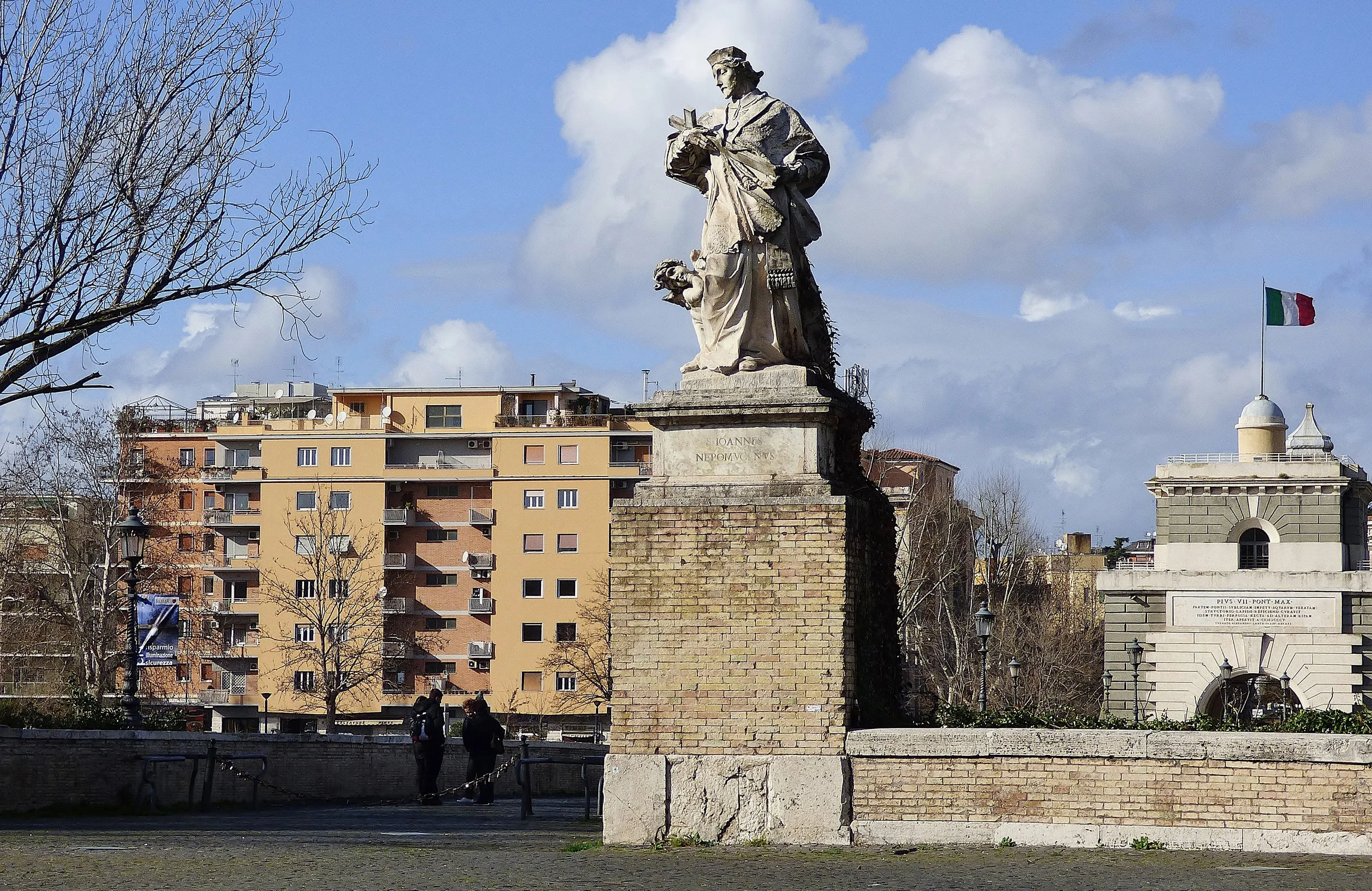
Statue of St. John Nepomuk
The bridge has endured floods, wars, and the weight of years for twenty-one centuries. Nowadays, it also bears the weight of hundreds, sometimes thousands, of padlocks attached to every possible structure.

Lovelocks on the Ponte Milvio, 2015.
Couples vow their love, secure the padlocks, and then toss the keys into the Tiber, a ritual popularized in the film Ho Voglia di Te (I Want You); and, periodically, the authorities come and remove the padlocks, a ritual prompted by the fact that in 2007 a lamp post on the bridge collapsed under its burden of amore. The “love lock” tradition has spread all over Europe – but it started here.
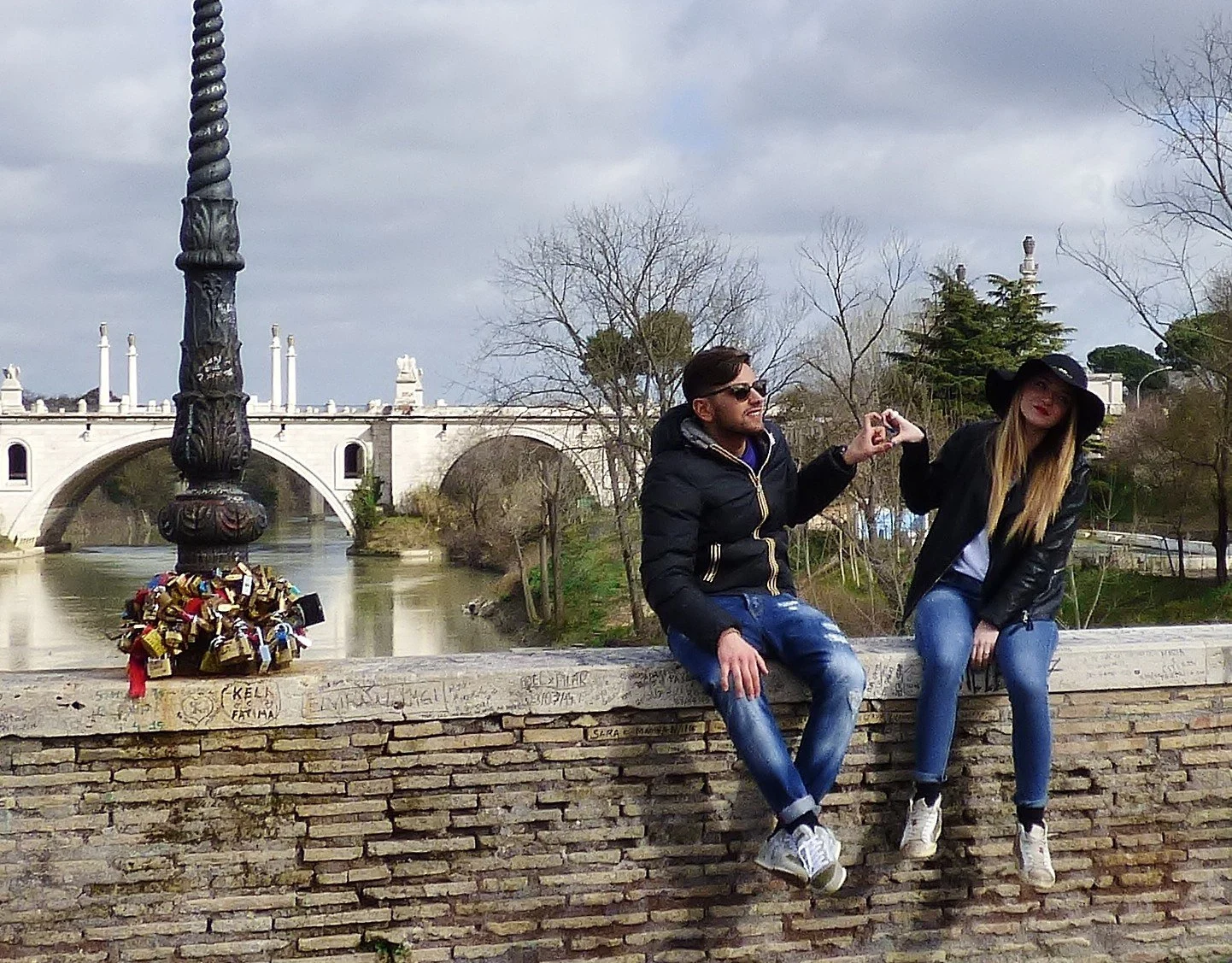
Two hearts beat as one
Most Sundays, an army of white canvas tents is arrayed along the riverbank, filled with antiques (to use a delightfully elastic term) and handicrafts. The market is huge and extremely popular. In all, the scene is refreshingly ordinary: modern Romans enjoying themselves ten miles or so from the historic centre, free from the sometimes-overpowering reminders of history.
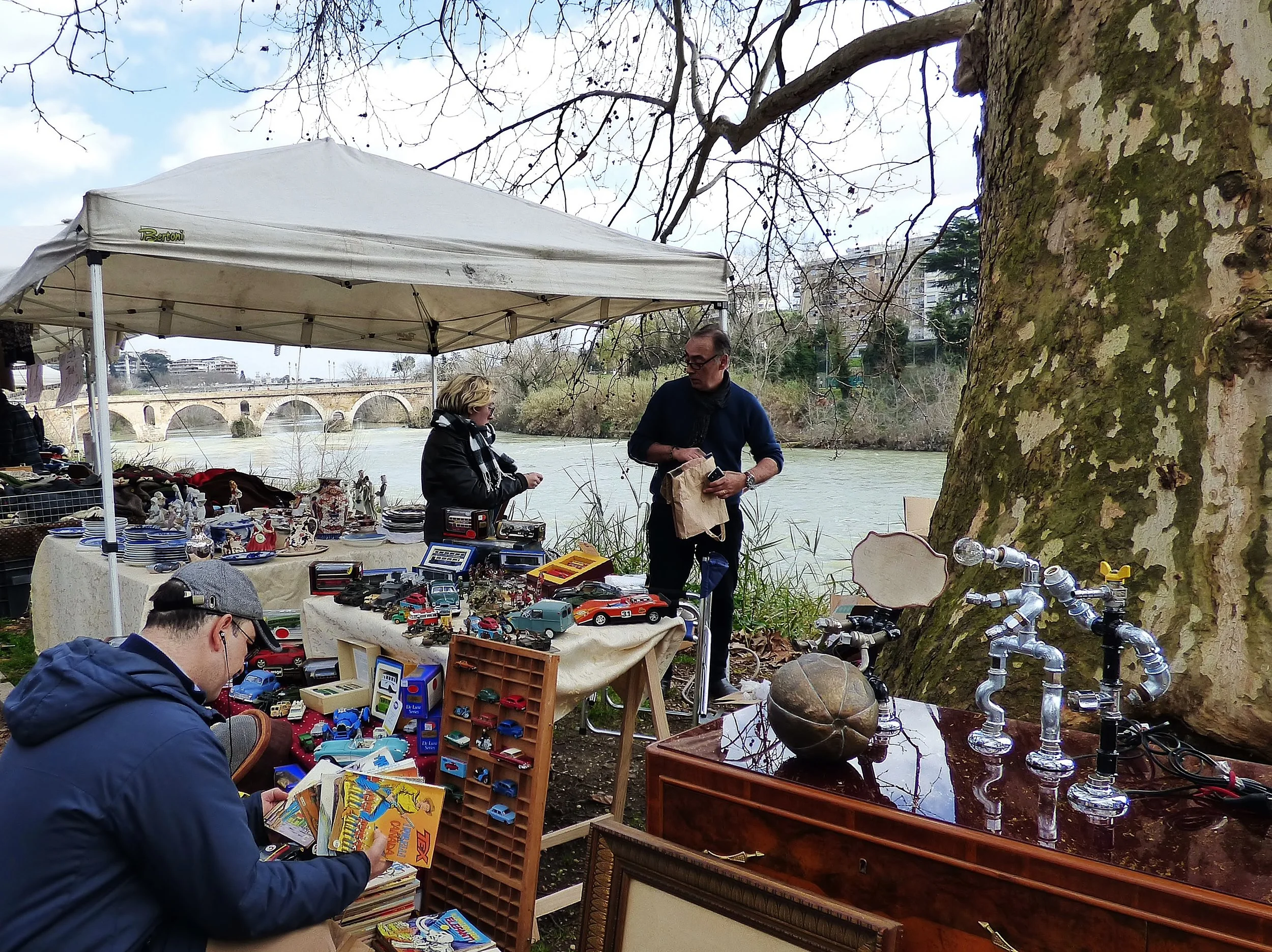
At the Ponte Milvio Antique Market
Except for the bridge …
Chiselled into the granite base of a statue of Christ, at the tower end of the bridge, are two worn and nearly invisible words: Ponte Milvio; and if you remember your history, the words bring the ancient world back with a vengeance. For across this bridge, in 312 AD, the Roman Emperor Maxentius marched his powerful Imperial army to confront the smaller army of Constantine, who claimed the throne for himself.

Ponte Milvio. Anonymous. Venetian School, 18th century
Eusebius of Caesarea, a friend of Constantine, wrote that the day before the battle, at noon, Constantine (who was not yet a Christian) saw a cross of light in the sky, above the sun; and on the cross were the words in hoc signo vinces: “In this sign thou shalt conquer.” And that night, Constantine dreamed he saw Christ, carrying the same sign. So Constantine commanded that a banner marked with the cross be made, and carried into battle.

Constantine’s vision of the cross, and the Battle of the Milvian Bridge, detail of a 9th-century Greek manuscript
Why did Maxentius cross the bridge? He could have stayed in Rome, with all its resources, and forced his enemy into a long siege, which would likely fail. But cross it he did, and suffered a crushing defeat; he himself was thrown from the bridge and drowned. Constantine became the unchallenged ruler of the Roman Empire.
That day, 28 October 312 AD, at the Battle of the Milvian Bridge, the entire western world changed radically. Constantine proclaimed tolerance of the Christian religion by the Edict of Milan in 313. Christianity, with the backing of the emperor, quickly became the dominant religion of the Empire. Constantine moved the capital of his empire from Rome to Byzantium, in ancient Thrace, where the Bosporus meets the Sea of Marmara, and renamed the city Constantinople.
The fall of Rome, the Byzantine Empire, feudalism, Christian medieval life, religious schism, the Crusades, the Renaissance, and our familiar modern world, might never have happened if Maxentius had prevailed at the old stone bridge.
© Text © 2017 by Joe Gartman; Photographs © 2017 by Patricia Gartman. First published in Italia! Magazine, February 2017