Brother Lippo’s Night Out
“You should not take a fellow eight years old and make him swear to never kiss the girls …”
In his 1855 poem “Fra Lippo Lippi”, Robert Browning invites us to imagine that the great early Renaissance painter, Filippo Lippi, has encountered a Medici police patrol while out in the dark Florentine streets in the wee hours, a bit tipsy and up to no good. “I am poor brother Lippo, by your leave! You need not clap your torches to my face … Let’s sit and set things straight now, hip to haunch …”
Filippo Lippi, born in 1406, was the son of an impoverished butcher and his wife. Both parents died while the boy was still a small child and “Lippo” was sent to live with his aunt, who was just as poor as his parents. One winter day when he was eight years old, Aunt Lapaccia grabbed him firmly by the arm, dragged him to the nearby convent church of Santa Maria del Carmine, and left the ragged and hungry child to the monks.
His new home with the Carmelite brothers provided two happy outcomes for Filippo: not only did he find welcome comfort, as he tells the sergeant: “I did renounce the world, its pride and greed … ‘Twas not for nothing – the good bellyful, the warm serge and the rope that goes all round” – but, as it soon became clear that Filippo was not a ready scholar, the Prior of the convent, when shown the doodles with which Filippo defaced his copybook, set him to study drawing. “Nay,” quoth the Prior, “turn him out d’ye say? In no wise. Lose a crow and catch a lark. What if at least we get our man of parts … to do our church up fine?”

Madonna & Child with Two Angels, by Filippo Lippi, Uffizi Gallery, Florence
Filippo was delighted to be given a wall to decorate, rather than the mere margins of a hymnal, and amazed the brothers with his lifelike portraits of monks, visitors, worshippers and, it seems, the Prior’s pretty “niece”. But the Prior objected to the lifelike images: “Your business is to paint the souls of men … never mind the legs and arms!” So, for a few years Filippo learned his craft, if not his art, inwardly complaining of the limitations he had to endure. “… say there’s beauty with no soul at all … if you get simple beauty and naught else, you get about the best thing God invents …”
In the meantime, other painters were busy in the right transept of the church, decorating a chapel belonging to the Brancacci family with scenes from Genesis and the life of St. Peter. One was a painter called Masolino, and another who “… slouches and stares and lets no atom drop … they call him Hulking Tom, he lets them talk … he’ll paint apace … I know what’s sure to follow.” “Hulking Tom” was none other than Masaccio, ridiculed for his appearance, but one of the greatest geniuses of the early Renaissance. In the chapel, young Filippo learned – from Masaccio - how he could paint both body, arms and legs and all, and soul.
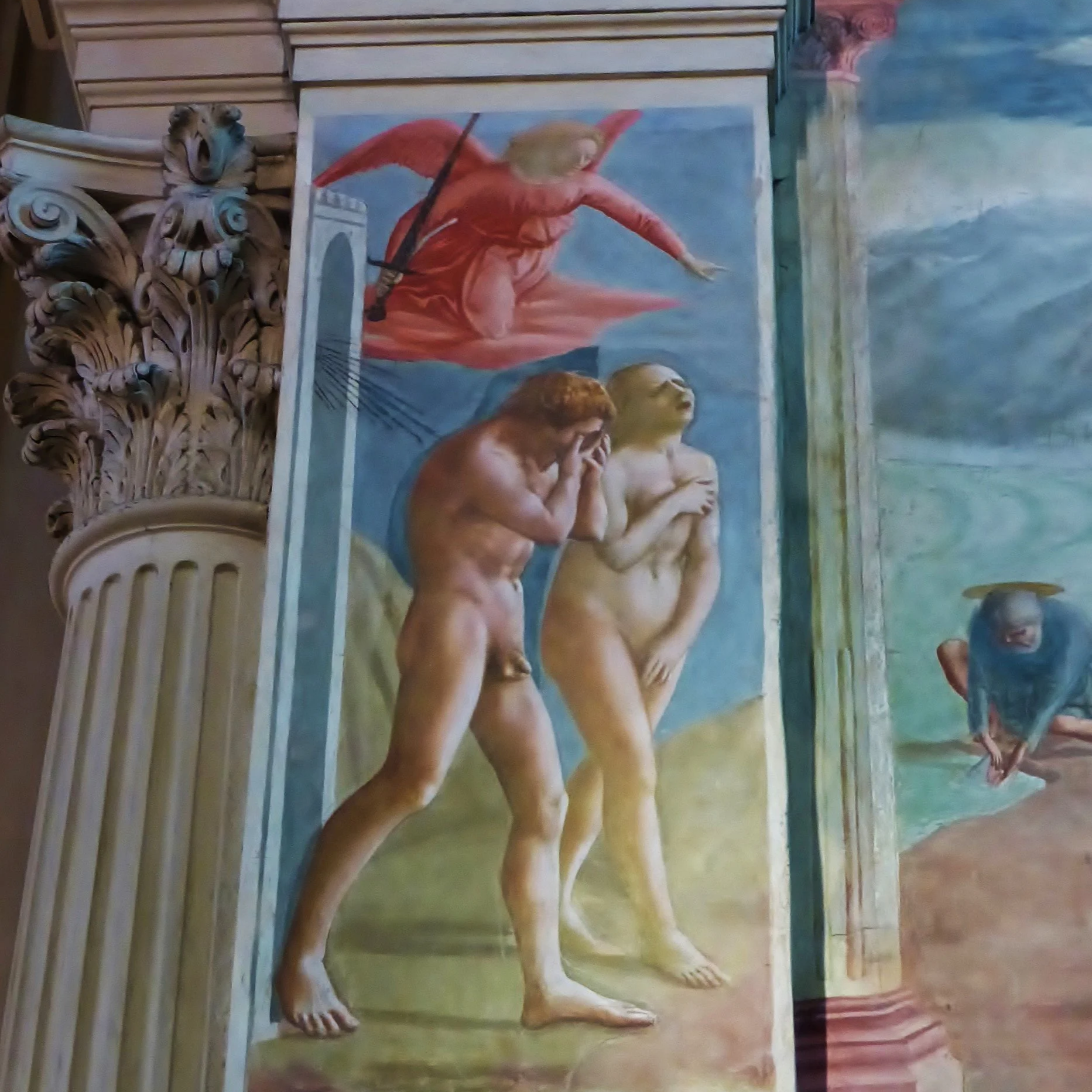
Expulsion from the Garden, by Masaccio, in the church of Santa Maria del Carmine, Florence
He tells the policeman how he came to be out so late: from an upper window of Palazzo Medici, where his patron Cosimo de Medici has locked him in his room to finish a painting of Jerome in the desert, he heard “a titter, like the skipping of rabbits by moonlight – three slim shapes, and a face that looked up … zooks, sir, flesh and blood, that’s all I’m made of!” So he shredded his bedclothes, “curtain and counterpane and coverlet” to make a ladder, and swarmed down to the street, to “an alley’s end, where sportive ladies leave their doors ajar.”
The officer suddenly realizes that he’s caught the Medici’s favourite painter, and that making an arrest is probably not wise; so he settles down to hear Lippo’s story, while he and his men drink up the quarter-florin’s worth of wine the painter buys them.
“I’m my own master, paint now as I please – having a friend, you see, in the Corner-house! … And yet the old schooling sticks, the old grave eyes are peeping o’er my shoulder as I work”. And then, sensing the policeman’s disapproval of his carousing: “… hearken how I plot to make amends … I shall paint a piece … God in the midst, Madonna and her babe, ringed by a bowery flowery angel-brood … lilies and vestments and white faces …”

Angels celebrate the Coronation of the Virgin, by Filippo Lippi, detail of Apse frescoes, Spoleto Cathedral
Browning’s poem does not follow Fra Lippo Lippi’s brilliant career after his night on the town. He taught Botticelli, among others. Among his greatest works was the decoration of Prato cathedral with the lives of John the Baptist and St. Stephen in 1456. In 1458 he eloped with a young nun, Lucrezia Buti, and they had a son, Filippino. Through the intervention of the Medici, he received a Papal dispensation to marry Lucrezia.

Burial Monument for Filippo Lippi, by his son, Filippino Lippi, church of Santa Maria del Carmine, Florence
Fra Lippo’s last work was a monumental cycle, Scenes from the Life of the Virgin Mary, in the Apse of Spoleto Cathedral. He died in Spoleto in 1469, when his son was twelve years old. Botticelli took over Filippino’s artistic education.
The Brancacci Chapel in Santa Maria del Carmine, where Fra Lippo learned from Masaccio how to paint souls, had never been completed; Masolino had abandoned the project, and Masaccio died young in 1428. In 1485, Filippino Lippi, now a famous painter in his own right, journeyed to his father’s old church in Florence, and finished the job.

Brancacci Chapel, in the church of Santa Maria del Carmine, Florence
© Text © 2019 by Joe Gartman; Photographs © 2019 by Patricia Gartman. First published in Italia! Magazine, September 2019