The Prisoner of Castello Aragonese
You’ll find the ancient town of Taranto at the northeast corner of the Gulf of Taranto, where the Salentine Peninsula, Italy’s “boot heel,” begins. In 1496, King Ferdinand II of Aragon, whose vast dominions included Sicily and Naples as well as his native Spain, built a great, seven-towered fortress there, the Castello Aragonese, on the ruins of a Norman fortification, which sat on the ruins of a Byzantine fort, beneath which were the ruined stones of Roman walls and deep below those, perhaps, a layer of fallen Carthaginian defences (from the Punic War era), and so on and on – all the way back to the founding of the city, where history gives way to legend. Spartans founded the city in 706 BC, it’s said, with a little help from the sea-god Taras, Poseidon’s son.
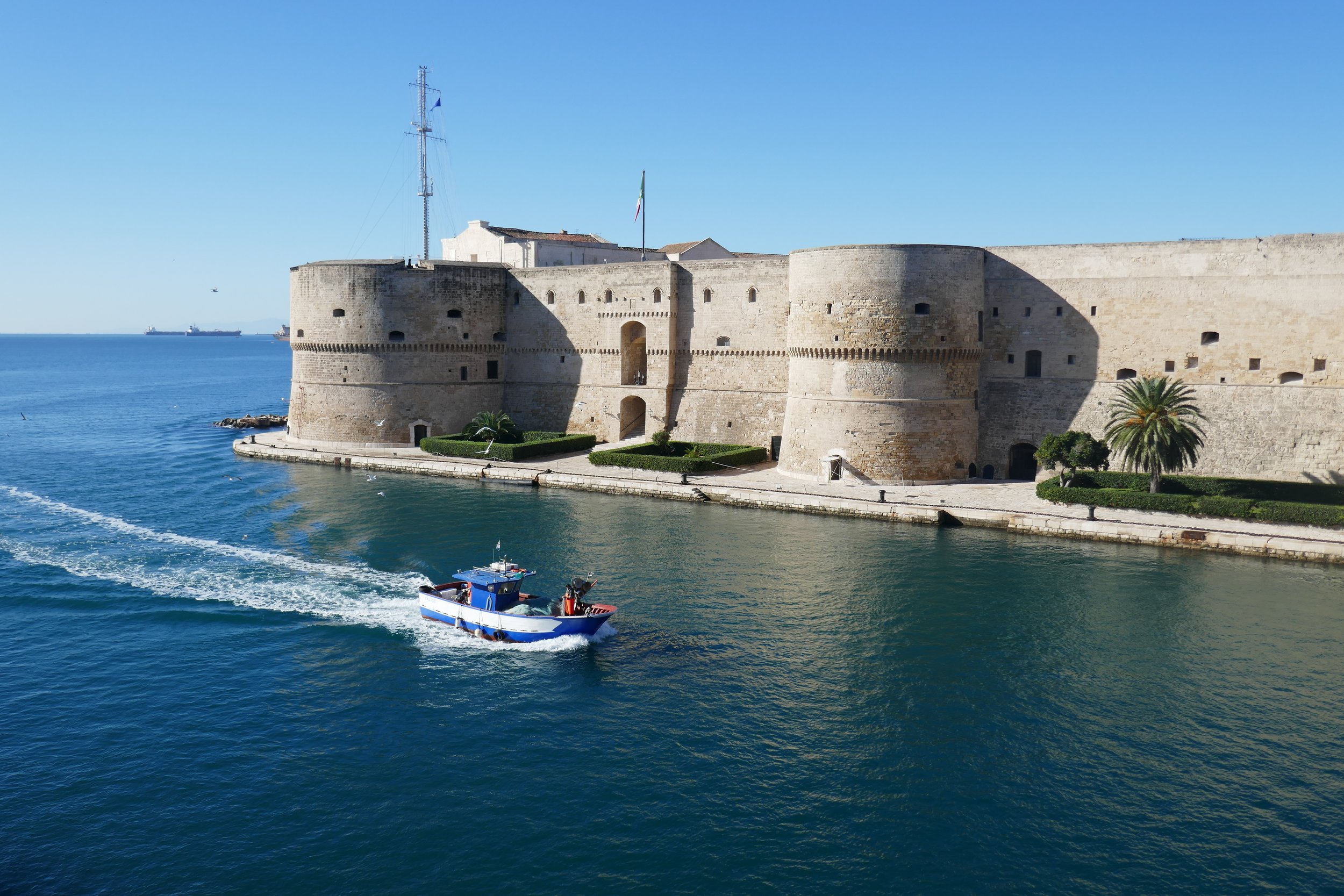
Castello Aragonese
Taranto’s borgo antico – the old city – is confined to a tiny island, only about a kilometre long and perhaps 300 metres wide. In ancient times the island was the tip of a peninsula that separated the Gulf, Mar Grande in local dialect, from a sheltered lagoon called Mar Piccolo. It became an island in the 15th century, when a channel was cut across the peninsula, right beside the fortress. Now, on a map, the old city looks like an ill-fitting jigsaw piece trying to fill a gap that’s just slightly too big.
I arrived in Taranto at the train station just west of the island, in a newer and very industrial part of the city, but I quickly crossed a short bridge with a very long name – Ponte Sant’Egidio Maria da Taranto – and found myself in the Old Town. My hotel turned out to be on Piazza della Fontana, where a fountain composed of stacked concrete blocks was bravely spouting away. The hotel was evidently a reclamation project – one half of the building had crumbling walls, a sagging roof, and broken windows, but the other half had been repaired, renovated, repainted, and was open for business.
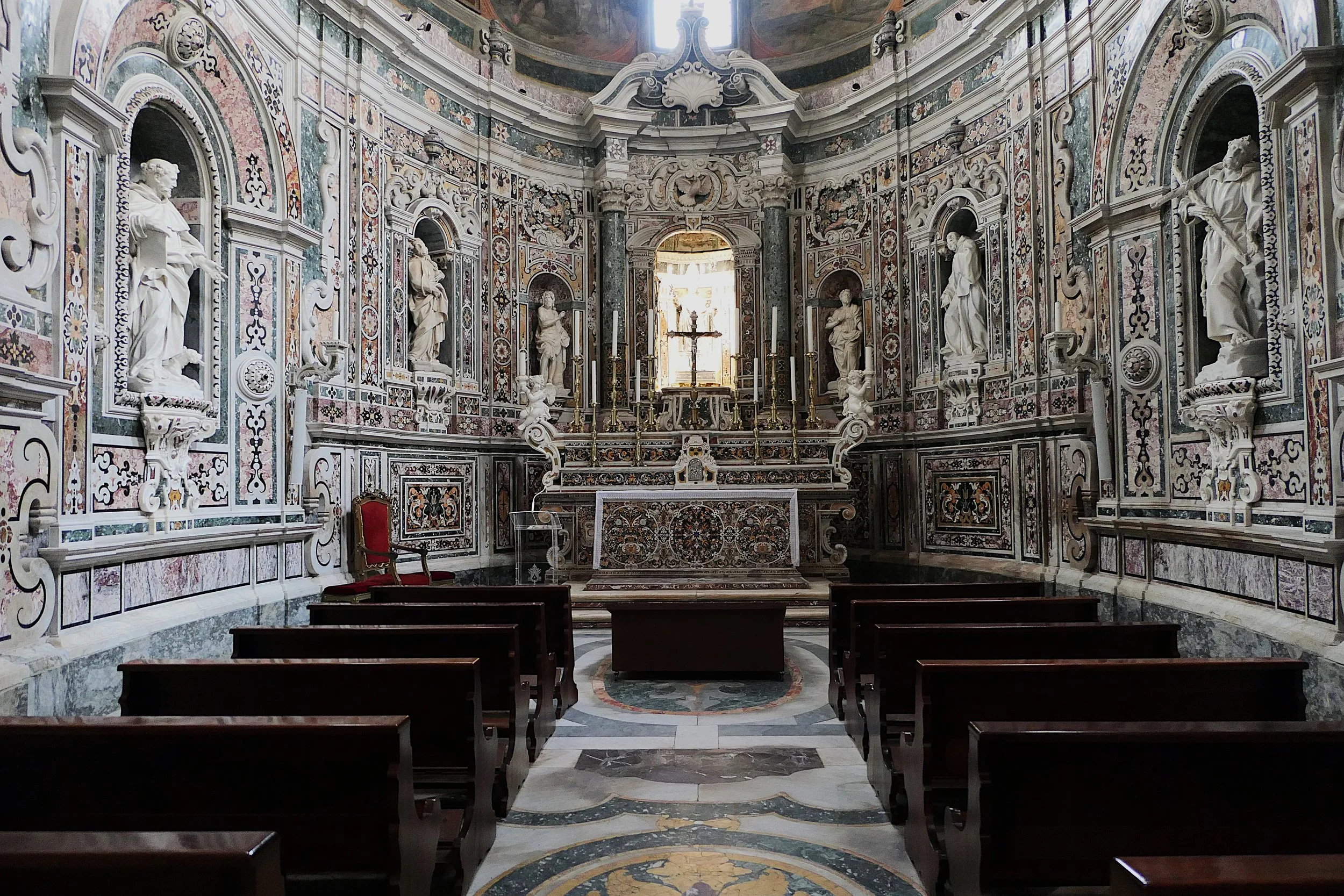
San Cataldo Church, Taranto’s Duomo (Cathedral)
I left my bag in my room, and set off for the opposite end of the island, wending my way among narrow alleys and a few dead ends, stopping briefly at the baroque Duomo, San Cataldo church. I reached the east end of the island, where I found an ingenious iron “swing bridge,” Ponte Girevole, crossing the artificial channel. Past the bridge I could see a modern avenue crowded with pedestrians, shops, and cafes. But my attention was held by the great fortress and its squat but forbidding towers.
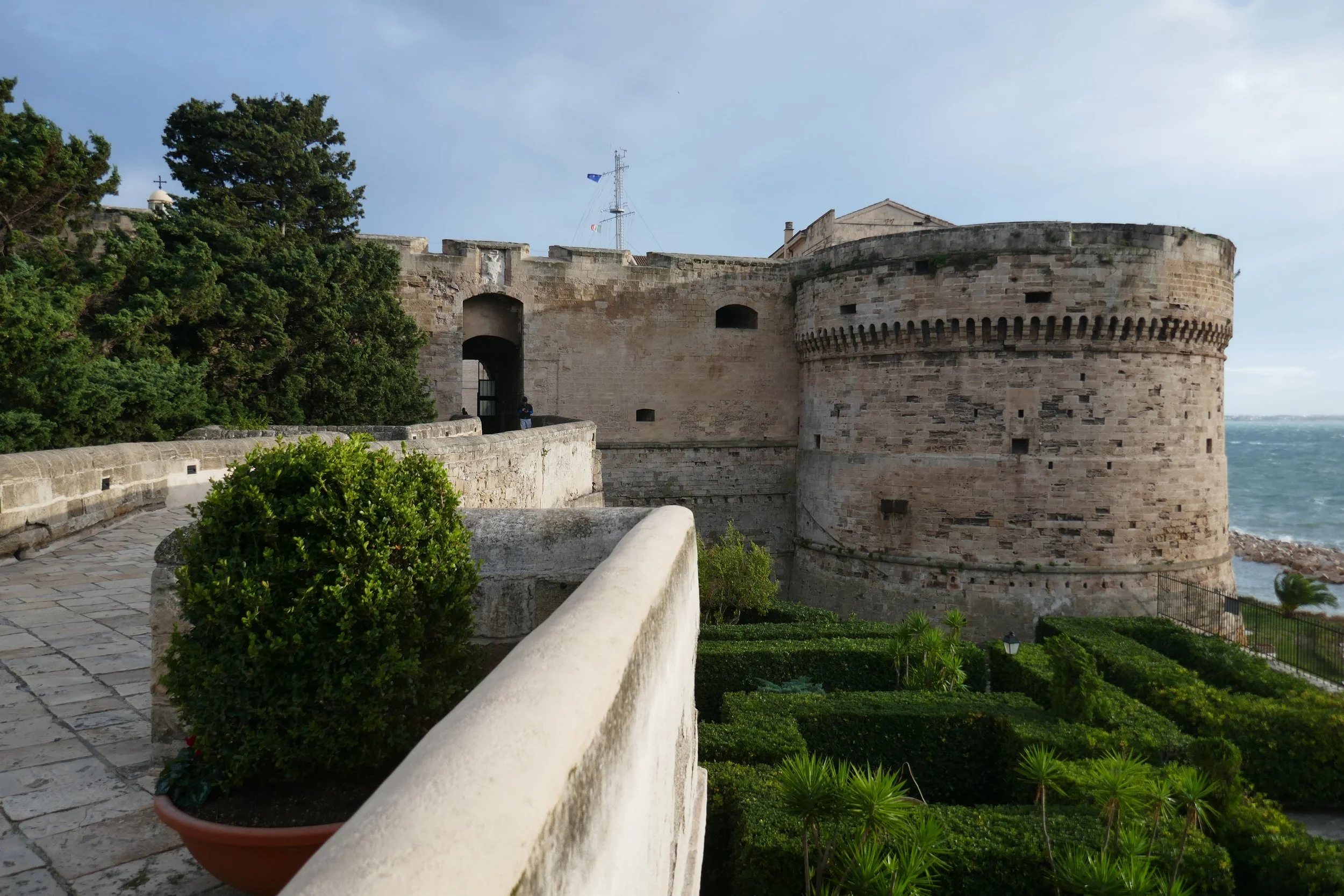
Entrance to the Castello
I was in luck. The fortress, which is now owned by the Italian Navy, was open for conducted tours. Our guide was a young naval officer, very starched collar and correct, who took us at a military pace up and down a multitude of tower stairs, gloomy passageways, underground rooms, lookout points, battlements, and finally to a dark chamber lit only by a small window high in its stony wall. “The fortress was also a prison,” he said. “And here we kept our most famous inmate.” He began his explanation, and I was transported in space and time to the Island of Hispaniola, in the middle of the 18th century; and that is where we, too, must go – if you’d like to hear the story.
A rather threadbare French aristocrat named Alexandre-Antoine Davy de la Pailleterie owned a small plantation on Hispaniola, in Saint-Domingue, which we call Haiti today. He also owned a slave named Marie-Césette Dumas, and fathered a son with her. Discouraged by the failure of his plantation, and shamed by his brother Charles, who owned a successful sugar plantation nearby, he decided to move back to France; and to pay for his passage he sold Marie-Césette. He left his son, Thomas-Alexandre Dumas, behind, evidently meaning to redeem him from Marie-Césette’s owner when he could. Thomas-Alexandre, meantime, shared his mother’s slave status.
In time, Pailleterie’s wealthy brother Charles died, and Pailleterie inherited his estate. In 1776, he sent for Thomas-Alexandre, who was, perhaps, fourteen years old. Pailleterie saw that he received a good education, and in time, introduced him into society as Thomas-Alexandre Dumas Davy de la Pailleterie. However, after a disagreement with his father, Thomas-Alexandre joined the French Army as a Private, under the name Alexandre Dumas.
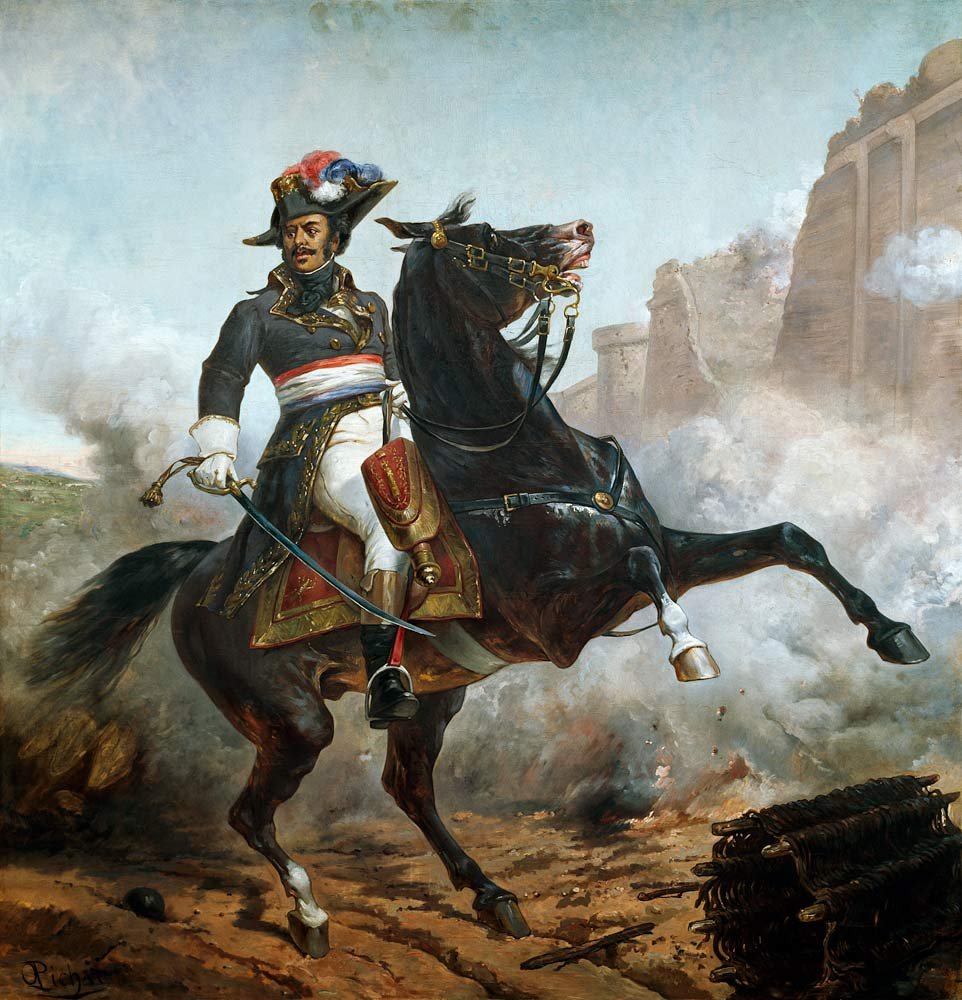
General Alexandre Dumas, Commander-in-Chief, French Army of the Alps
Alexandre Dumas was physically imposing, very strong, and highly intelligent. Moreover, after the French Revolution began, the demand for competent officers, and his success as a commander in the field, meant that he quickly progressed through the ranks. Despite the fact that he was mixed-race, by 1793 he was a brigadier general and Commander-in-Chief of the Army of the Pyrenees, and later, the Army of the Alps.
He married Marie-Louise Labouret in Paris, before accompanying Napoleon Bonaparte on the Egyptian Campaign. In Egypt, he quarrelled with Bonaparte, who ordered him back to France. But Napoleon neglected to provide him transport, so Alexandre chartered a ship, which began to leak while plying the Ionian Sea. Alexandre was forced to land at Taranto, which was part of the Kingdom of Naples at the time, so he was promptly arrested and imprisoned in Castello Aragonese.
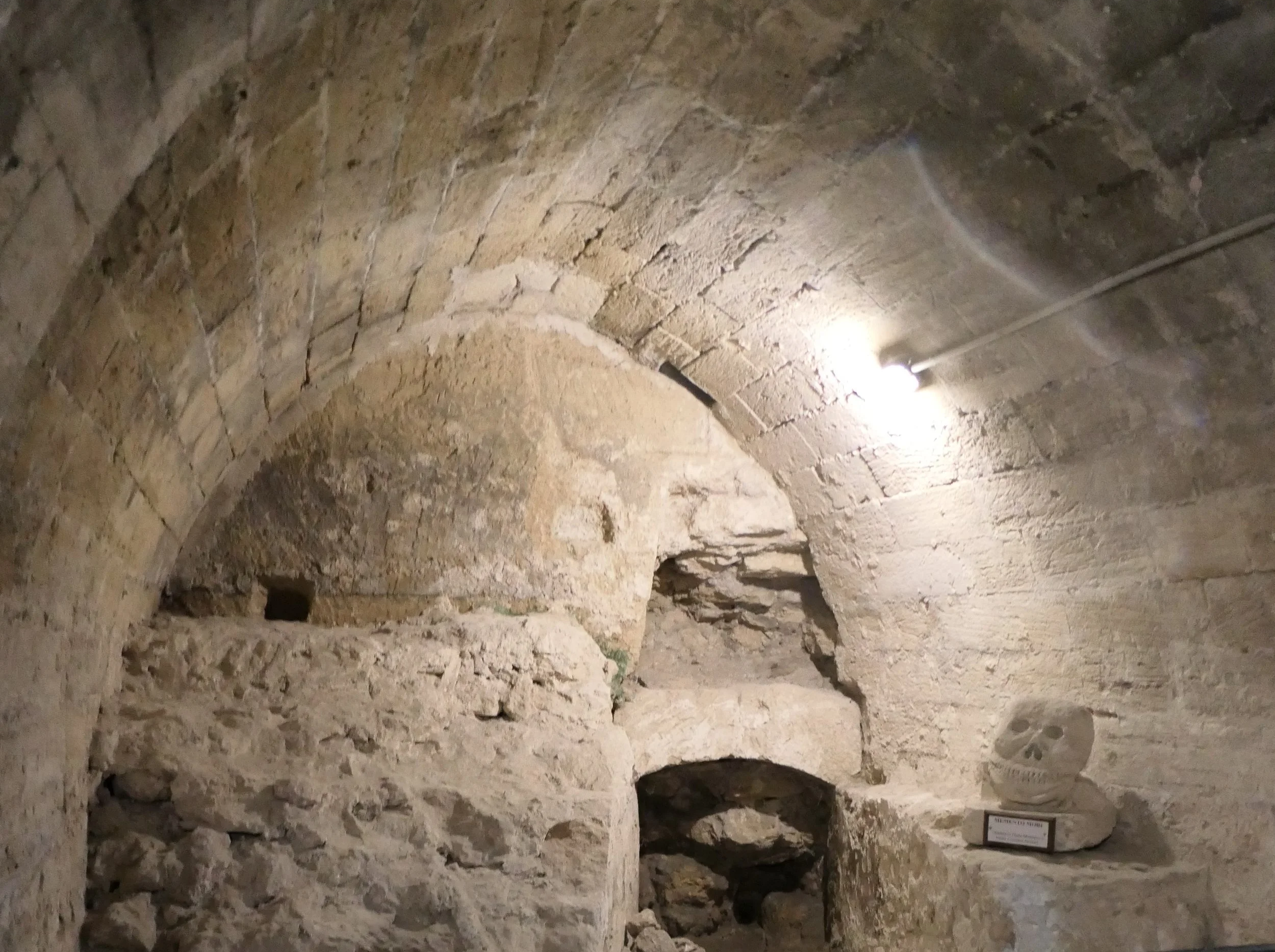
General Dumas’ cell in Castello Aragonese
He kept a journal during his captivity, detailing the inhumane treatment he suffered before he was finally released in 1801. He retired in Villers-Cotterêts, between Paris and Reims, where Marie-Louise bore him a son. He died four years later, aged 43 years.
His son’s name was also Alexandre Dumas, who, years later, wrote a famous novel about an unjust and cruel imprisonment. By the way – when Columbus first visited the north coast of Hispaniola in 1493, he named a prominent mountain there in honour of Christ - Monte Cristo.
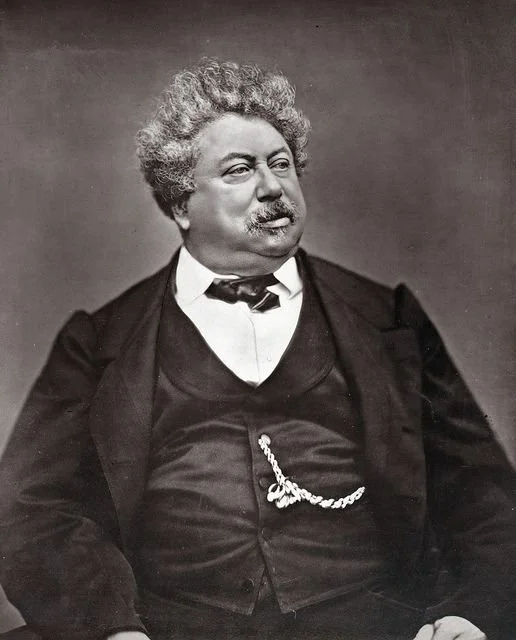
Alexandre Dumas, author of The Three Musketeers and The Count of Monte Cristo, etc., and son of General Alexandre Dumas
© Text © 2025 by Joe Gartman; Photographs © 2025 by Patricia Gartman. First published in Italia! Magazine, August/September 2025