A Day at the Races
You’ll find them along the old Appian Way in Rome, a few hundred yards south of the San Sebastian Catacombs: two ruined towers in a field east of the road. There’s a gate marked Villa di Massenzio and entry is free. When you reach the towers, you’ll see two crumbling brick walls extending from them, in parallel, forming the long sides of a grassy field. A stone arch stands where the walls end in the distance. A long, low brick barrier bisects the field lengthwise.

Towers at either end of the starting gates, Circus of Maxentius
You don’t need to have read Pliny or Suetonius to know that you’ve found an ancient racetrack, where charioteers once raced headlong behind teams of two, four, or even more powerful horses. Perhaps you’ll recall that wonderful sequence in Ben Hur, the old movie with Charlton Heston. It's an amazingly vivid (and sweaty) depiction of a chariot race, long before CGI (computer generated imaging) put dozens of stunt performers out of work.
Well, you’re an imaginative person. Let us imagine, together, the towers as they were seventeen centuries ago, with twelve carceres, starting gates, between them. Of course, the gates restrain twelve quadrigas, four-horse chariots that rattle and shudder behind their impatient steeds. We’ll see the crumbling walls whole again; and behind them, multi-story grandstands filled with excited spectators. Suddenly a white cloth floats down from the Imperial box, and the gates spring open. The chariots hurtle down the track, and the crowd roars.
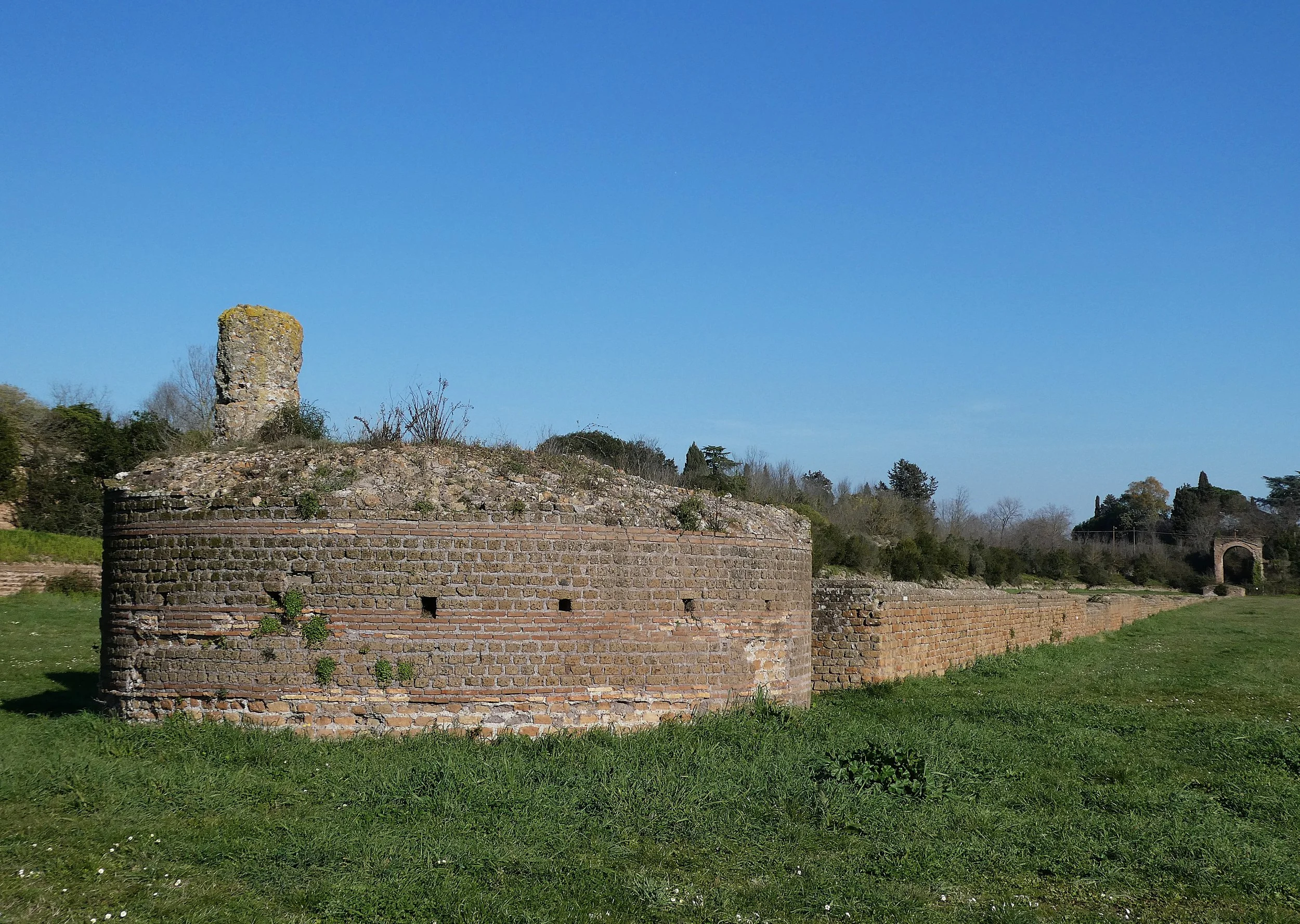
Spina of the Circus of Maxentius
You notice that the spina, the central barrier, is faced with marble, and filled with statues, columns, miniature temples, and a tall obelisk. The obelisk looks familiar: haven’t we seen it on Bernini’s fountain in Piazza Navona? But wait – a chariot has crashed while rounding the spina, and the charioteer is being dragged along behind it! Finally he releases the reins, and lies motionless. Attendants rush to remove him. As the chariots complete the first circuit, one of seven wooden porpoises, mounted on a horizontal pole, falls head-downward: one lap is complete. When all the porpoises are upended, the race will be over – and so will our daydream.
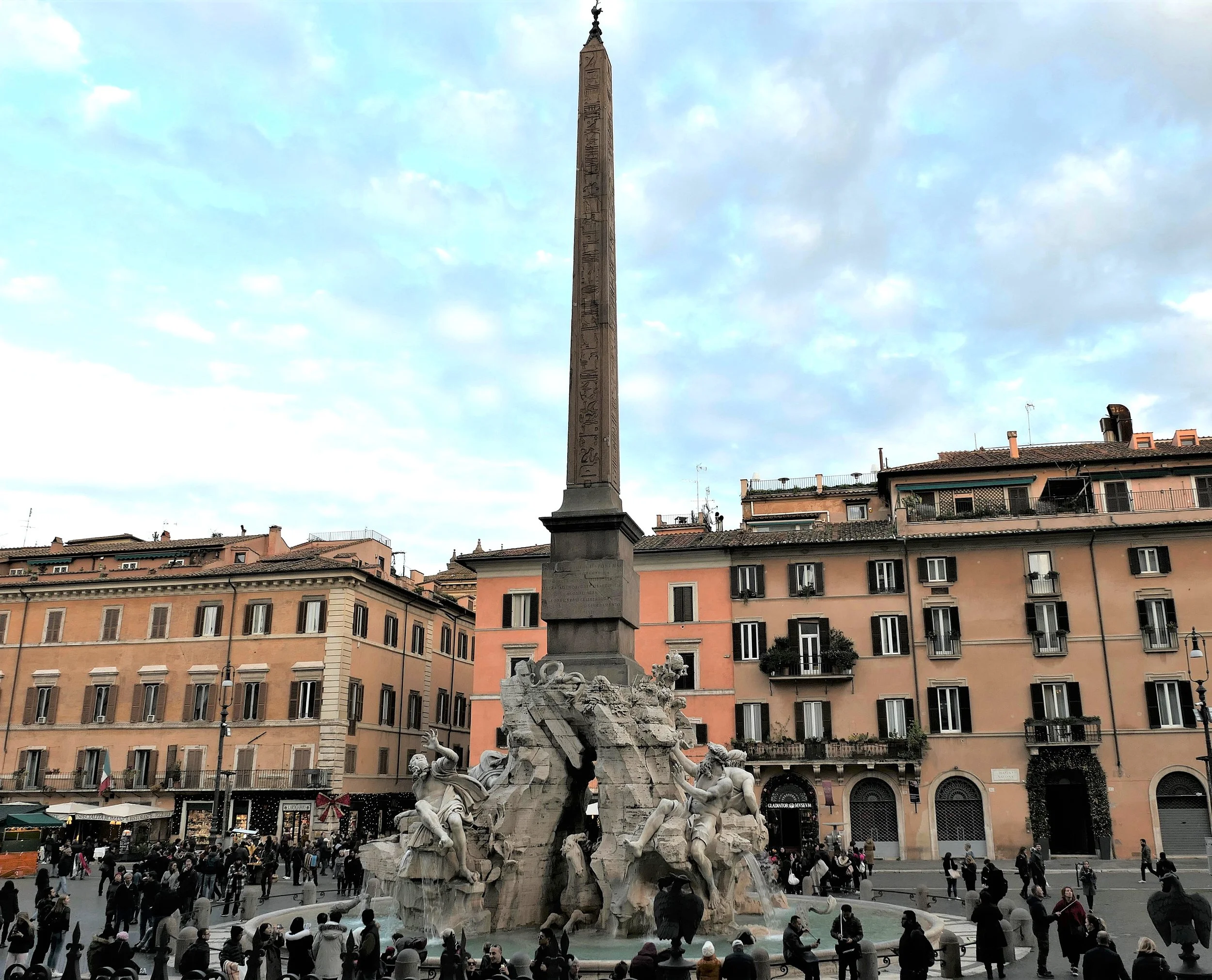
The obelisk atop the Four Rivers Fountain in Piazza Navona once decorated the spina of the Circus of Maxentius
You’ll be glad to know that such races probably did once take place here, at the Circus of Maxentius. Once, however, is the operative word. The Roman Emperor Maxentius built the Villa and the circus in 309 AD. Just as the track was completed, his young son, Valerius Romulus, suddenly died. He was fourteen years old. Maxentius declared his son a god, and held funerary games celebrating the event. It’s likely that chariot races were among the events. Though the circus was the second largest in Rome, history records no other races there. Three years later, Maxentius died fighting Constantine at the Milvian Bridge. Centuries passed, and the towers crumbled. The obelisk fell, in pieces, but was raised again, elsewhere, after thirteen centuries. You know where to find it.
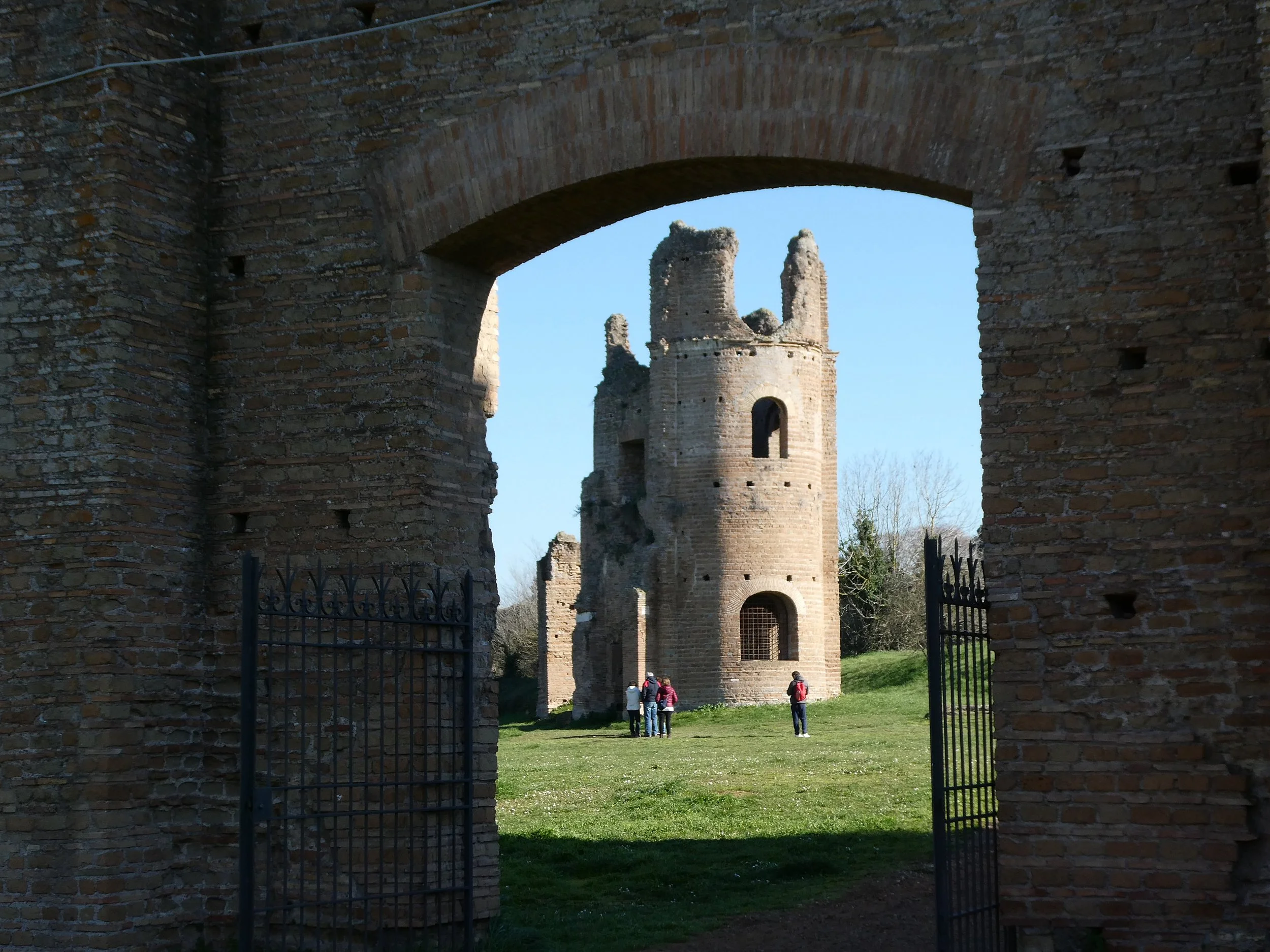
Gate leading from the Villa of Maxentius to the Circus of Maxentius
For the Circus Maximus – Circo Massimo – the largest of Rome’s racecourses, it’s an entirely different story. Its history begins when Rome was still a village. It’s said that Romulus, after founding Rome, organized a festival of games in a valley between the Aventine and Palatine hills. He invited the neighbouring Sabines to bring their families to the party. Then, while their guests were engrossed in a particularly exciting footrace, or perhaps a boxing match, a group of young Romans suddenly grabbed around thirty young Sabine women and made off with them. The rest of the Romans managed to fight off the indignant relatives, and Rome’s population began to grow.
You’ll find the scant remains of the Circus Maximus in that very same valley, where King Tarquinius Priscus laid out a chariot racecourse in the 6th century BC. Spectators stood on the hillsides, and the spina was a water-filled trench.
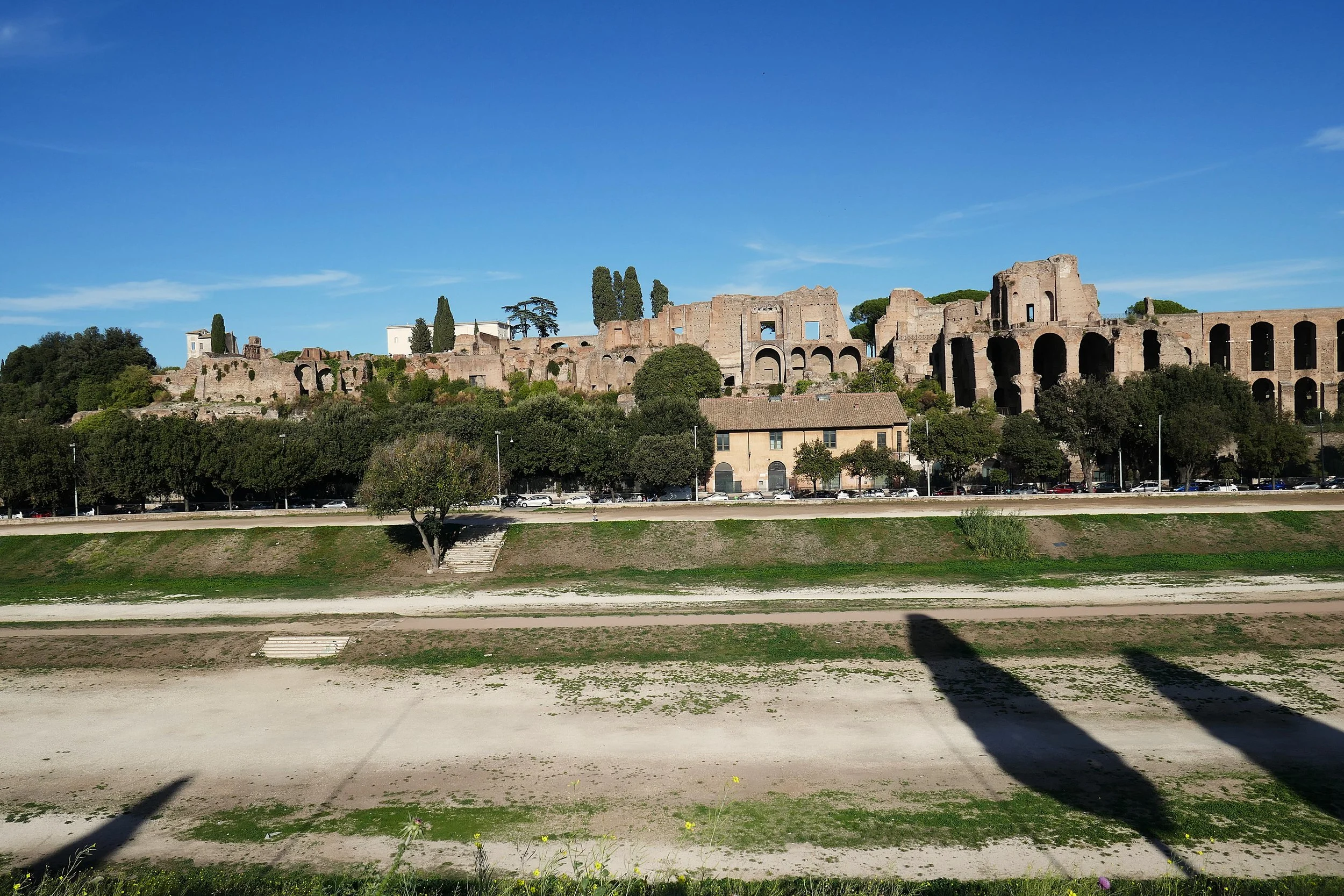
The shadows of Italian cypresses point across the Circus Maximus to the Imperial palaces on the Palatine Hill
The circus was enlarged and improved over the centuries by various rulers such as Julius Caesar, Augustus, Nero, and Trajan. (It was during Nero’s reign that the great fire of 64 AD began in the wooden shops and taverns beneath the circus arches.) At its largest, the track measured 540 metres by 80 metres, and the multi-story, arch-supported stands could hold 150,000 racegoers – perhaps more. Augustus erected an Egyptian obelisk on the richly decorated spina in 10 BC. It’s now in Piazza del Popolo. Another was installed in 357 AD by Constantius, and now stands behind St. John Lateran.
The races were wildly popular, even more than gladiatorial contests. The specially-bred horses were from stud farms in North Africa. Many of the drivers, slaves or poor freedmen, became famous, and some very rich. A man named Diocles earned 35,863,120 silver sesterces in a 24-year career; it’s even more astonishing that he lived to retirement.

Circus Maximus, circa 1553, steel engraving by Nicolas Beatrizet
By the 4th century AD, there were 66 racing days a year and 24 races per day. Chariots raced in teams, or “factions”, identified by colours: red, green, blue and white. Betting was unofficial, but vast sums were wagered. Strangely, the sexes were not segregated at the races, as they were at the Coliseum. The poet Ovid describes, with delight, an afternoon spent flirting with a pretty girl at the races. Among the many gallantries he attempted is an offer to fan her with his wax tablet, upon which he probably recorded his betting picks. With the rise of Christianity, chariot racing’s popularity gradually faded; the last race in the Circus Maximus was in 550 AD.
The ruins of a great racecourse still stand beside the Via Appia, where games were held just once, in sorrow. Almost nothing remains of a greater one, in the valley between the Aventine and the Palatine hills, where for a thousand years daring charioteers drove their thundering teams, and the Romans cheered.
© Text © 2023 by Joe Gartman; Photographs © 2023 by Patricia Gartman. First published in Italia! Magazine, April/May 2023