Fame
The Paris Salon of 1893, held by the French Académie des Beaux-Arts, was one of the most important art exhibits of its time. Among the entries was a small bronze statue of a teenage girl in nun's attire, leaning pensively on the back of her chair, chin in hand. It was called Dopo il Voto – After the Vow – and the girl’s rueful awareness of how much she had renounced was so clear that the sculpture became the talk of the show. The young Italian who made it, Pietro Canonica from Turin, was just 24 years old, but he soon began to receive commissions from the international beaux-monde. His portraits were especially valued for his ability to convey emotions in bronze and stone, and for his technical virtuosity.
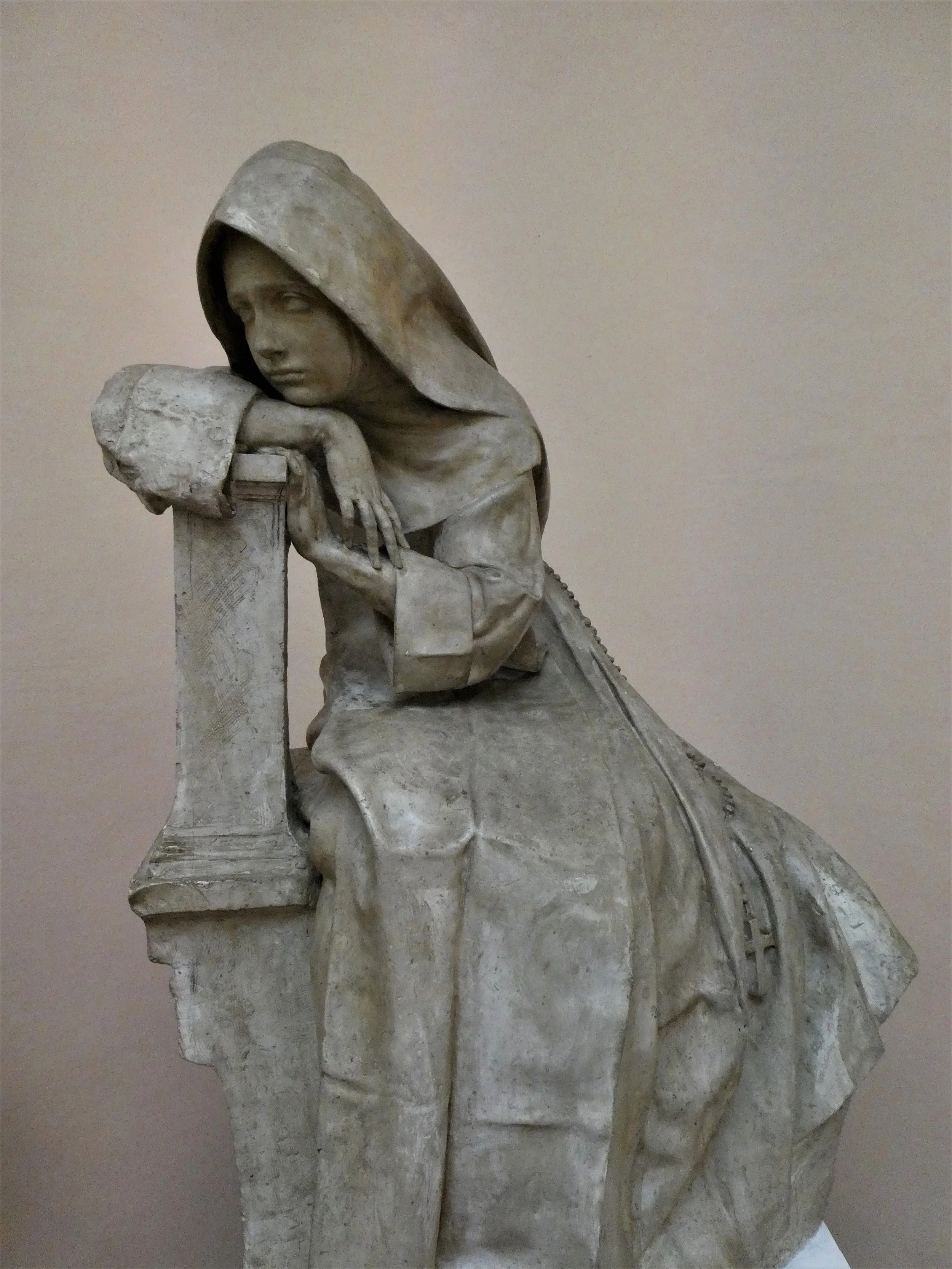
“After the Vow”
So, just over a century ago, before the Great War, Canonica became one of the most sought-after sculptors in the world. The great royal houses of Europe paid him large sums for portraits, memorials, and monuments. Though the world of aristocratic privilege largely disappeared with the First World War and the Soviet revolution, Canonica's talents remained in demand, supplying, among other things, memorials for fallen soldiers in many an Italian piazza.

“Czar Nicholas II of Russia” - patinated preliminary plaster model
One day last winter, in Rome’s Central park, Villa Borghese, I happened upon a 17th-century palazzo called, historically, the Hen House. (It seems the Borghese family’s poultry-keeper once lived there, if not actual chickens.) Nowadays, the building is the Museo Pietro Canonica. Canonica settled permanently in Rome in the 1920s and persuaded the Rome municipality to let him renovate and use the building, promising to leave his artworks to the city. He lived and worked there until he died in 1959. The palazzo contains hundreds of works from his long and extremely productive life.
Standing beneath a fourteen-foot-high equestrian statue, I looked up to see the stern face of Faisal I, the first Hashemite king of Iraq, his Bedouin headdress nearly brushing the ceiling. Nearby, and just as imposing, was another mounted rider: Simón Bolívar, the liberator of Venezuela. I saw Grand Duke Nikolai Nikolaevich Romanov astride his horse, his muttonchop sideburns bristling. There were two monuments celebrating Kemal Ataturk, who overthrew the Sultan and founded the Republic of Turkey. Against a wall there was a portrait bust of Czar Nicholas II of Russia. Many of the works were plaster models, patinated to look like bronze, that Canonica made before casting the real sculptures.
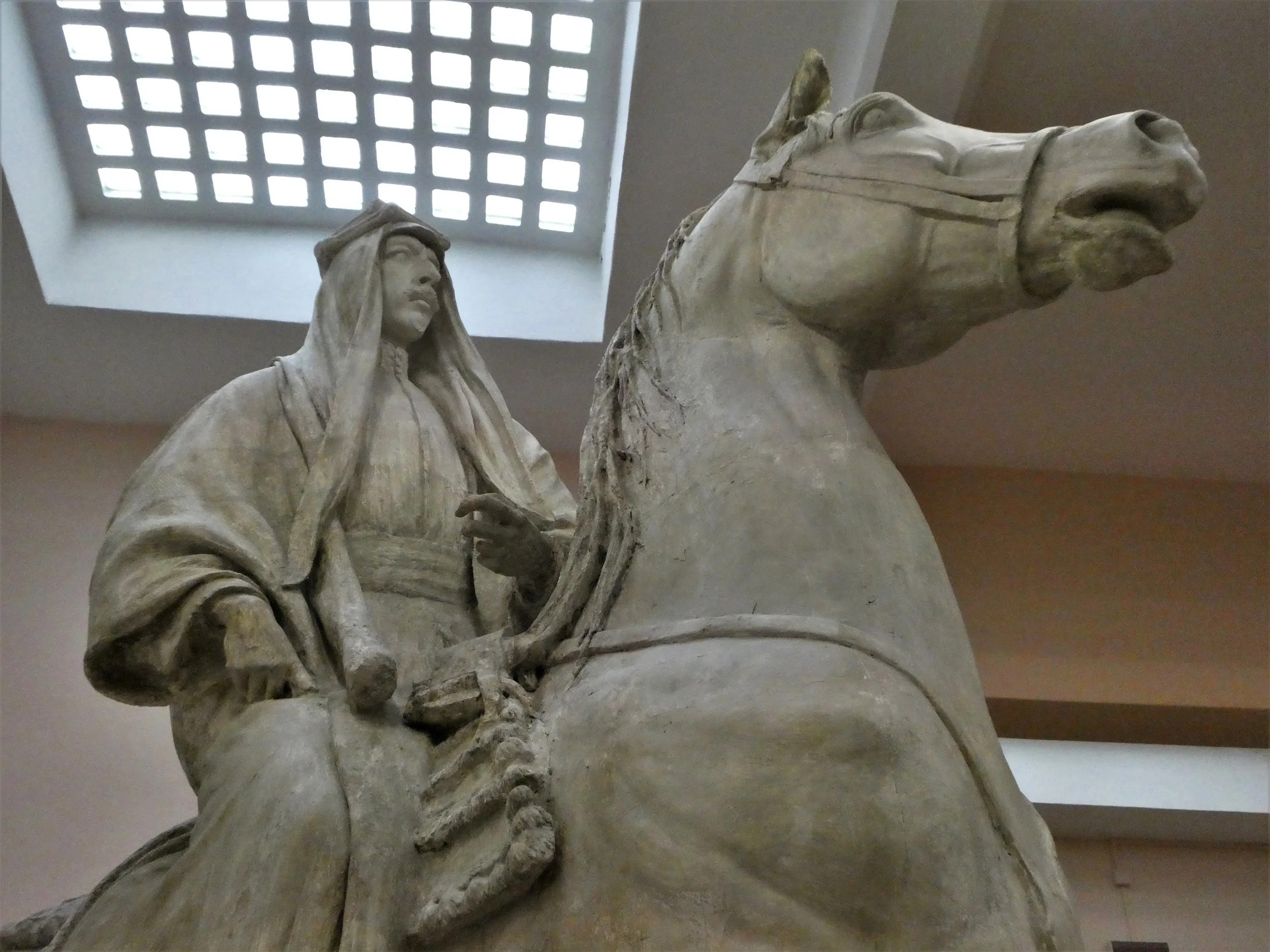
“Faisal I, King of Iraq” - full size preliminary model
It occurred to me that all these superb images of powerful men, brought so strangely together in Canonica’s museum, are a potent reminder of how events confound even the mighty, as the fates of some of the completed sculptures suggest: Faisal’s monument in Baghdad was destroyed in 1958 when his grandson, Faisal II, was executed after a coup d'état. Nikolai Nikolaevich’s statue in St. Petersburg was destroyed in 1917 during the Russian revolution, and the location of Czar Nicholas II’s portrait is unknown. The Czar and his entire family were, of course, brutally executed by Bolshevik soldiers in 1918.
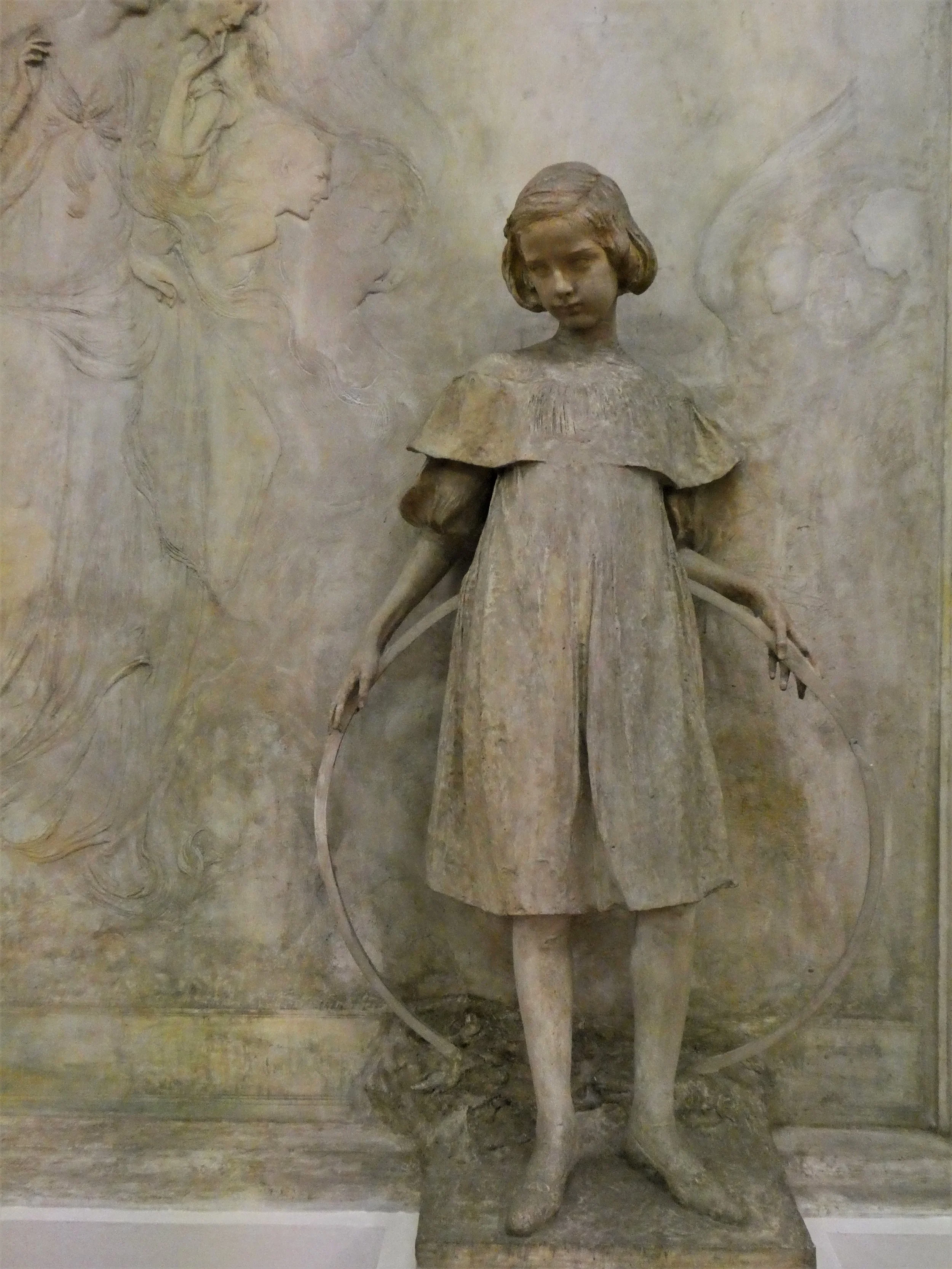
“Funerary Monument for Laura Vigo”
Nevertheless, Canonica’s work still can be found around the world, in Britain, Holland, Turkey, Colombia, Argentina, Egypt, Russia and the Vatican – and, of course, Italy. But heroic monuments are not the only works on display in the palazzo. There are dozens of portrait busts of aristocrats and others, all utterly believable. Queen Alexandra and King Edward VII are there, in bronze copies of marble portraits now in Buckingham Palace and Osborne House respectively. His portrait of Princess Emily Doria Pamphilj, a great beauty, is breathtaking. There are religious works of passionate intensity, some intriguing allegorical pieces, and several funerary memorials. One for Laura Vigo, a child who died in Turin around 1908, is especially moving.

“Princess Emily Doria Pamphilj”
There were relatively few visitors in Canonica’s museum. As I viewed the legacy of this extraordinary man, I thought of the crowds competing for selfie-space at the Galleria Borghese, a few minutes’ walk away. Of course, there should be crowds at the Galleria, where works by Bernini and Canova and Caravaggio dazzle the eye. But I was glad I could come and admire Canonica’s work as well. Perhaps he did not have Bernini’s supernatural ability to awake marble to life; but he was, in his time, among the very best, and most famous, sculptors in the world, and possessed his own spark of divine fire.
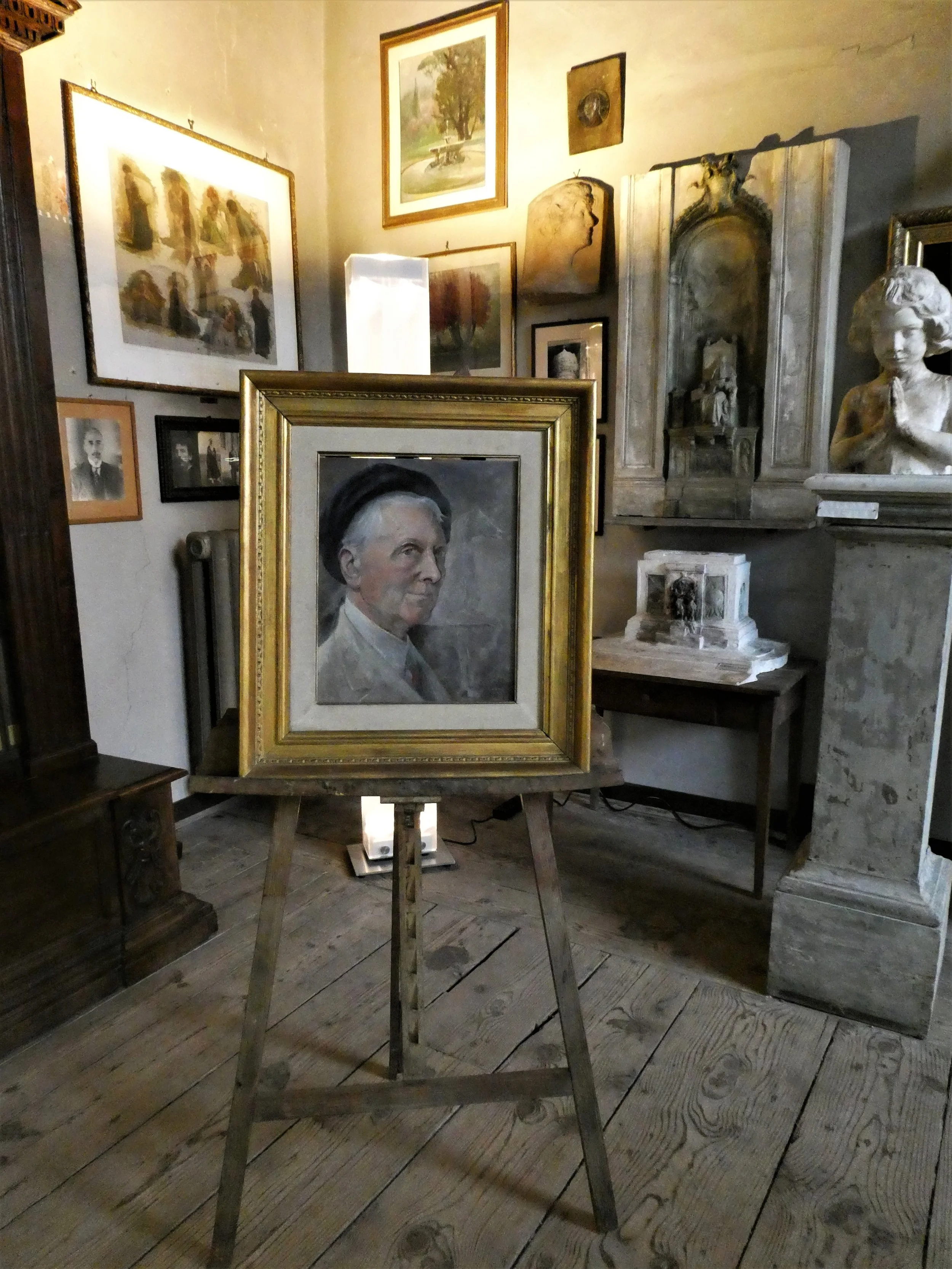
A corner of Canonica’s studio, with a painted self-portrait
I asked a friendly and helpful woman named Ninette Lima, at the entrance, if I could visit the quarters where Canonica and his wife had lived. She helped arrange for two delightful young students, Livia Fabrizio and Francesco Bonmartini Fini, who were on a work/study project at the museum, to conduct me around the facility. From them I learned details of the works we viewed, and, in addition to the modest apartment, I was even allowed to visit an underground room where ranks of ancient Roman sculptures stand. They were collected by the Borghese family, and used to decorate the grounds of the Villa, but have now been replaced in the park by copies. Though their creators have been forgotten, the statues live in comfortable retirement in Canonica’s basement, safe from pigeons and the elements. I think he would be pleased.
© Text © 2018 by Joe Gartman; Photographs © 2018 by Patricia Gartman. First published in Italia! Magazine, July 2018