Fishing for Miracles
“According to the old chroniclers, the year 589 was a miserable one, weather-wise, for Italy; and after a dreary, dark, and rainy summer, Rome was hit that fall with a disastrous flood. Bishop Gregory of Tours, citing an eye-witness in his Histories, describes churches collapsing and granaries destroyed. He also says that dozens of water-snakes and a giant dragon were washed through town by the deluge. Snakes and dragons weren’t the worst of it, though, because no sooner had the flood abated than “a pestilence” ravaged Rome, claiming many lives, including that of Pope Pelagius II.
Pelagius was succeeded by Pope Gregory I, usually now called St. Gregory the Great. Pope Gregory (not to be confused with Gregory of Tours) was a prodigious writer, and in a work called the Dialogues, he recounts another flood, again quoting an eye-witness, that also occurred in the autumn of 589, but this time in Verona.
It seems the Adige, that turbulent stream, had breached its banks north of Verona, and a fast-moving flood began to submerge much of the town. In despair, hundreds of citizens fled to the shelter of San Zeno’s church. (San Zeno had been the beloved Bishop of Verona two centuries before. He died around 371 AD.) At the time of the flood, his church was not the Basilica of today, but a smaller structure built over the saint’s grave by Theodoric the Great in the 5th century. As the waters rose around the building, the crowd began to pray, asking San Zeno to intercede with Christ, and save them from a watery death.

Basilica of San Zeno, Verona
St. Gregory writes: (The water) “… did so swell, that it came to the very church of the holy martyr and Bishop Zeno; and though the church doors were open, yet did it not enter in. At last it grew so high, that it came to the church windows, not far from the very roof itself, and the water, standing in that manner, did close up the entrance into the church, yet without running in.”
So, of course, when I visited Verona I was eager to see San Zeno’s church, even though it was not the waterproof original. There I found, framed between a 9th century Abbey tower and the church’s own tall campanile, a dignified Romanesque façade of mellow cream-colored tufa, contrasting gracefully with white and pale-pink marble accents, with a great “wheel-of-fortune” rose-window in the upper storey of the nave. (Small carved figures around the window illustrate the vagaries of fortune.)
The most famous of the many art works in the church is Andrea Mantegna’s celebrated altarpiece. But the beautifully preserved Romanesque interior is a work of art in itself, with a splendid wooden “ship’s keel” ceiling above the nave, still-colourful 12th to 14th century frescoes along the walls, and aisles defined by polychrome marble columns carrying graceful round arches. The main church floor ends with side-stairs leading up to the presbytery, while central steps lead down into the crypt (where, according to Shakespeare, Friar Laurence performed Romeo and Juliet’s marriage ceremony.)

Presbytery above, Crypt (where Shakespeare set the marriage of Romeo & Juliet) below
The crypt is a forest of columns, topped with fanciful 12th century figured capitals, that supports the presbytery and chancel above. Behind the columns are San Zeno’s relics, his face covered with a silver mask. In the presbytery, I found a wonderful statue of the saint, who apparently was an enthusiastic angler: he’s smiling, and a fish is dangling from his crozier.

San Zeno and his catch
The Gothic apse of San Zeno’s church, a later reconstruction, is quite deep; and Mantegna’s altarpiece is well beyond the altar. Despite the distance, Mantegna’s early Renaissance mastery of perspective, skilful use of oil paint, penchant for subtle illusionism, and dramatic flair make this superb painting memorable. It’s usually described as a triptych, but it’s not. It’s a “sacred conversation” – Mary and child surrounded by saints – in a frame with two real wooden half-columns dividing the picture: a continuous scene into which Mantegna integrates the columns. In a typically imaginative touch, Mary’s halo bears a striking resemblance to the church’s rose window.
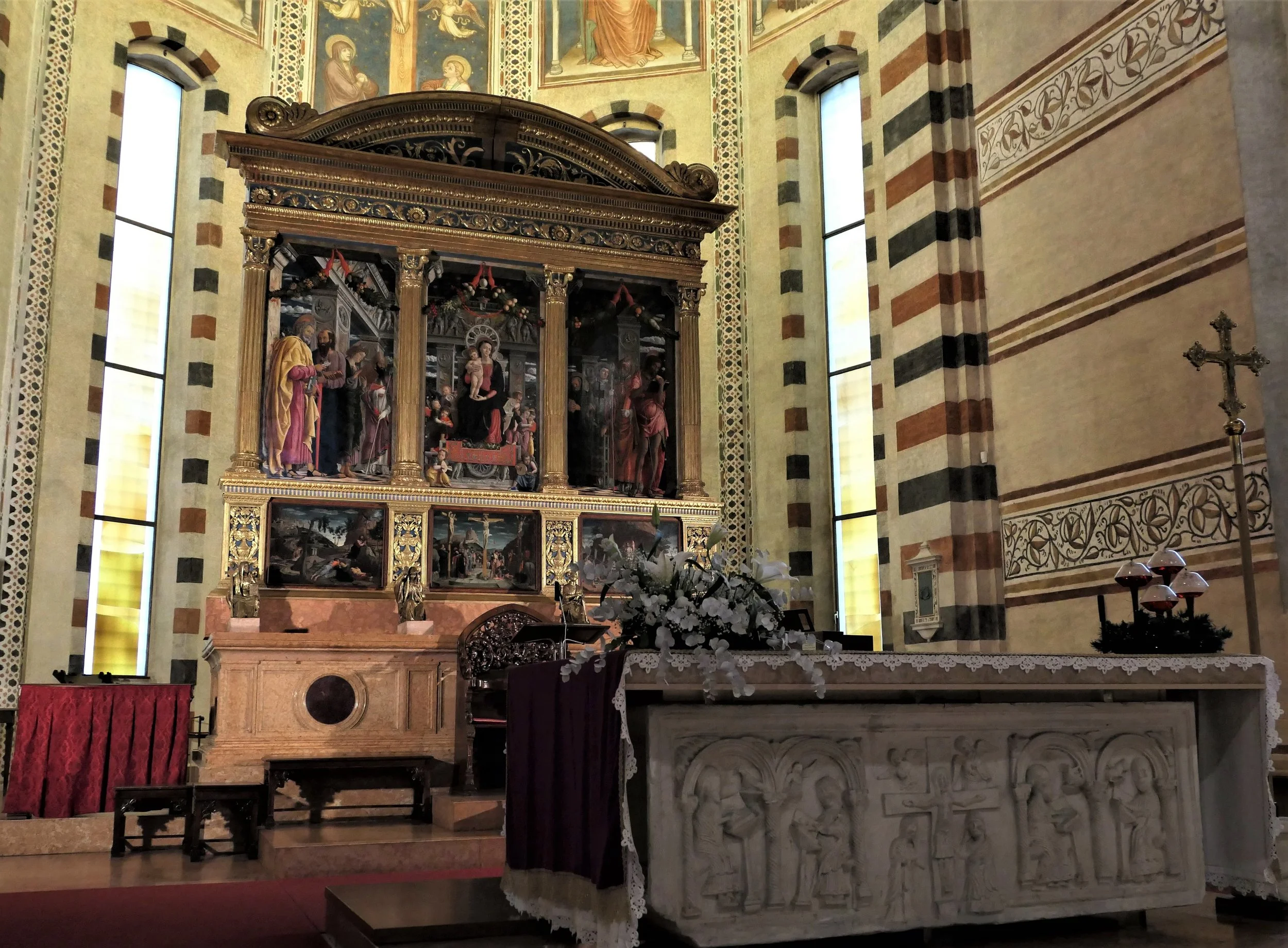
The San Zeno Altarpiece, Mary & Child with Saints, by Andrea Mantegna, ca. 1457
But it was not until I was leaving that I encountered my favourite aspect of the church: 48 bronze relief panels nailed to the 11th century spruce-wood main doors. Most of the panels are as old as the doors, and recount familiar bible stories. But four of them are 12th century, and illustrate the miracles of San Zeno: One pictures the climactic moment when Zeno, fishing on the riverbank, sees a pair of oxen stampeding toward the rushing stream, pulling a careening cart and a terrified carter. Realizing that the oxen are possessed by the devil, he commands the demon to depart, and the oxen come to a screeching halt just in time.

Gallienus gives Zeno his Imperial crown
Another tells the story of two rascals who steal a fish from Zeno’s basket, only to find that the fish is impossible to cook, stubbornly remaining raw whether broiled, steamed, or fried. Realizing that God has found them out, they seek out the saint and repent.
A very dramatic panel shows a young woman, her body contorted in agony, expelling a demon from her mouth, as San Zeno performs an exorcism. She’s the daughter of the Roman Emperor Gallienus. The last panel shows Gallienus gratefully presenting Zeno with his imperial crown, which the holy bishop later sells, distributing the money to the poor. There are carping critics, I suppose, who will point out that Gallienus and Zeno lived in different centuries. As far as I’m concerned, they can save their breath – we’re talking miracles here!
© Text © 2023 by Joe Gartman; Photographs © 2023 by Patricia Gartman. First published in Italia! Magazine, February/ March 2023