The Food of Love
Le Roncole and Busseto – mention these towns, and Giuseppe Verdi immediately comes to mind. He was born in Le Roncole but grew up in Busseto, and thousands of opera-loving pilgrims visit these small towns in Emilia-Romagna every year, probably humming snatches of the Anvil Chorus or Va Pensiero all the while. Or Lucca – who can think of that picturesque Tuscan city without seeming to hear Pavarotti nailing that last vincerò in Nessun Dorma? For Lucca is the birthplace of Puccini, and in the piazza named for him, there is a bronze statue of the Maestro himself, debonair and handsome as ever.
And then there is Pesaro. It’s on the Adriatic, just where the ancient Via Flaminia turned up the coast toward Rimini. For some, the name will evoke memories of the Malatesta and Sforza families, who ruled the town in turn during the 15th century. Art lovers will recall the famous “Madonna of Pesaro” by Titian, from the Church of the Frari in Venice.

Gioachino Rossini, attributed to Constance Mayer, c. 1820 - Civic Museum, Piazza Mosca, Pesaro
Many of us, though, will hear music. Perhaps the overture to Guillaume Tell will gallop across our minds, possibly accompanied by the Lone Ranger and Tonto. Or Figaro may be boasting of his tonsorial talents to the admiring citizens of Seville. For Pesaro is the birthplace of Gioachino Rossini, the most popular opera composer of his time. Besides Guillaume Tell and Il Barbiere di Siviglia, works like La Cenerentola, La Donna del Lago, and L'italiana in Algeri were wildly popular during his lifetime, and are still performed regularly today.

Teatro Rossini, Pesaro
Rossini had many facets to his personality. Besides being a musical genius, he was a well-known and enthusiastic gourmand, as his figure later in life amply attests. Many famous chefs created dishes that they named in his honour, including Tournedos Rossini, a classic filet mignon with foie gras, truffles, and Madeira sauce. According to tradition, he personally invented the recipes for Cannelloni Rossini (filled with foie gras and truffles) and a risotto flavoured with beef marrow. He had a good deal of time to devote to his culinary hobby after he stopped composing operas, for at the age of 38, with an equal number of operas to his credit, he retired.
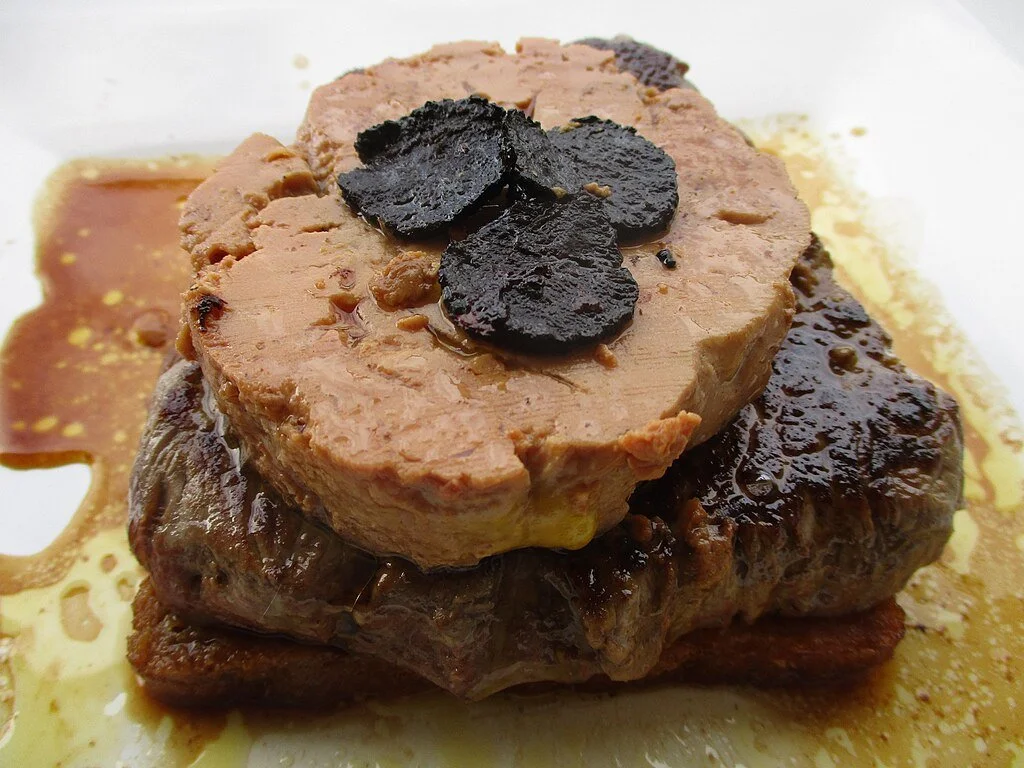
Tournedos Rossini, courtesy Arnaud 25, CC BY-SA 4.0 <https://creativecommons.org/licenses/by-sa/4.0>
His operas remained popular despite his retirement, and though he lived to be 76 years old, he died a wealthy man. After bequests to his surviving relatives, he left the rest of his estate to the Comune of Pesaro. The legacy was used to establish a musical conservatory in the town, now known as the Conservatorio Statale di Musica "Gioachino Rossini". Here, hundreds of young musical hopefuls study composition, music theory, and performance.
The Fondazione G. Rossini, also created by his bequest, helps to sponsor the annual Rossini Opera Festival; and each August several of the master’s works live again on the stage of the Teatro Rossini. In the town’s restaurants classic dishes are revived, too – with lots of goose liver and truffles, no doubt – that’s the way the Maestro liked them.
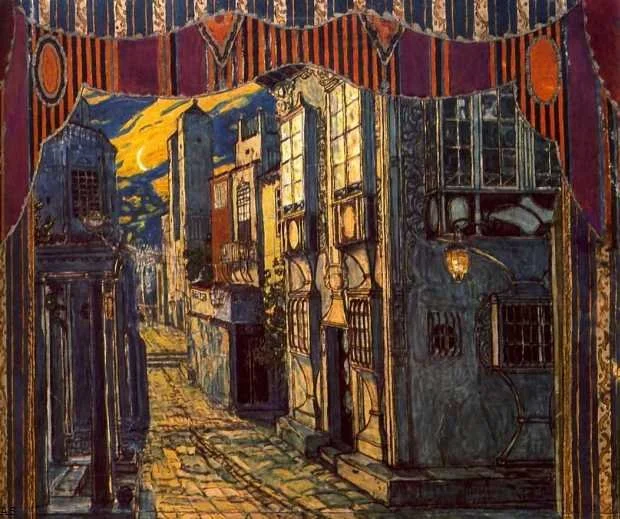
Set design for “The Barber of Seville”, by Aleksandr Golovin, 1923
© Text © 2015 by Joe Gartman; Photographs © 2015 by Patricia Gartman. First published as “The Food of Love, in Pesaro” in Italia! Magazine, April 2015