Gods Among the Machines
Just off Via Ostiense, in Rome, about halfway between the Pyramid of Cestius and the Basilica of St. Paul Outside the Walls, you can visit the first public electrical generating power plant in Rome. You might think it’s an odd choice for a tourist to make, but even if you’re a stranger in the Eternal City, you’ll probably meet some people you know there. For instance, a few months ago I saw old Emperor Caracalla, beside a huge diesel-powered engine. He was scowling, as usual. Augustus was there, too, looking a little the worse for wear, along with his brother-in-law, Marcus Agrippa. I think I saw Antinous, too, Hadrian’s young favourite.

Caracalla
But it wasn’t only Roman Emperors and their friends there among the giant centrifuges, turbines, compressors, and generators. The gods were there, as well: Zeus himself, and Aphrodite, lightly clad, posing in front of a gigantic cast iron tank. Athena looked rather more sedate, and Apollo made an appearance, too, as he always seems to do. Quite a gathering; and why not, since they are all ancient marble masterpieces (though a bit worn and chipped, sometimes), from the collections of the Capitoline Museums.

Aphrodite, looking fetching despite some missing parts
What, you may ask, are 400 or so classical sculptures, as well as mosaic panels, stone funerary monuments, sarcophagi, and a whole 4th-century AD mosaic floor depicting a hunt for exotic animals, doing in a power plant? Well, first of all, the plant no longer generates electricity, though in its day (1912 until 1963) it powered half the streetlights in Rome. So, as of 1963, it sat unused. In 1990, the Rome Electricity and Water Board (ACEA) renovated it as an industrial archaeology exhibit; and then, beginning in 1997, it was used to house some of the sculptural works from the Capitoline Museums while the main museums, the great twin palaces on Michelangelo’s Piazza Campidoglio, were being renovated.

Ancient athlete and early 20th century turbine
Exhibiting the artworks in the power plant was expected to be a temporary measure, but the startling juxtaposition of ancient and (relatively) modern was well-received by visitors. And since there is no shortage of ancient sculpture in the Capitoline collections, the old power-plant, now called Centrale Montemartini, (after Giovanni Montemartini, who designed the facility), became a permanent satellite museum of the Musei Capitolini. Conceptually, the museum is both a collection of ancient art, particularly sculpture, and an example of the technological skill of the first half of the twentieth century.
There are two floors of exhibits in the plant. The piano terra, the ground floor, features few of the giant machines, but there are some superb works of art there, including portrait heads of Augustus, Mark Antony, Julius Caesar, and Cleopatra – a cast of characters worthy of Hollywood or Cinecittà. There is a rather melancholy statue of an aristocrat carrying the death masks of his father and grandfather, probably in a funeral procession.

Floor mosaic, a hunting scene from the 4th century
The first floor contains two large rooms, the Sala Macchine, or engine room, and the Sala delle Caldate, the boiler room. There is a balcony from which you can see both great rooms, their enormous machines, the sculptures, and a large mosaic floor, looking like a displaced section of the famous Villa Romana del Casale floors in Sicily.
But it is in the engine room and boiler room that the marble gods and goddesses are seen to best effect among the giant, impressive, and yet touchingly antique machines.
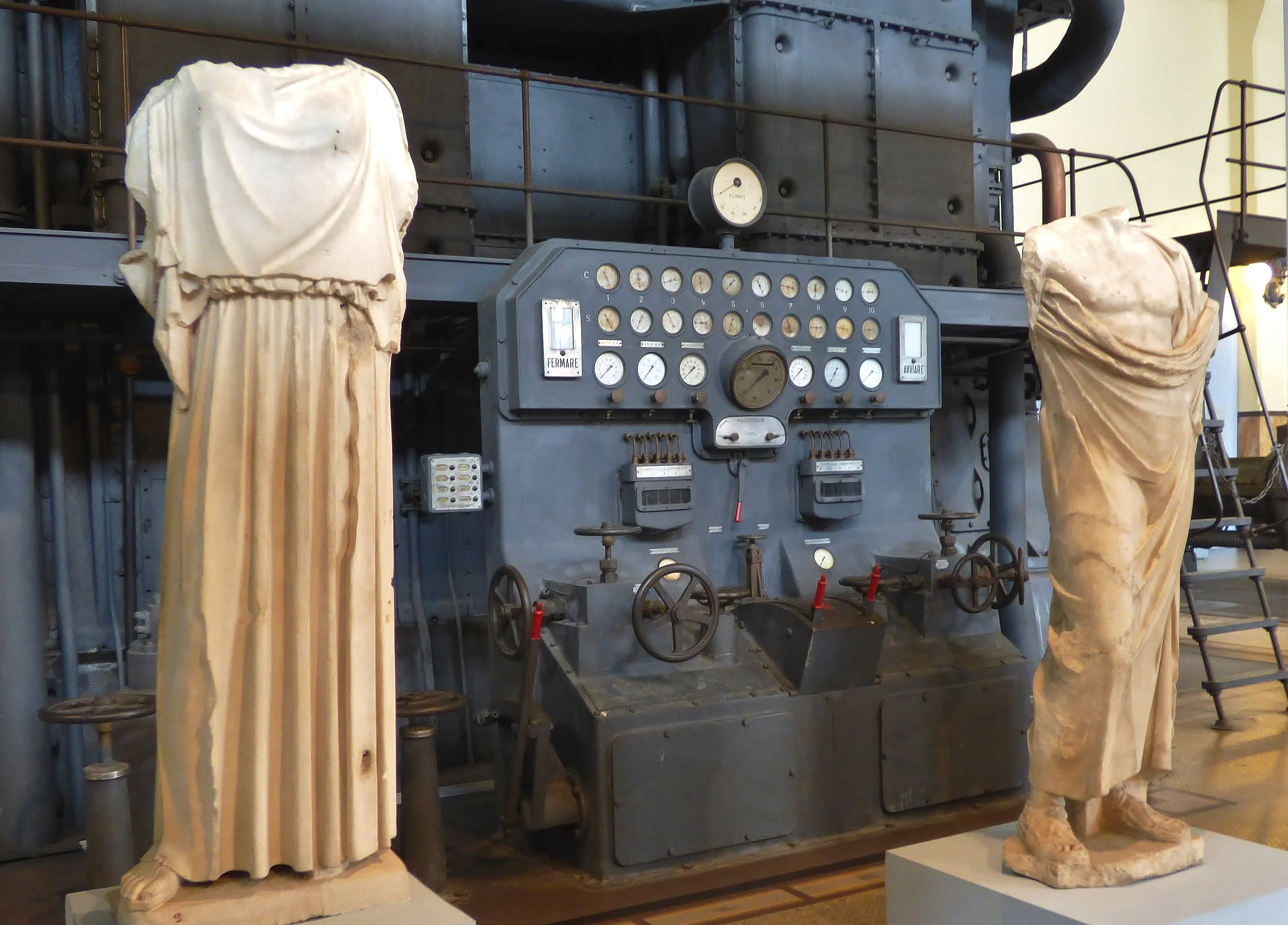
In fact, it is rather moving to look past the lovely, gleaming-white marble figure of a woman (alas, minus both arms and head, but still lovely), and see the large control panel of a huge diesel-powered generator. There, on the panel, the banks of analogue rotary dials and controls seem as anachronistic as the statue. Where are the digital readouts? It’s as if the modern pace of change has accelerated so much that the funny old round dials seem as ancient as the statue. It left me with the gloomy thought that the marvels of our world may be forgotten much sooner than the ancient gods
© Text © 2016 by Joe Gartman; Photographs © 2016 by Patricia Gartman. First published in Italia! Magazine, November 2016