On the Hill of Shards
There’s an olive tree atop the Acropolis in Athens. Greek legend says that the tree was planted by Athena, as a gift to the city, when she and Poseidon contended to become the patron god of the city. Athena won, of course, and the city was named Athens in her honour, because her gift was much more useful than Poseidon’s offering of a salt-water spring. (Poseidon had obviously not thought things through.) The tree became the progenitor of all the olive trees in Greece.
The tree has survived many injuries over the years. For instance, the Persians sacked and burned Athens in 480 BC, but when the Greeks reclaimed their city, the burned tree sprouted a new branch. German occupation forces in WWII severely damaged it, but, after the war, workers from the American School of Archaeology managed to save a cutting that was replanted by Princess Sophia of Greece in 1952. You can still find the tree, if you visit Athens. It’s in front of the Erechtheion, on the Acropolis.
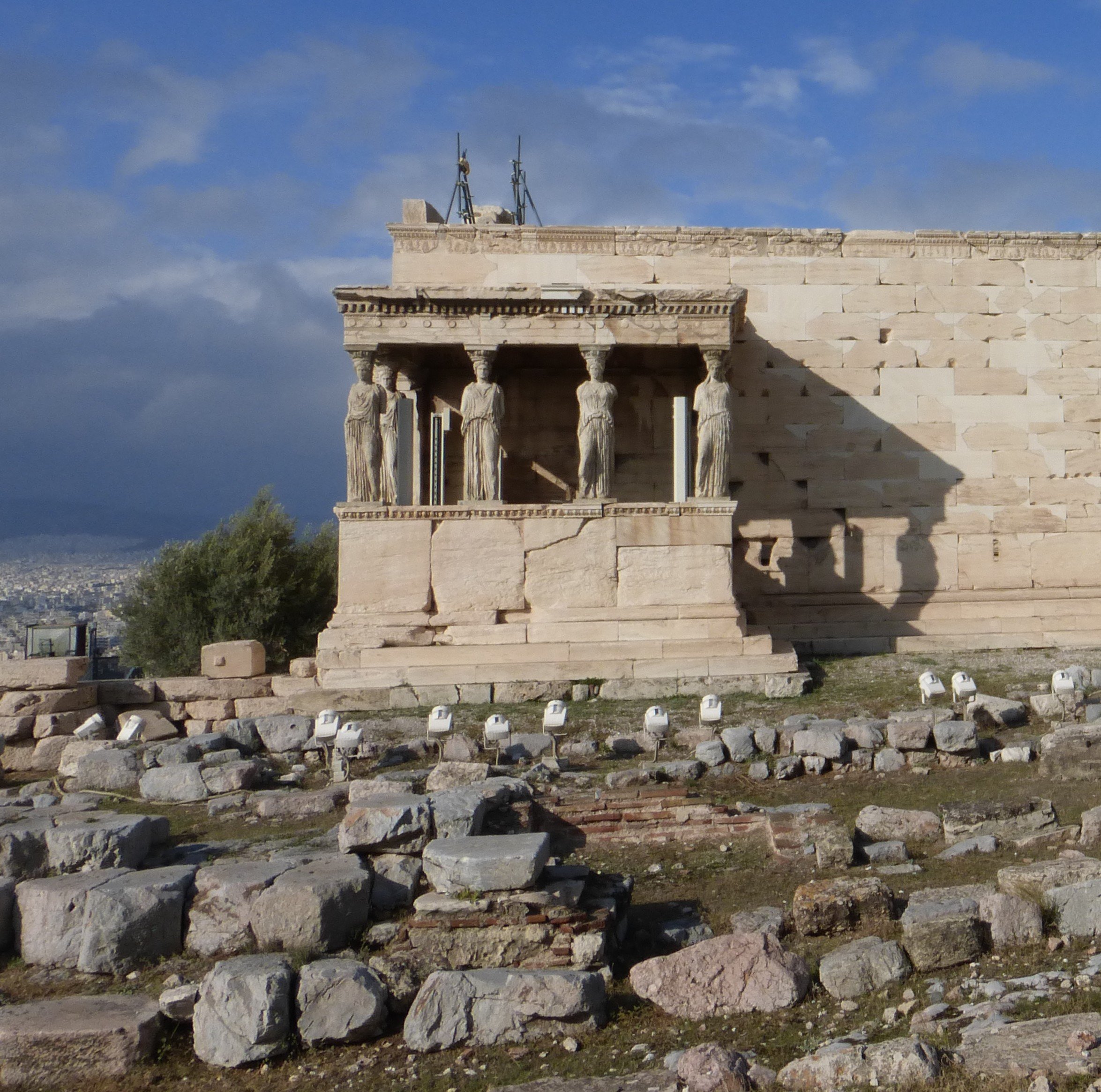
The Erechtheion and its legendary tree
When the Athenians chose the olive tree over the salt-water spring, they certainly hit the jackpot. There are a multitude of uses for the tree and its fruit. But it was the Romans who really put Athena’s gift through its paces; they ate olives, of course, but it was olive oil that literally and figuratively greased the wheels of Roman civilization.
They did use it for cooking, of course. Somehow scientists who’ve examined ancient skeletons have determined that Romans of the 1st century AD got 25% of their calories from olive oil, about ¼ cup per day. It was used for medical treatments, too. In Classical Greece, Hippocrates called olive oil “the great healer,” and prescribed it for many different ailments. The Romans did the same. It was the base for antiseptic ointments, pain-relieving salves for sunburn, rash, and insect bites, and for most cosmetics and perfumes.
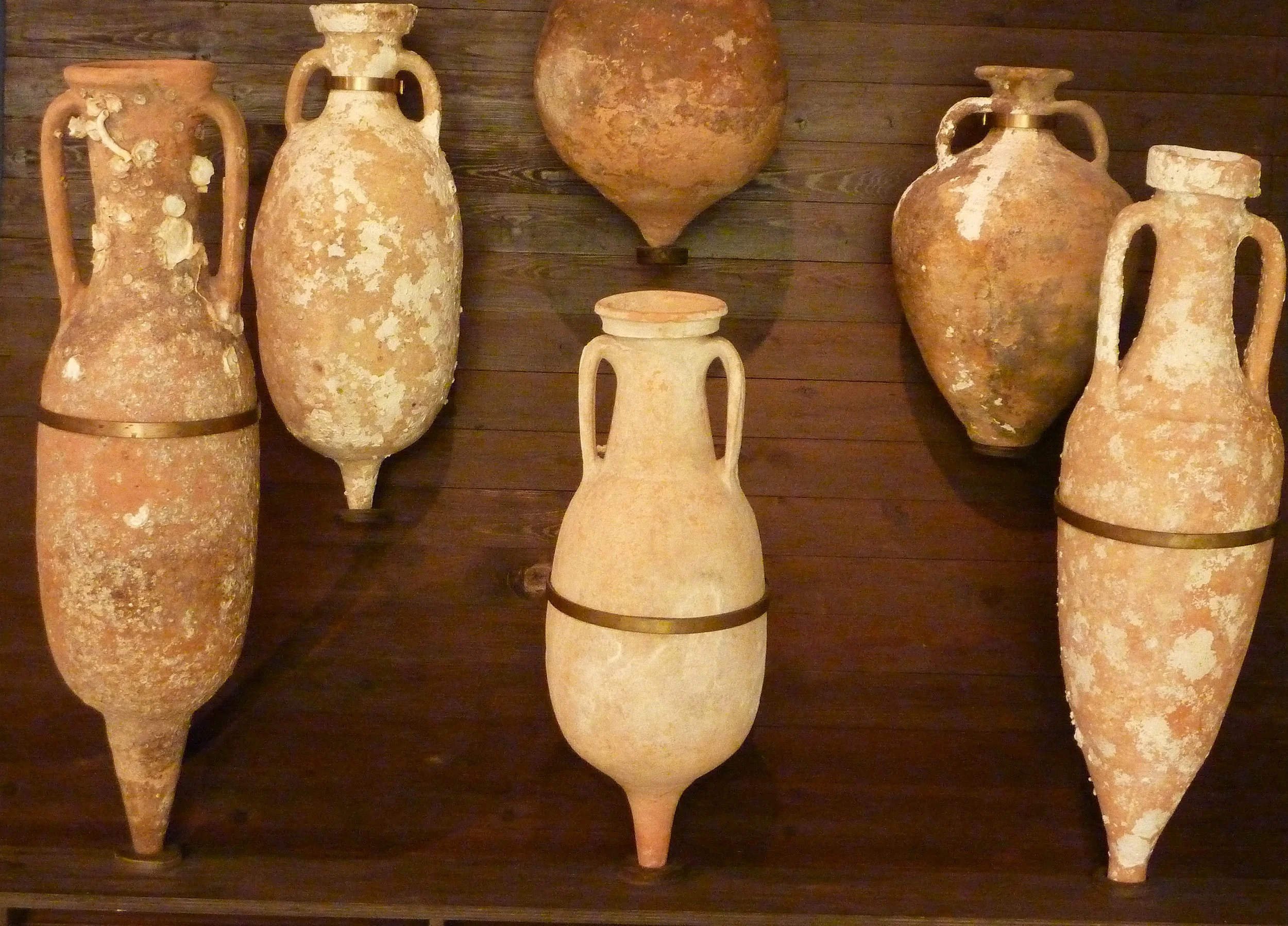
A selection of amphorae, used in antiquity for shipping olive oil, wine, and grain
Ancient Rome was famous for its many elaborate public baths, but they did not use soap there. Instead, after bathing and exercising, they coated their bodies with olive oil, and then scraped it off with a curved metal blade called a strigil. (Sometimes the mixture of dirt, dead skin, and oil was collected after scraping, and sold as a cure for ailments such as “inflammation of the genitals.” It was called gloios in Greek and strigimentum in Latin.)
Roman life after dark was lit by millions of oil lamps, and by now you can guess what kind of oil was used. Olive oil was also used as a preservative for wood; and it was the lubricant for Rome’s thousands of wagon, cart, and chariot wheels. There were millwheels and other machines with moving parts that needed oiling, as well.
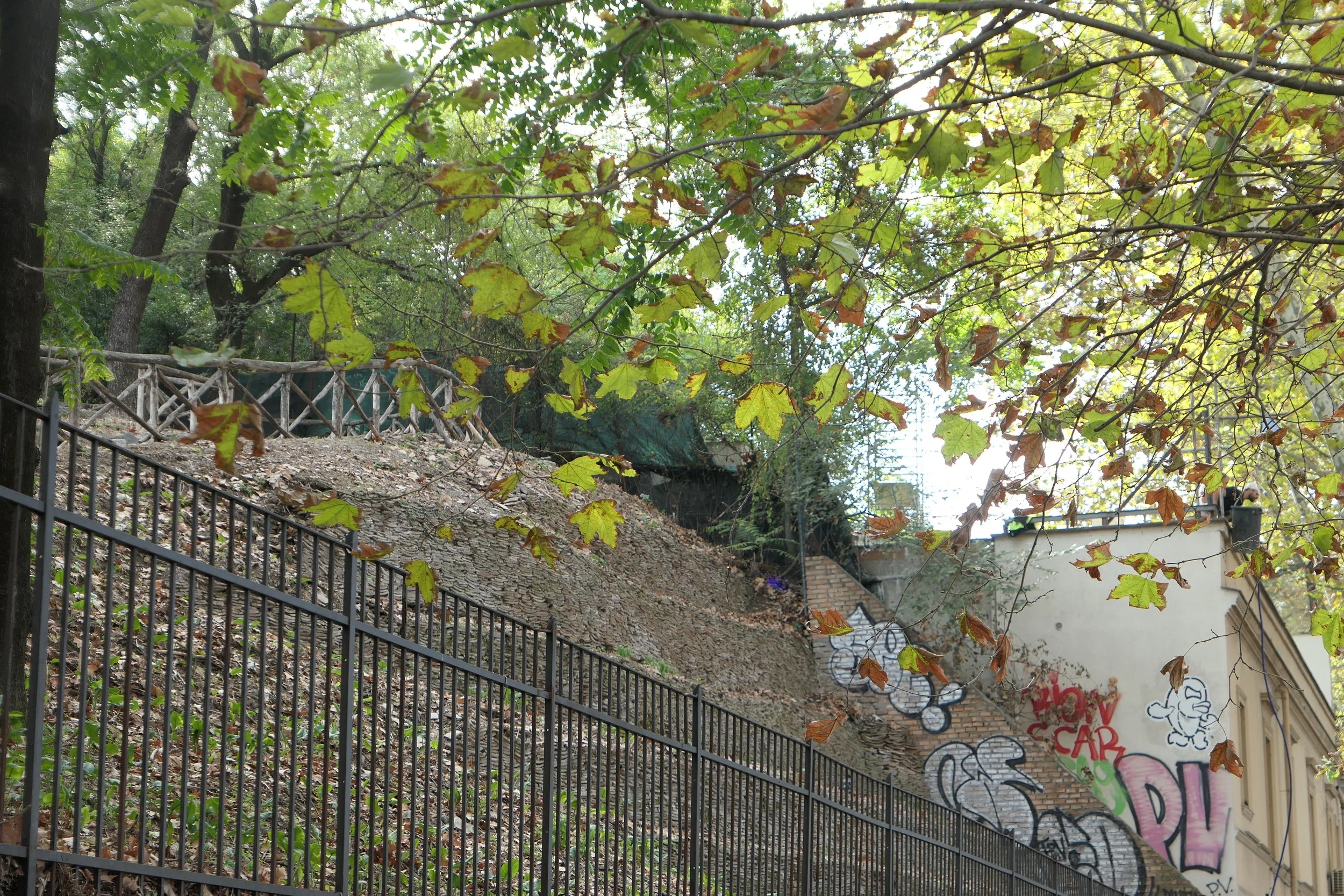
The hill is composed of untold millions of shards, with accumulated dirt supporting plants and trees
By about the 1st century BC, the city’s demand for olive oil was so great that Rome began to import it from overseas, and the best, most reliable, source was a province in southern Spain called Hispania Baetica, which had vast olive plantations. The oil was shipped in large, thick-walled amphorae, made in Spain, with a capacity of about 70 litres each. They were trans-shipped from ocean going vessels at the Port of Ostia to barges and hauled upstream on the Tiber to the river port of Emporio, near the vast, now vanished, warehouses of Porticus Aemilia south of the Aventine hill. Here, the oil was decanted into great holding tanks, ready to be tapped for distribution. Trouble was, the emptied amphorae couldn’t be re-used, because the residual oil absorbed by their terracotta interiors soon became rancid and spoiled any liquid, such as wine, that might otherwise have been transported in them.
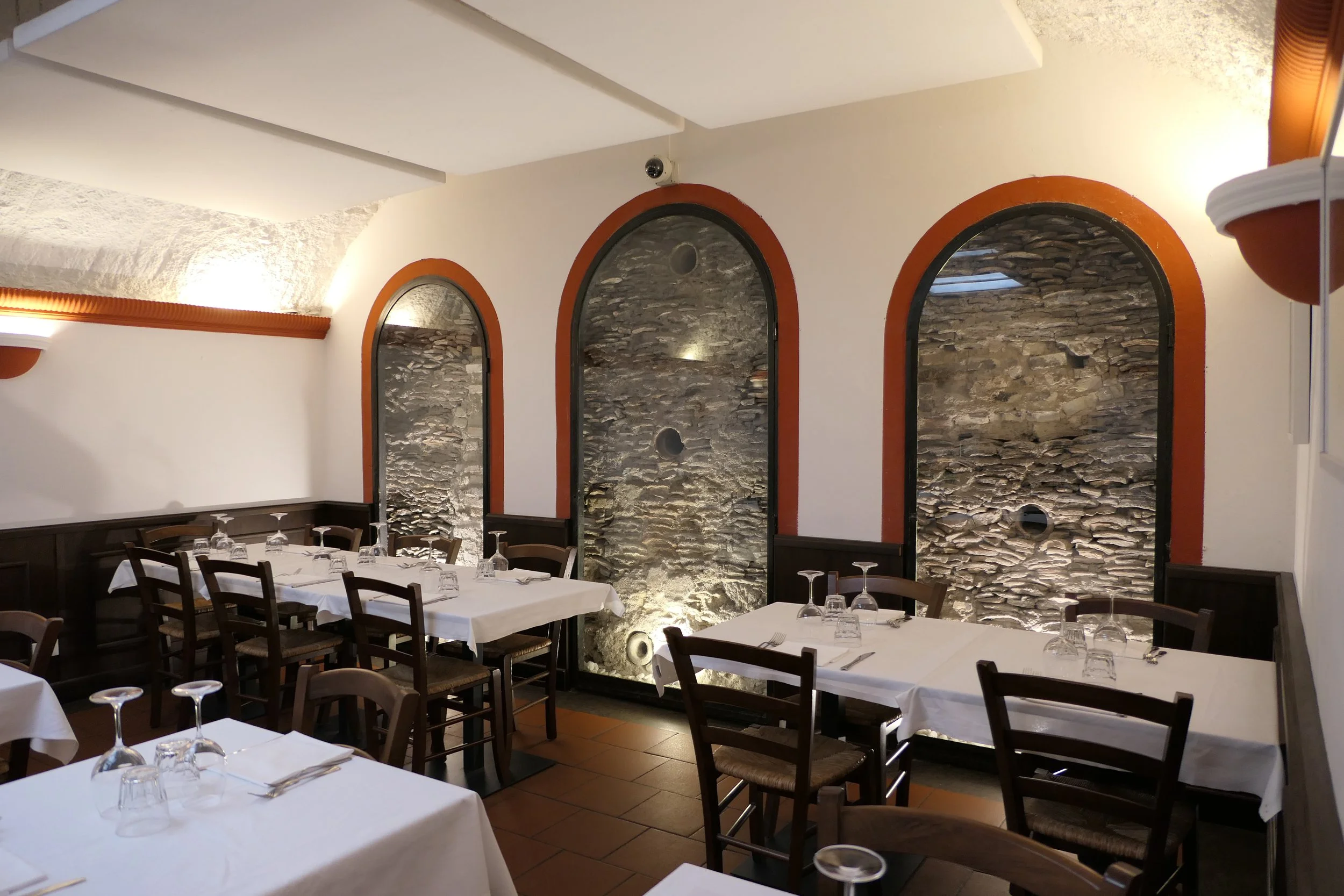
Dining room of Ristorante Flavio al Velavevodetto, which has been hollowed out of Monte Testaccio’s tightly stacked shards
By 260 AD, an estimated 53 million olive-oil amphorae had arrived at the Emporio port. And if you’d like to see what happened to them, close-up, I recommend lunch at Flavio al Velavevodetto at the foot of Monte Testaccio. Look out the large dining room windows. Thousands of broken pottery pieces, neatly stacked edgewise, fill the entire space, because you’re within Monte Testaccio now – a hill 115 feet high and more than a kilometre in circumference, made of amphorae shards.
From the 1890s to 1975, there were slaughterhouses near the hill, whose workers took the off-cuts home and over time developed a local style of cooking using offal and cheap meats. There was a neighbourhood market in Piazza Testaccio for many years; it was moved nearer the hill in 2012. Eateries in the market feature traditional Testaccio cuisine.
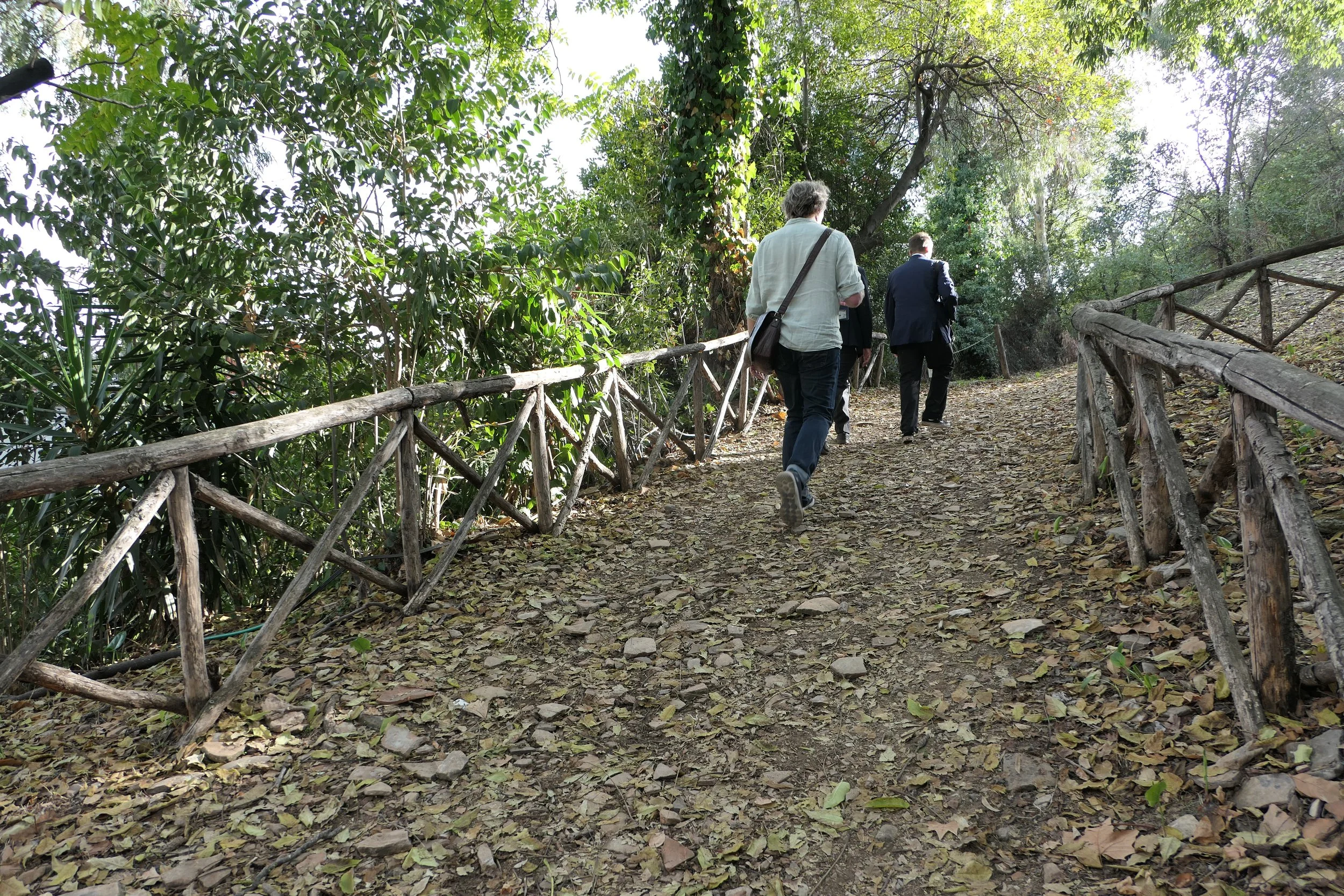
The pathway to the summit
By a lucky chance, last November we were in Rome on the one day of the year that the Sovrintendenza Capitolina allowed unescorted visits to the hill. We climbed the ramp-like path up the side of the hill. On the surface the shards are scattered and a layer of blown-in dirt supports grass, underbrush, and small trees. A cross stands upon the highest point: a reminder of Good Friday processions long ago when the Hill of Shards became Golgotha, the Hill of Skulls, and three crosses would be erected.
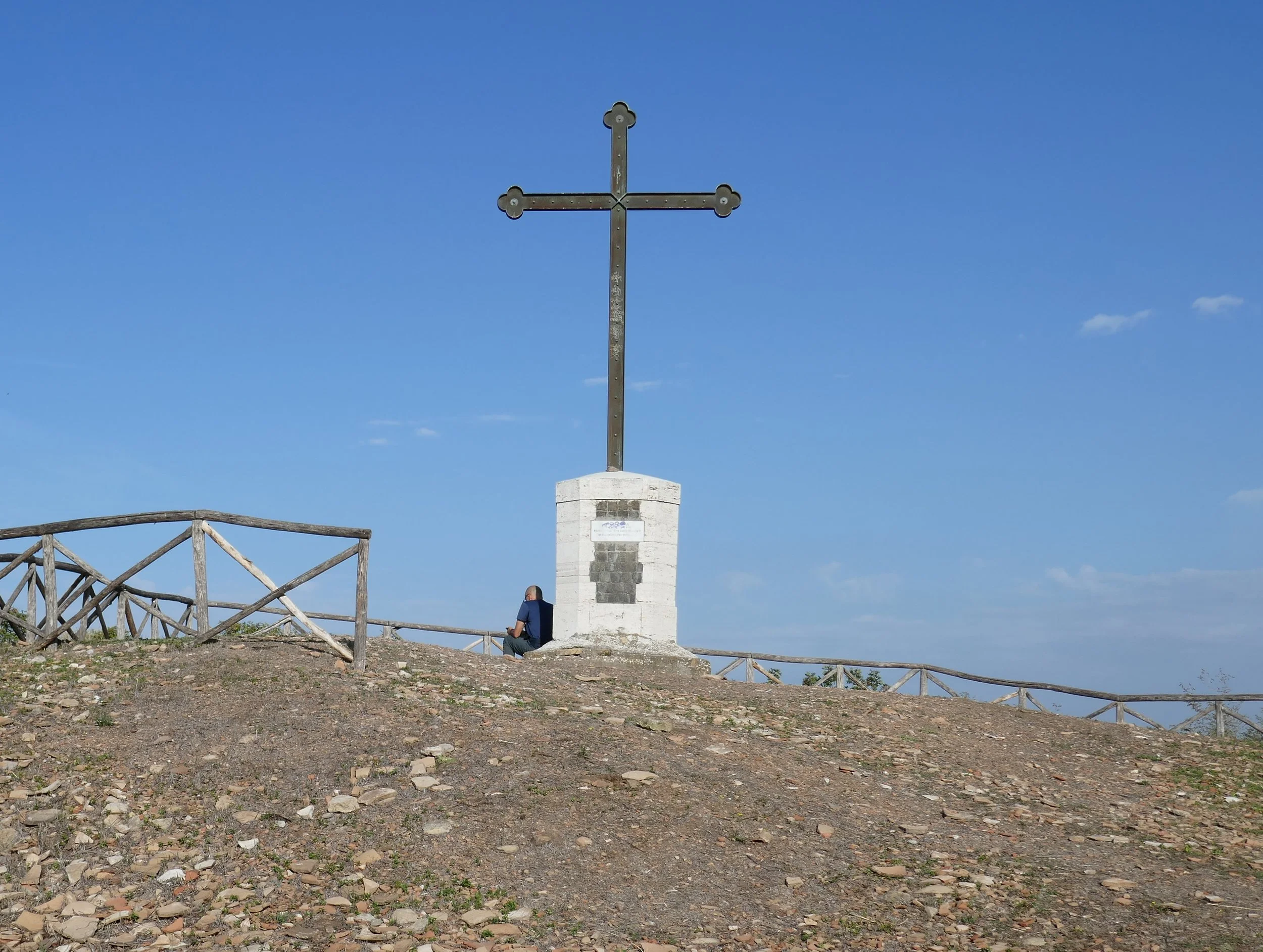
A cross on the crest of Monte Testaccio, a memory of religious processions once held there
There were rowdy pre-Lenten carnivals here, too, in Medieval times. But for many years, the hill, locally called Monte dei Cocci, was just an unremarkable knoll, good for walking or picnics. Later, trattoria, bars, and restaurants began to cluster around the base of the knoll. Lately, a team of Spanish archaeologists have been excavating and studying the shards – very wise of them. It’s said that you can learn a lot about people by studying what they throw away. Nowhere is this more true than on the Hill of Shards.
© Text © 2025 by Joe Gartman; Photographs © 2025 by Patricia Gartman. First published in Italia! Magazine, December/January 2025