Il Furioso and the Brothers of San Rocco
A narrow alley, the Salizada San Rocco, squeezes between a gelateria and the apse of the Church of the Frari, and widens into a small campo, at the end of which the church of San Rocco can be found. Here the saint’s body rests complete, so they say, except for one finger. Venice is blessed with many cosy little squares, and this one is particularly worth finding. The façade of San Rocco’s church is handsome, though 18th century; but forming a right angle with the church is the splendid façade of the Scuola Grande di San Rocco, largely unchanged since the 16th century.

The Scuola Grande di San Rocco on the left; Chiesa di San Rocco to the right
San Rocco – Saint Roch, in English – is a somewhat mysterious character. Some say he was born in Montpellier, in southern France, in the late 13th century. Others insist he was born in Voghera, in Lombardy, in the early 14th century. (In fact, it was from Voghera that two Venetian brothers, following a well-known Venetian tradition, stole his body and spirited it back to La Serenissima.)
When his wealthy parents died, Rocco, following another well-known tradition, gave all his money and possessions to the needy, donned the simple clothes of a pilgrim, and set out to comfort the poor and sick. He contracted bubonic plague, fled into the wilderness to pray, and survived; and thereafter, in pious thanks to God, spent his life helping plague victims, miraculously curing many of them. To judge from the hundreds of paintings and sculptures his story inspired, he often hiked up his tunic to show the healed bubo on his thigh, no doubt to give hope to the suffering.
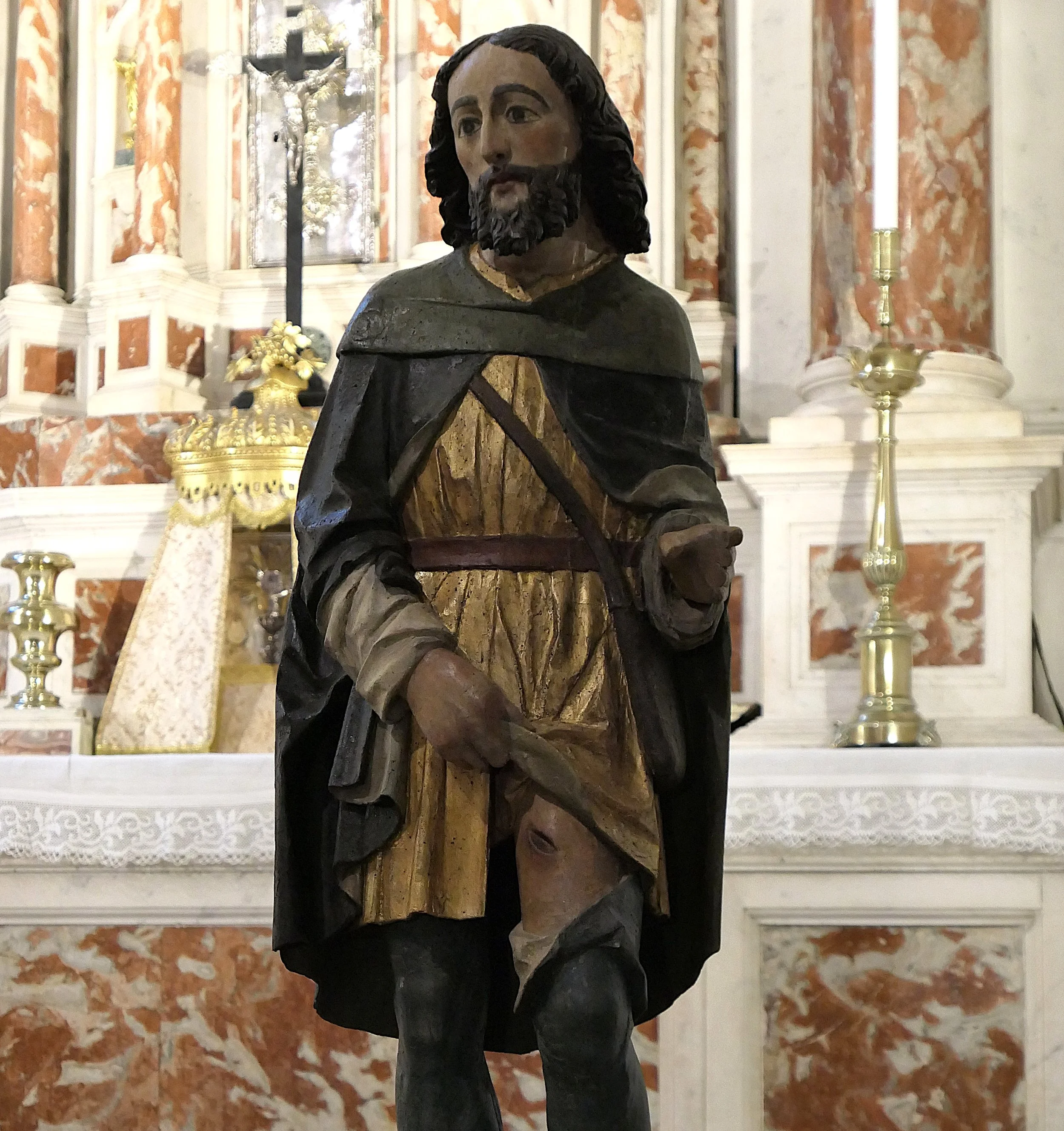
San Rocco, sculpture by Bartholomew Bon in the Chiesa di San Rocco, mid-15th century
The Scuola Grande di San Rocco is the home of a confraternity, or brotherhood, of citizens, formed in 1478, dedicated to the saint and to providing aid to the sick, especially to victims of the plagues that repeatedly afflicted the city. In the years when the Republic flourished, there were numerous scuole formed by tradesmen and artisans in Venice, analogous to the guilds of the European middle ages; these were the small schools, the scuole piccolo. There were six – perhaps seven – scuole grandi, however, that were quite different: large confraternities of wealthy, often aristocratic citizens. They were social clubs, where men of similar standing could hobnob, and they were furnished and decorated elaborately for the purpose. But they were also charitable institutions, each with its own speciality: caring for the sick, feeding and clothing the destitute, providing dowries for poor young women, and so on.
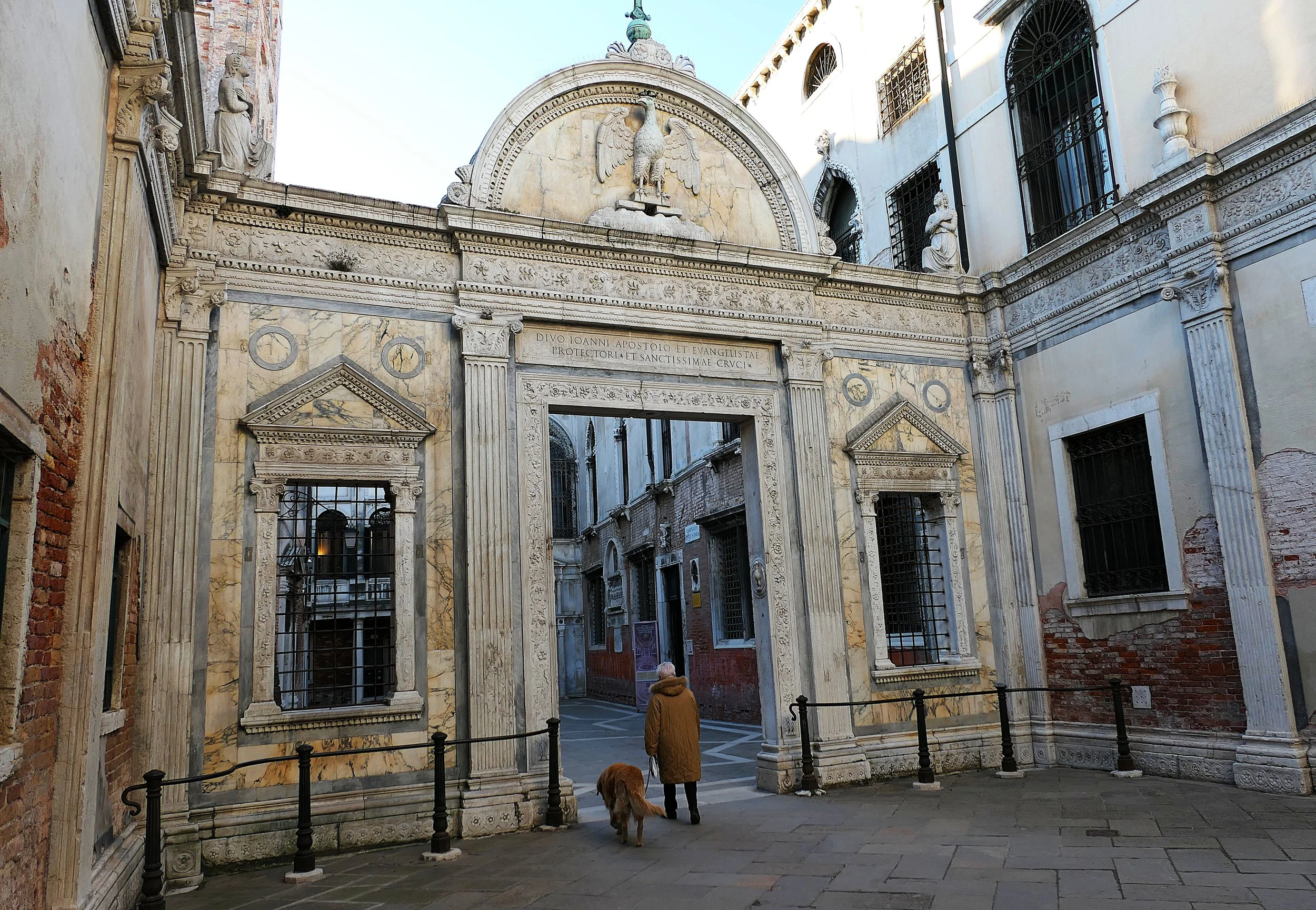
Entrance to the Scuola Grande di San Giovanni Evangelista, whose famous painting collections now reside in the Accademia
Of all the scuole grandi, the Scuola of San Rocco is the only one whose property and organization has survived relatively intact. Behind the half-Renaissance, half-Byzantine façade of the Scuola Grande di San Marco, for example, you’ll now find Venice’s main hospital. If you pass through the archway in Pietro Lombardo’s exquisite marble screen guarding the Scuola Grande di San Giovanni Evangelista, you’ll find that their famous cycle of paintings by Carpaccio, Gentile Bellini and others, has been moved to the Accademia. Time has dealt similar blows to the other great “schools” as well – except for San Rocco’s.
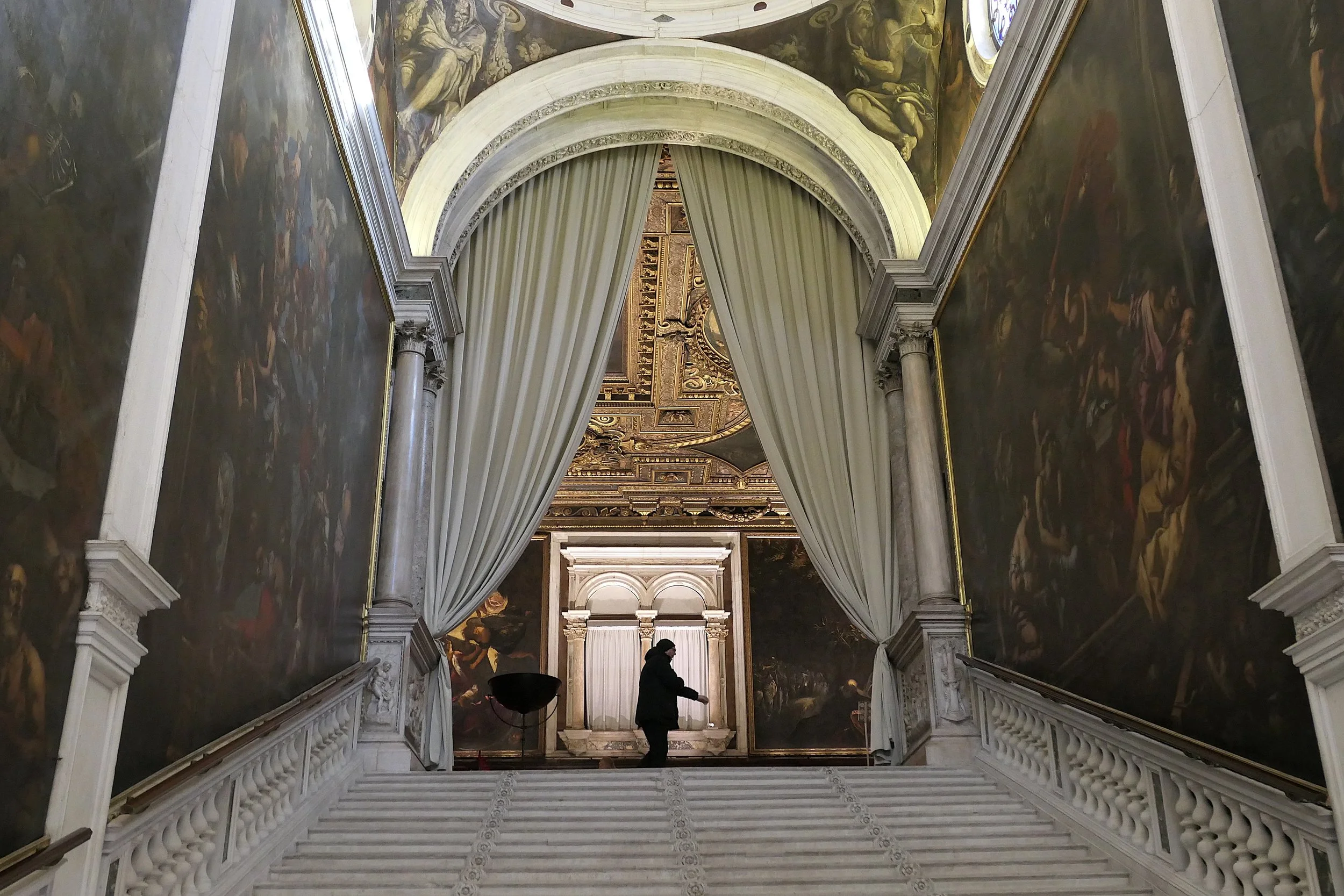
Staircase leading to the Sala Capitolare
There, behind that marvellous façade, are rooms connected by graceful staircases, great windows framed by slender Corinthian columns, marble floors with polychrome inlay, walls and ceilings covered with elaborate mouldings of deeply carved and gilded wood framing giant oil paintings. In the magnificent Sala Capitolare, the Upper Assembly Hall, I came face to face with the creator of most of the paintings. He was growing like a sturdy branch out of the glowing walnut wainscotting that lined the room. Turns out he was a startling wooden sculpture, one of a dozen or so, by Francesco Pianta, from the 1670s. There he was, Jacopo Robusti, glaring fixedly at me in the light of a nearby lantern. His fellow artists called him Il Furioso because of the speed and violence of his working technique. He was also known as Tintoretto, because his father was a cloth dyer, a tintore, and as Tintoretto he is remembered today.

It all began with a clever but rather disreputable trick. When the Brothers invited several painters, including Veronese, to submit sketches for an oval panel of San Rocco for the ceiling of their Sala dell’Albergo, Il Furioso instead managed to complete and secretly install a fully finished oil painting in the desired space. The other artists were incensed and the Brothers were hesitant, but Jacopo said that if the Scuola didn’t want to pay him, he’d let them have the picture for free. It was an offer the Brothers couldn’t, or at least didn’t, refuse; and Tintoretto continued to paint for the Scuola another twenty-five years, earning a reputation that brought him many other commissions. He married Faustina Episcopi, daughter of a prominent member of the Scuola Grande di San Marco, and eventually joined the Brothers of San Rocco as a member of the confraternity.
The Brothers did well, too: for a quarter-century, they enjoyed the services of one of the greatest painters of the Venetian Renaissance for the very economical sum of 100 ducats a year, a phenomenal value whether measured by artistic merit or square yard of canvas: Il Furioso liked his pictures large, and they cover most walls and ceilings of the Scuola’s vast headquarters.
When you visit, use the hand-held mirrors the Brothers provide to view the ceilings or your neck will regret it; and if you’ve been wondering what happened to San Rocco’s missing finger, it’s in a silver reliquary in the Treasury on the top floor.
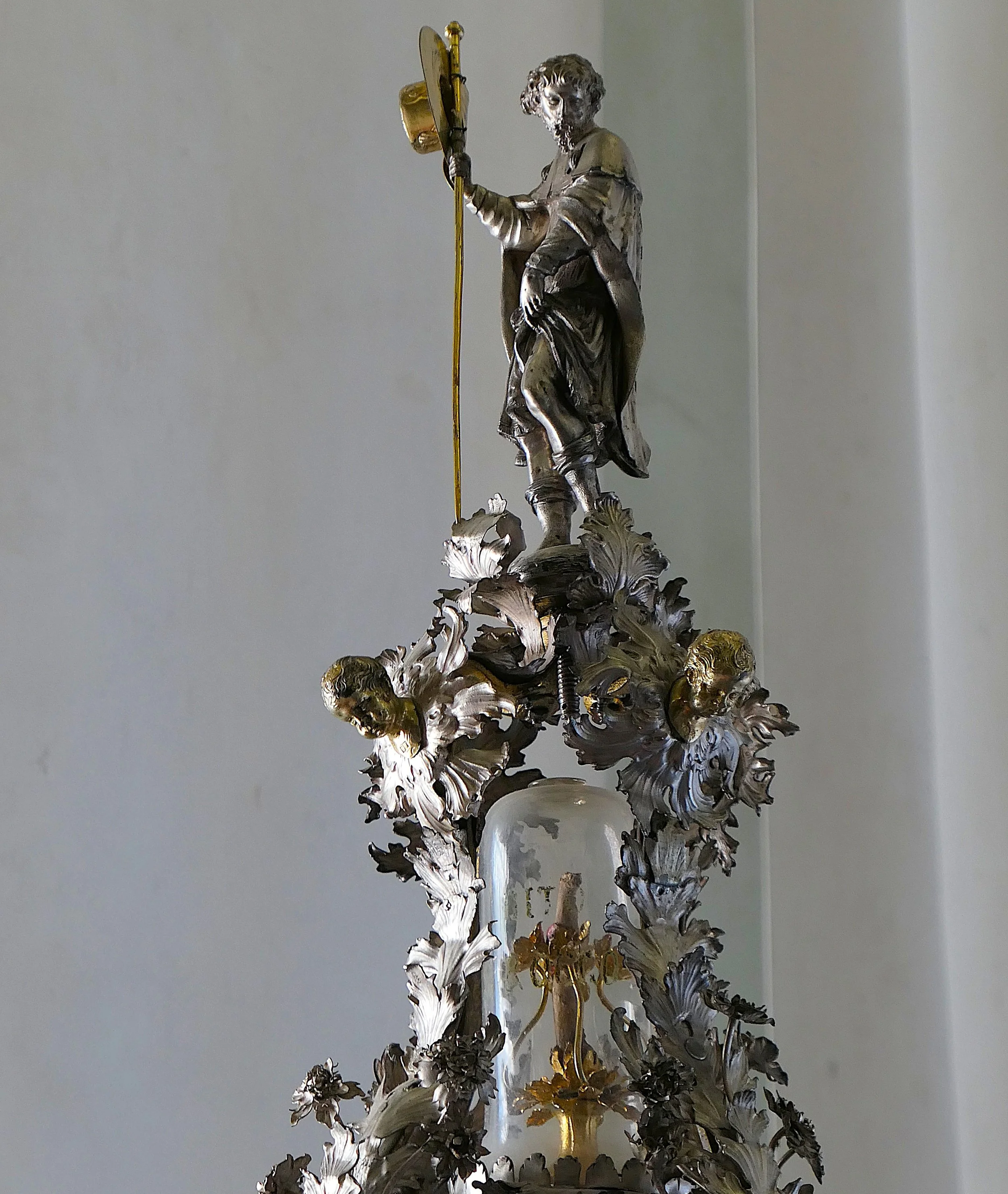
Silver reliquary containing San Rocco’s finger
© Text © 2022 by Joe Gartman; Photographs © 2022 by Patricia Gartman. First published in Italia! Magazine, April/May 2022