The Painted Room
January, 2010: The Marchese is not paying any attention to us. We don’t take offense, of course, because he’s a busy man. In fact, he’s deep in conversation with his secretary, Marsilio, while a file of young men in their Sunday best waits to speak with him. His wife, Barbara, a formidable lady with a snow-white veil drawn over her hair, sits patiently beside him while he conducts business.
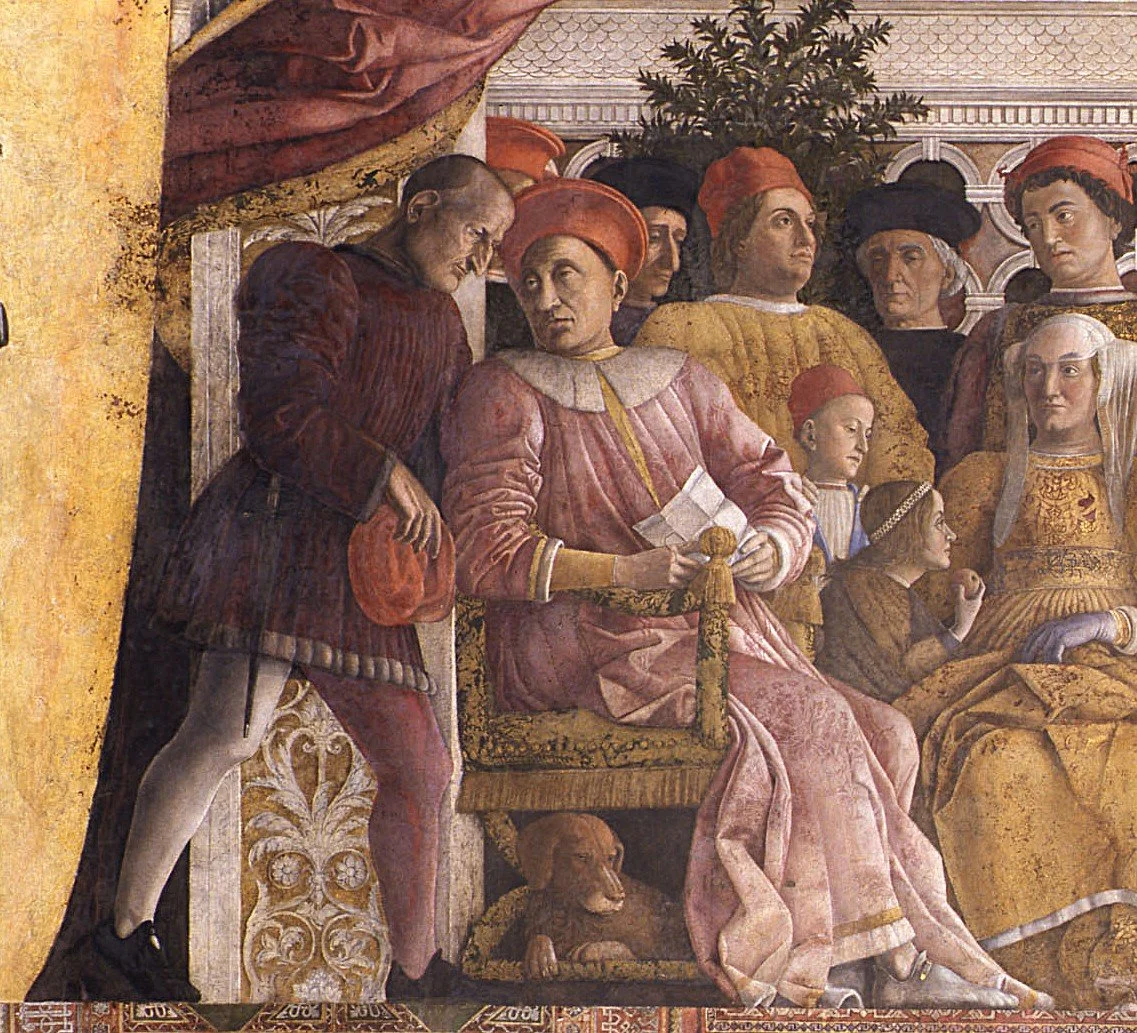
The Marchese and his court
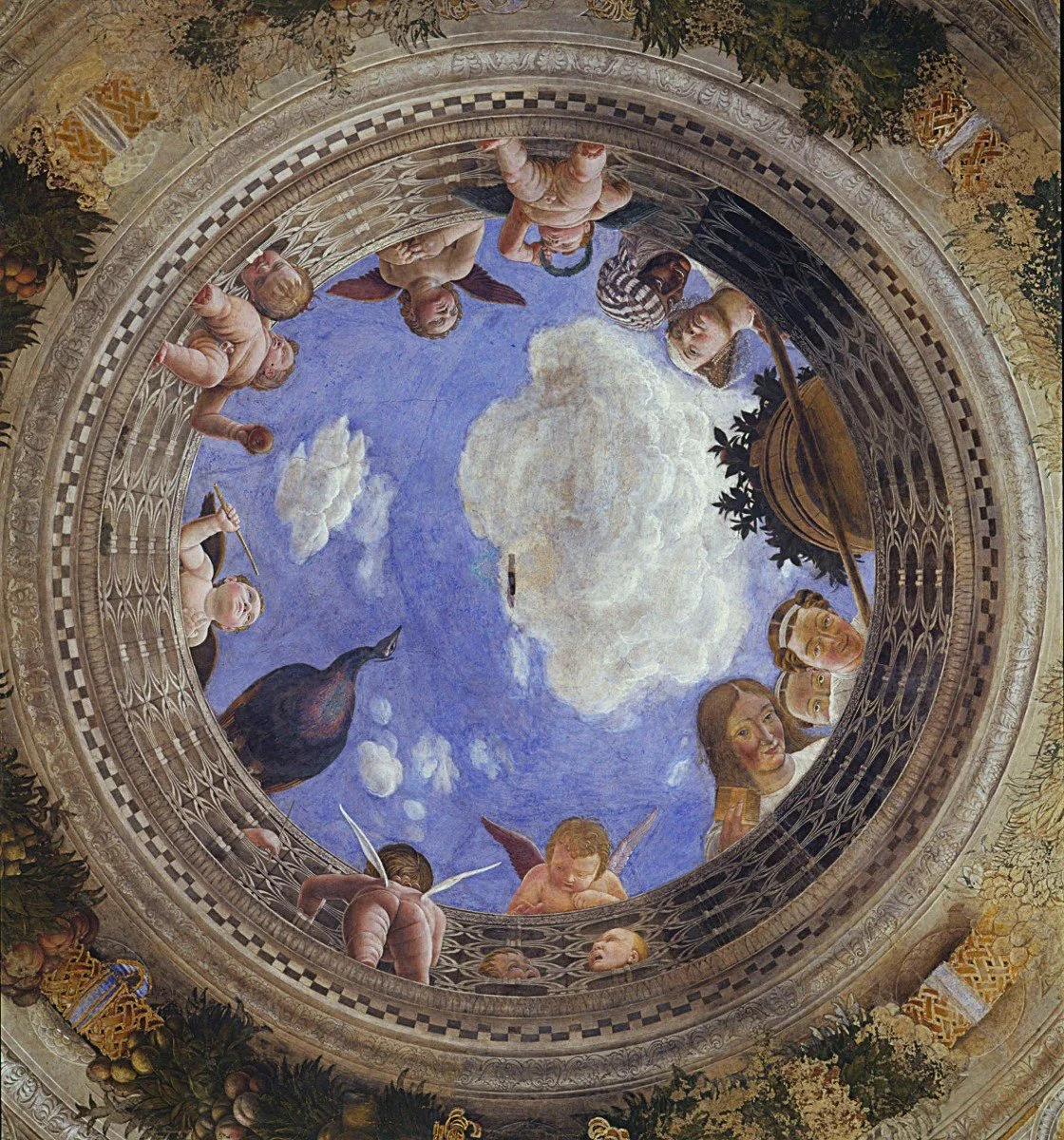
We’re in a pavilion of the Ducal Palace in Mantua. It’s an extraordinary space, open on one side to the surrounding countryside, and there is a circular opening or oculus in the domed ceiling through which we can see the sky and a few clouds. Surprisingly, it seems that a number of servants and other folk have climbed onto the roof and are peering down into the room. They’re a jolly group – a few naked children cling precariously to the rim of the oculus, while some of the smiling women seem intent on tipping a large potted plant down onto our heads.
As I look out toward a lovely Renaissance city perched among the distant hills, I notice that the Marchese has deserted his post and is now outside with a couple of the younger children, greeting his son Francesco who has just returned from Rome.
We might as well be visitors from another time for all the notice anyone takes of us. Well, actually, there are a couple of people staring at us, although I hadn’t realized it before. A diminutive elderly woman, no more than three feet tall, is looking at us with undisguised contempt from among the courtiers waiting for the Marchese. And there is a man pacing the corridor outside the pavilion, alternately looking meaningfully at his watch and then at us. I know what that means. We’ve overstayed our time. He’s too polite to actually throw us out, especially as it’s the middle of winter and there are no other visitors. But we take one more, long gaze around before leaving the pavilion. Darned if it looks like winter outside – balmy sunshine glows on the surrounding hills. It all seems rather dreamlike, fantastic, real and yet unreal.
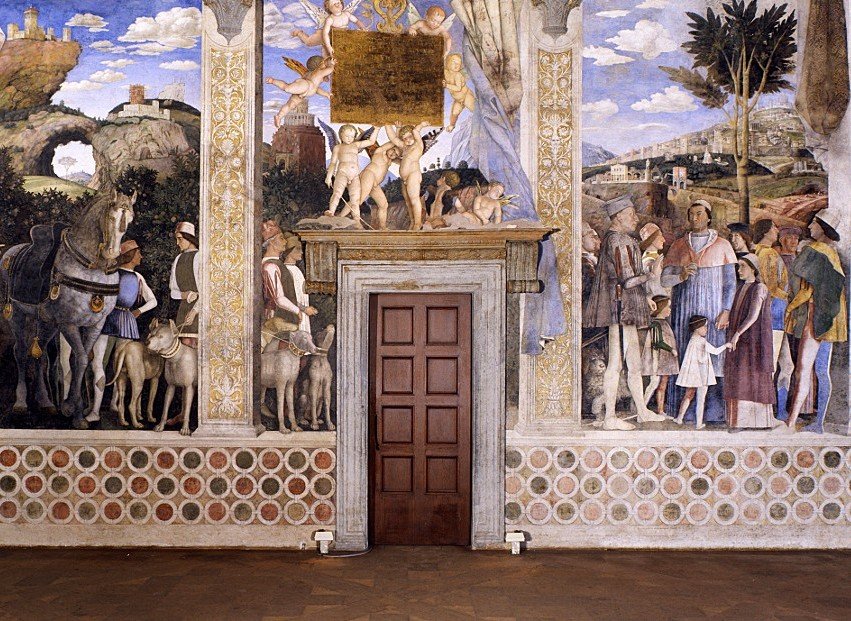
And, in fact, it is a fantasy. But not ours. The only twenty-first century participants in this scene are my wife, Pat, and myself, and the impatient guard with his ticking wristwatch. And the apparent pavilion with its family gathering and view of the outdoors is also an artful contrivance. In fact, we are in a smallish room surrounded on all sides by substantial stone walls, part of the formidable palace/fortress of the Gonzaga family, who ruled Mantua for nearly 400 years. The Marchese and his wife, his courtiers, the countryside, the little scowling dwarf, the hole in the roof and the playful peasants above us, all are painted wraiths. This startlingly real but fantastical scene was created more than five hundred years ago by one of the most skilful and important artists of the Italian Renaissance, Andrea Mantegna.
It’s called the Camera Picta, (the painted room), or alternatively the Camera degli Sposi, (the wedding chamber) since it supposedly celebrated the marriage of Ludovico Gonzaga, Marchese of Mantua, and his wife, Barbara of Brandenburg. The Camera Picta is in one of the four square towers of Castello San Giorgio, a sternly fortified part of the Palazzo Ducale complex. Ludovico commissioned the decoration of the room in 1465. For the job, Mantegna resurrected and perfected the quadratura technique of ancient Roman artists – a difficult type of trompe l’oeil painting. By 1474, he had created the most influential illusionistic scene of his time, not equalled until Antonio da Correggio’s soaring ceilings in the next century.

Part of the Ducal Palace of Mantua, including Castello San Giorgio and its four towers
Mantegna was court painter to the Gonzagas of Mantua for 49 years, from 1460 until his death in 1509. Among his patrons was Isabella d’Este, Marchesa of Mantua and wife of Francesco II Gonzaga. She recognized Mantegna’s genius, and gave him important commissions for her famous Studiolo, though she was a demanding client and their relationship was sometimes stormy. Mantegna liked to live well, and had expensive tastes; like Isabella, he was a collector of art and antiquities, with which he decorated the house that he built for himself in Mantua.
He used a unique “circle in a square” design, the circle forming an interior courtyard. He began construction in 1476 but took 20 years to finish the project – Andrea was a busy man, much in demand, and couldn’t spare much time to his own home. By all accounts he was a rather prickly fellow, and who can blame him? He built the house on land given him by Ludovico Gonzaga in payment for his artistic service, but financial pressure made him sell it to Francesco Gonzaga in 1502. There’s a famous bronze bust of Mantegna in the church of Sant’Andrea that shows the artist looking as if he’s just received the foreclosure notice.
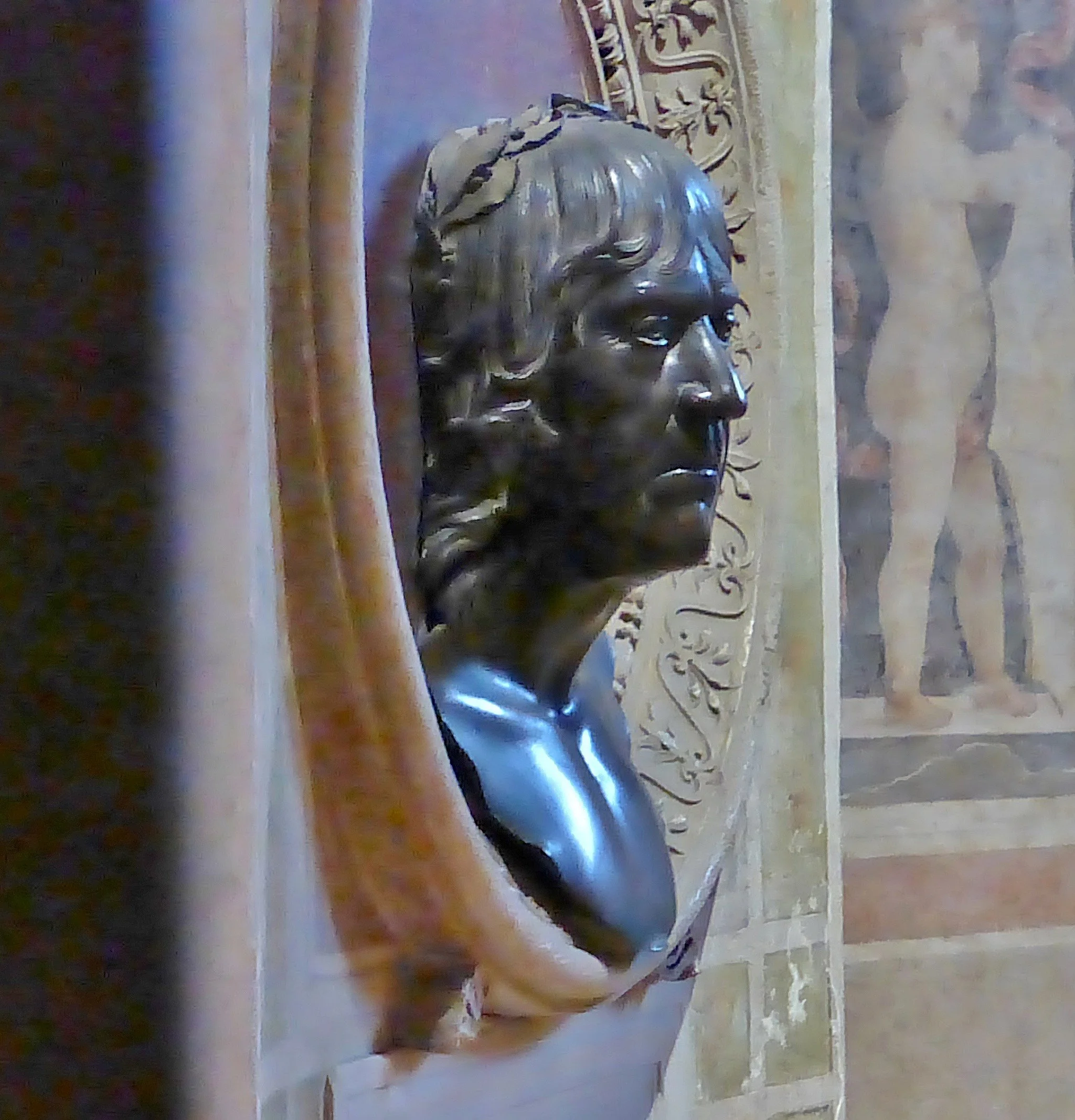
Bust of Andrea Mantegna in the Church of Sant’Andrea
He created many magnificent works. One of the most famous, the Lamentation over the Dead Christ, showing Christ’s body in extreme and disturbing foreshortening, is now in the Brera Museum in Milan. It was found in his house after his death, where he evidently kept it for more than 30 years. But the Painted Room is his masterpiece, an astonishing tour-de-force that has influenced artists ever since.

The Lamentation over the dead Christ, by Andrea Mantegna, 1490 - Brera Museum, Milan
September, 2015: I wrote the little fantasy above to express my amazement at Mantegna’s achievement, a couple of years before the Painted Room and the Ducal Palace in Mantua were severely damaged by the violent earthquakes of May, 2012. After the earthquakes, the Painted Room was closed for almost three years. Soon after the closure, I contacted the Ministry of Culture for information. The Superintendent for the Province of Mantua at the time, dott.ssa Giovanna Paolozzi Strozzi, very kindly sent me an overview of the damage and the daunting work that would be required to reopen the site. I despaired of ever seeing the Marchese and Marchesa and their grumpy little friend again. However, the site did re-open last April, with a limit of 1500 visitors per day. You can find more information at the official website of the Palazzo Ducale, Mantova (www.mantovaducale.beniculturali.it). When you go, no doubt the chap with the ticking wristwatch will have his eye on you. Still, even if it’s a short visit, it’s one you won’t forget.
© Text © 2015 by Joe Gartman; Photographs © 2015 by Patricia Gartman. First published in Italia! Magazine, December 2015