Paradiso Lost; or, The Case of the Missing Cantos
If you’ve spent much time in Tuscany, you already know that Tuscan bakers, by tradition, customarily omit salt from their bread. Now, while rest of the world may find a Tuscan dinner roll nearly inedible, we must remember that someone accustomed from infancy to tasteless, insipid, bland baked goods will have a different opinion. It’s a tradition that dates back many centuries; I can’t recall at the moment how it started, but even in Dante’s Paradiso, when Beatrice introduces Dante to the ghost of his great-great grandfather, Cacciaguida, the old man predicts Dante’s exile from Florence and how he will yearn for home:
Thou shalt have proof how savoureth of salt The bread of others, and how hard a road The going down and up another’s stairs.
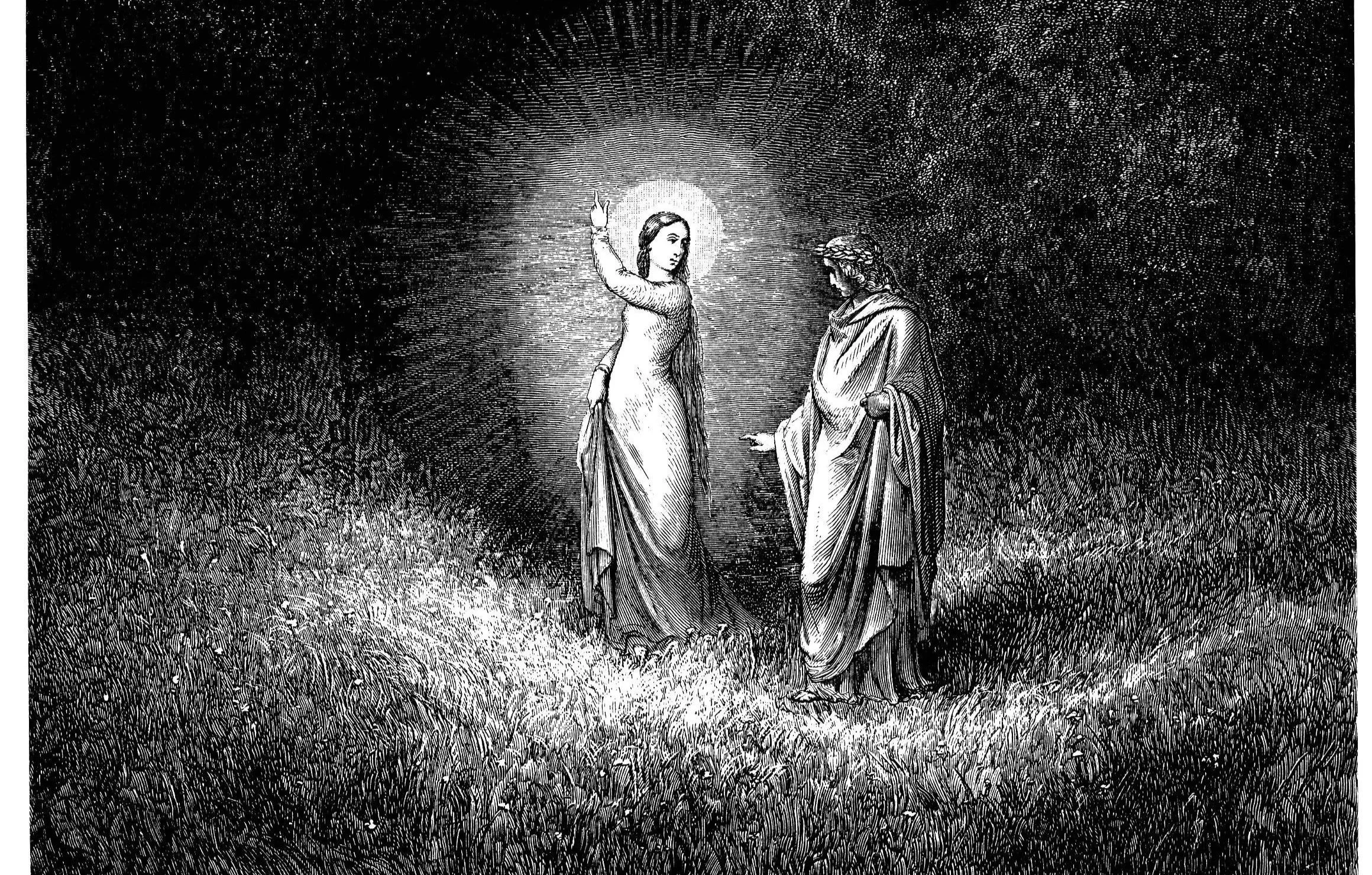
Beatrice bids Dante go into the Inferno with Virgil, by Gustave Doré, 1861
You’ll no doubt recall that Dante Alighieri was exiled from Florence while on a diplomatic mission to Rome because his political party fell from power while he was away. The story involves White Guelfs, Black Guelfs, Ghibellines, Pope Boniface, Prince Charles of Valois, the Battle of Campaldino, and a lot more. The gist of it is that the new regime charged him with corruption and banished him from the city under pain of death. He couldn’t even stop for a change of clothes. It was the 27th of January, 1302. He never saw Florence again.

Statue of Dante in Piazza Signoria, Verona
Historians debate how and where Dante lived for the next twenty years. It’s well-known that he spent time in Verona and Ravenna, but where else had he been? And how had a perpetual refugee managed to compose the Divine Comedy? After all, it’s a work that has been recognized for seven centuries as one of the greatest literary achievements in history: a monumental expression of religious feeling, philosophical thought, and unforgettable imagery. It was also a poem that demonstrated (with a little help from Boccaccio and Petrarch) that the Tuscan vernacular dialect could become the unifying language of Italy.

Giovanni Boccaccio, etching by Raffaelo Morghen, 1822
I decided to consult the earliest biography I could find, which turned out to have been written by none other than Giovanni Boccaccio himself. As a source, Boccaccio has some important advantages. He was eight years old when Dante died, so they were near contemporaries. He appears to have known two of Dante’s sons, and, in 1350, met Dante’s daughter Antonia – or rather, Suor Beatrice – in a Ravenna monastery, when he delivered 10 gold florins to her from the Orsanmichele church in Florence. (Belated remorse for the poet’s exile, I suppose.)
In his chapter on Dante’s travels, Boccaccio says that Dante first stayed in Verona, at the court of Bartolomeo della Scala, where he remained for two years, and subsequently was sheltered by the rulers of Casentino and Lunigiano in Tuscany, and then in Urbino. Later, after stays in Bologna and Padua, he returned to Verona, where he found his most important patron, the greatest of the Lords of Verona, Cangrande della Scala. (Boccaccio calls him “Messer Cane”. Dante dedicated the “Paradiso” to him.)
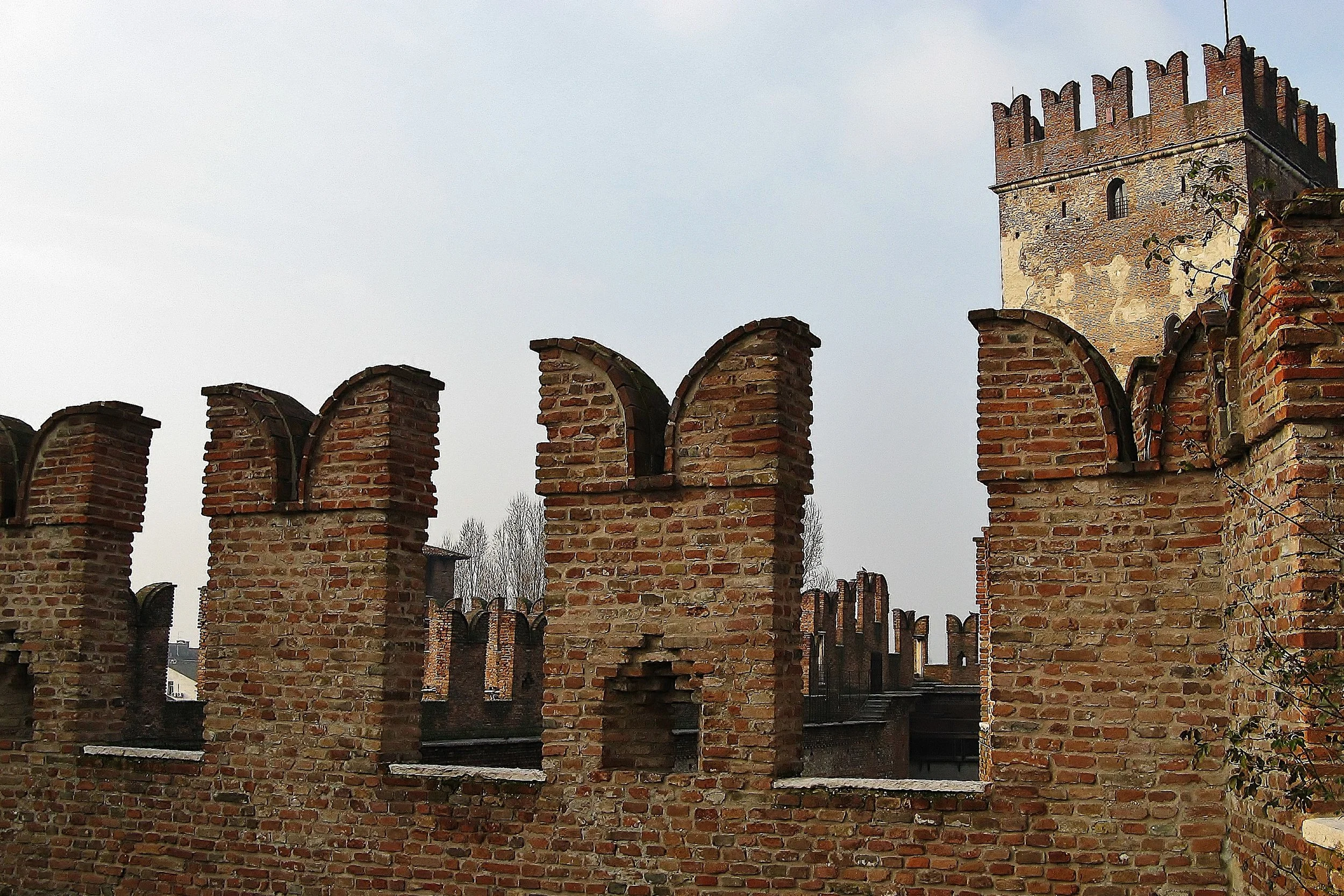
Crenellated battlements of Castelvecchio, Cangrande della Scala’s castle in Verona
All the while, Dante worked on his great poem. “The Divine Comedy” is a work of more than 14,000 lines, divided into three books, or “Canticles”, and each canticle is divided into “Cantos”. In all, the poem consists of 100 cantos. The three canticles are Inferno, Purgatorio, and Paradiso. According to Boccaccio, “It was Dante’s custom, when he had finished six or seven cantos, more or less, before anyone else saw it, to send it from wherever he was, to Messer Cane della Scala, whom he reverenced beyond any other man.” (It seems Cangrande periodically distributed copies at his own expense.)
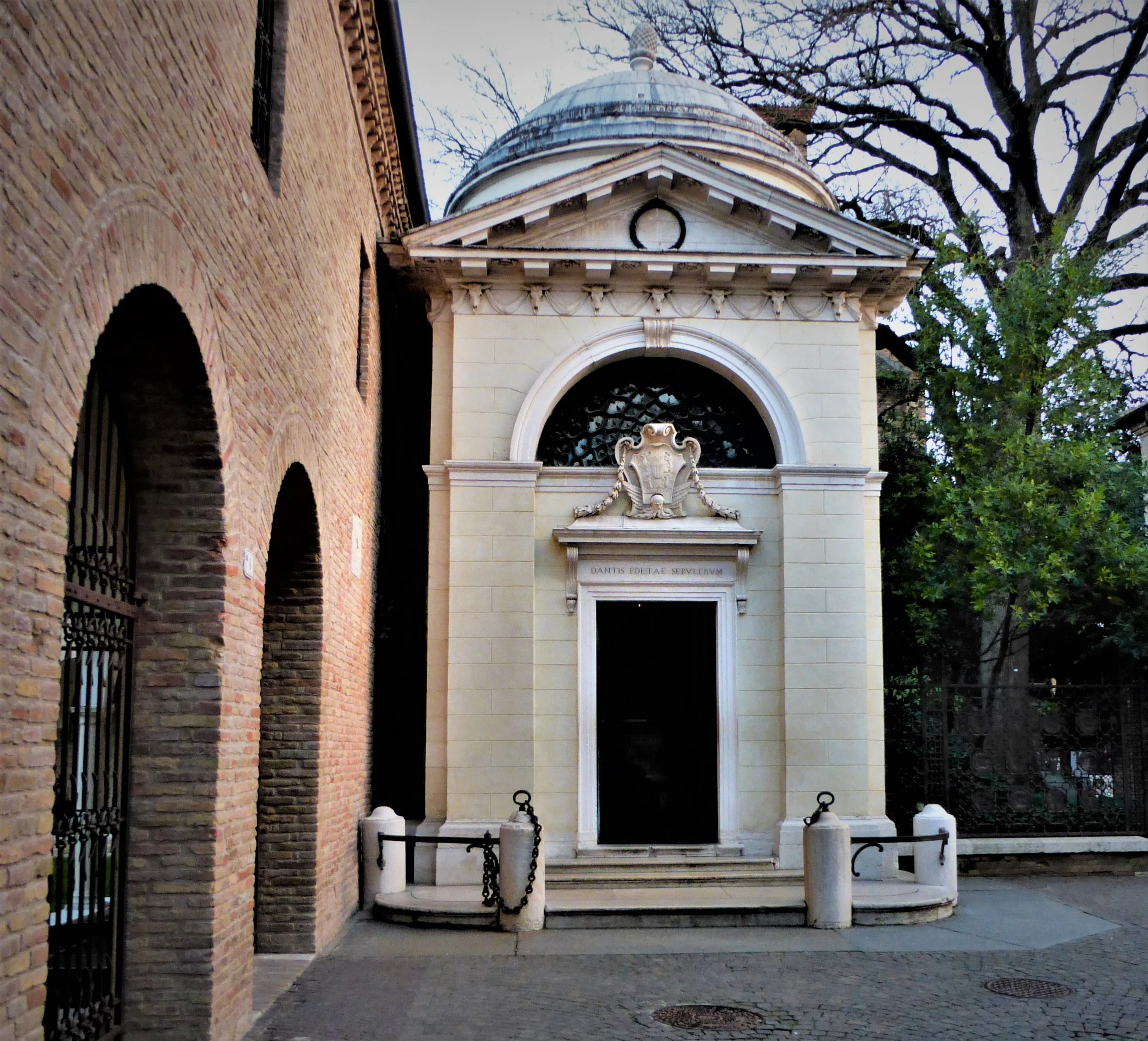
Monument marking Dante’s tomb in Ravenna
After several years in Verona, Boccaccio says that Dante made his way to Paris; and after some time there, travelled to Ravenna, where he was welcomed by the city’s ruler, Guido Novello da Polenta, to whom he became a close advisor. In fact, in the Fall of 1321, Guido sent him on a diplomatic mission to Venice. As we have seen, diplomatic missions and Dante didn’t fare well together; he contracted malaria and died on 14 September 1321.
According to Boccaccio, after Dante died, the last 13 cantos of the Paradiso were missing. Panic ensued, and “Jacopo and Piero, sons of Dante, each of whom was a writer of verse, on the persuasion of some of their friends, had resolved, so far as they could, to finish their father's work, that it might not go imperfect, when to Jacopo … appeared a marvelous vision …”
In a dream, Dante appeared to Jacopo, “clothed in shining raiment”; and led the dreaming Jacopo to Dante’s house. There he touched a spot on his bedroom wall, and disappeared. Jacopo awoke, and taking a friend with him, went to Dante’s house where they found a concealed opening, just where the ghost had indicated, in the bedroom wall:
“In it they found some writings, all mildewed by the dampness of the wall, and near to rotting … Carefully cleaning them from the mildew, they read them, and saw they contained the thirteen cantos … Therefore in great joy, copying them, they sent them first, according to the custom of the author, to Messer Cane, and then joined them, as was fitting, to the imperfect work. In this manner the work, composed in many years, was completed.”
Of course, there are plenty of naysayers who’ll offer more prosaic explanations, nowadays – such as that the “missing” cantos had actually already been sent to Cangrande, and he was simply delaying their release to increase demand. But really … whoever heard of a publisher doing such a thing?
© Text © 2023 by Joe Gartman; Photographs © 2023 by Patricia Gartman. First published in Italia! Magazine, June/July 2023