The Ponte delle Torri
There is a great fortress on a height overlooking the Umbrian town of Spoleto. It is called the Rocca Albornoziana, after the man who ordered it built in 1359, Cardinal Egidio Albornoz. It was intended to symbolize and impose Papal rule over the town and the region around it. From it, a wary ruler could survey the town; but the fortress also looks across the deep valley of the Tessino River toward Monteluco, Spoleto’s “holy mountain”. There, on slopes thickly forested with oaks, are cool springs; and small streams course among the trees. The Romans who established the town called Monteluco a grove sacred to Jupiter, and later, in medieval times, Christian communities of monks and hermits were established there.
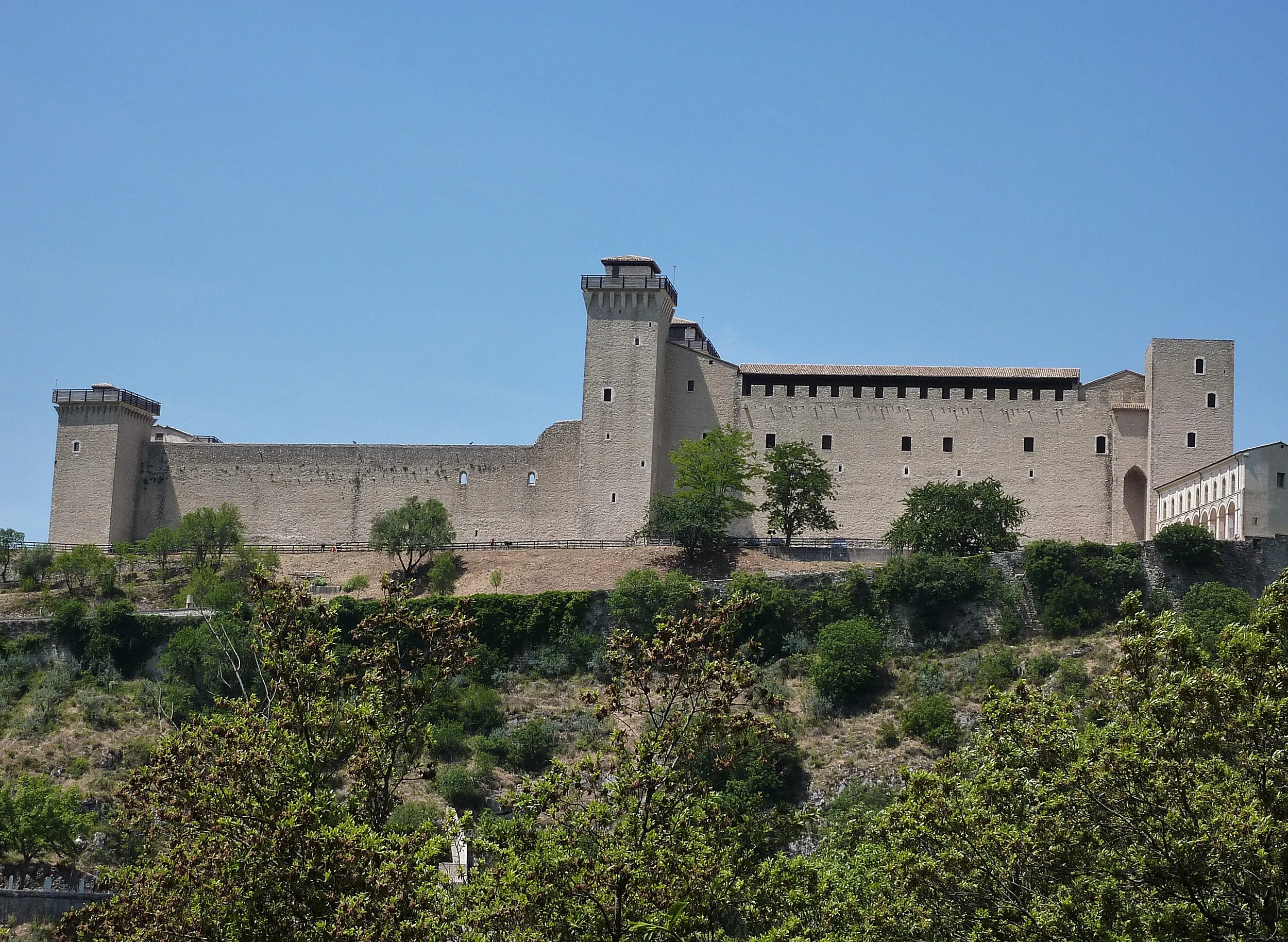
The Rocca Albornoziana of Spoleto
Between the fortress and the holy mountain, the valley is spanned by a magnificent structure, both bridge and aqueduct, impressive as the fortress, and much more beautiful. It’s a bit mysterious, too. You might think the ancient Romans built it – after all, they were aqueduct-building wizards. Many people over the years thought so. 18th-century Grand Tourists visited it, eager to see a work of the ancients. In 1786, the great German poet, Goethe, admired the “noble spirit” of this “work of antiquity”. The artist J.M.W. Turner painted it in 1840. Perhaps he was undecided; he showed the bridge enveloped in mist.
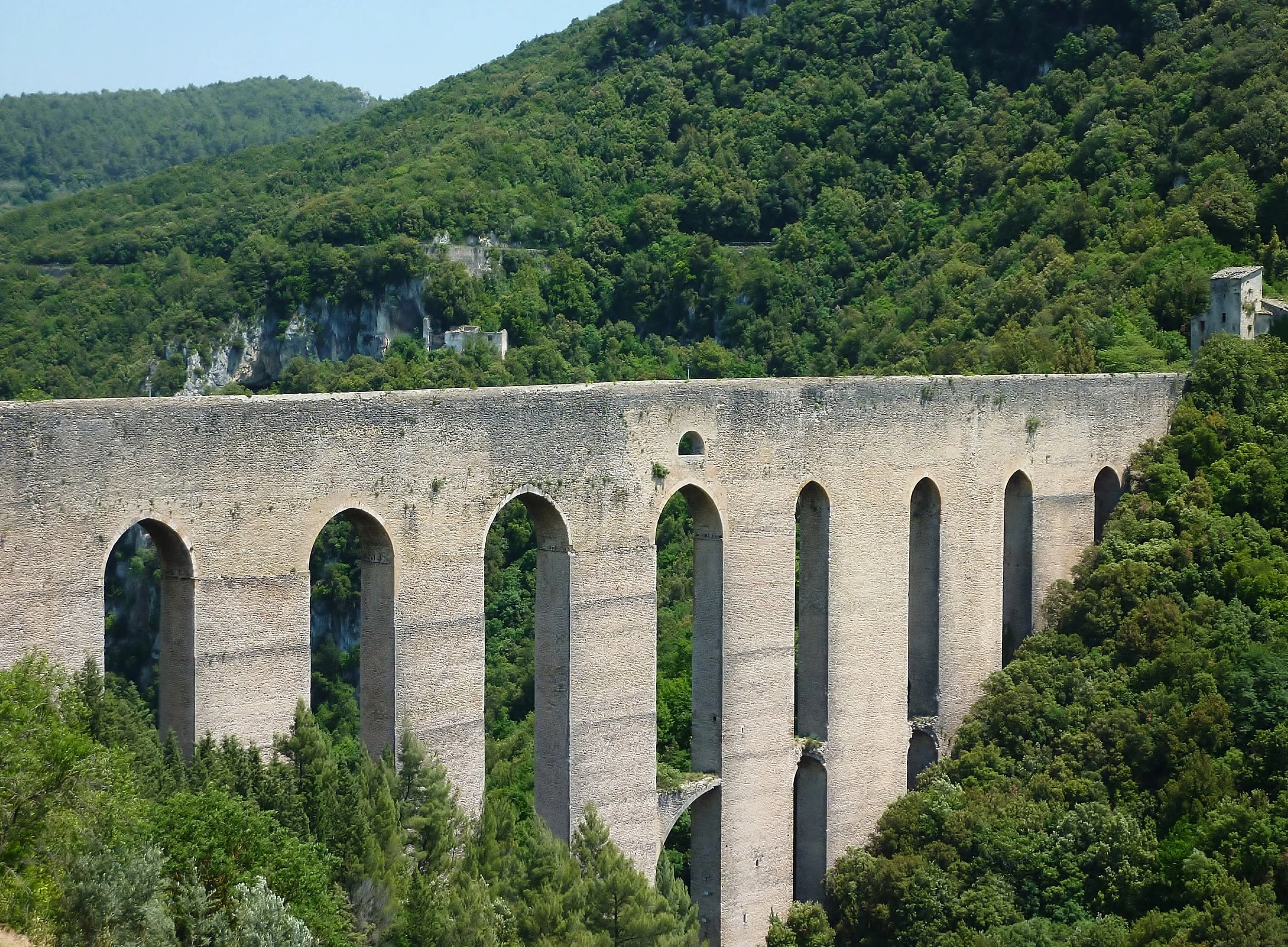
The Ponte delle Torri
Unlike the Grand Tourists, we have access to many images of Roman aqueducts, and this bridge is … different. For one thing, it is tremendously tall. At its highest point it is approximately 250 feet above the river. Of course, the Romans built aqueducts of great height, too, but usually with much shorter arches in two or more courses. The colossal piers of this bridge, and the ten graceful, narrow, pointed arches that separate them, rise dizzyingly from the very depths of the valley. The arches almost seem to be enormous lancet windows, like those in Gothic cathedrals.
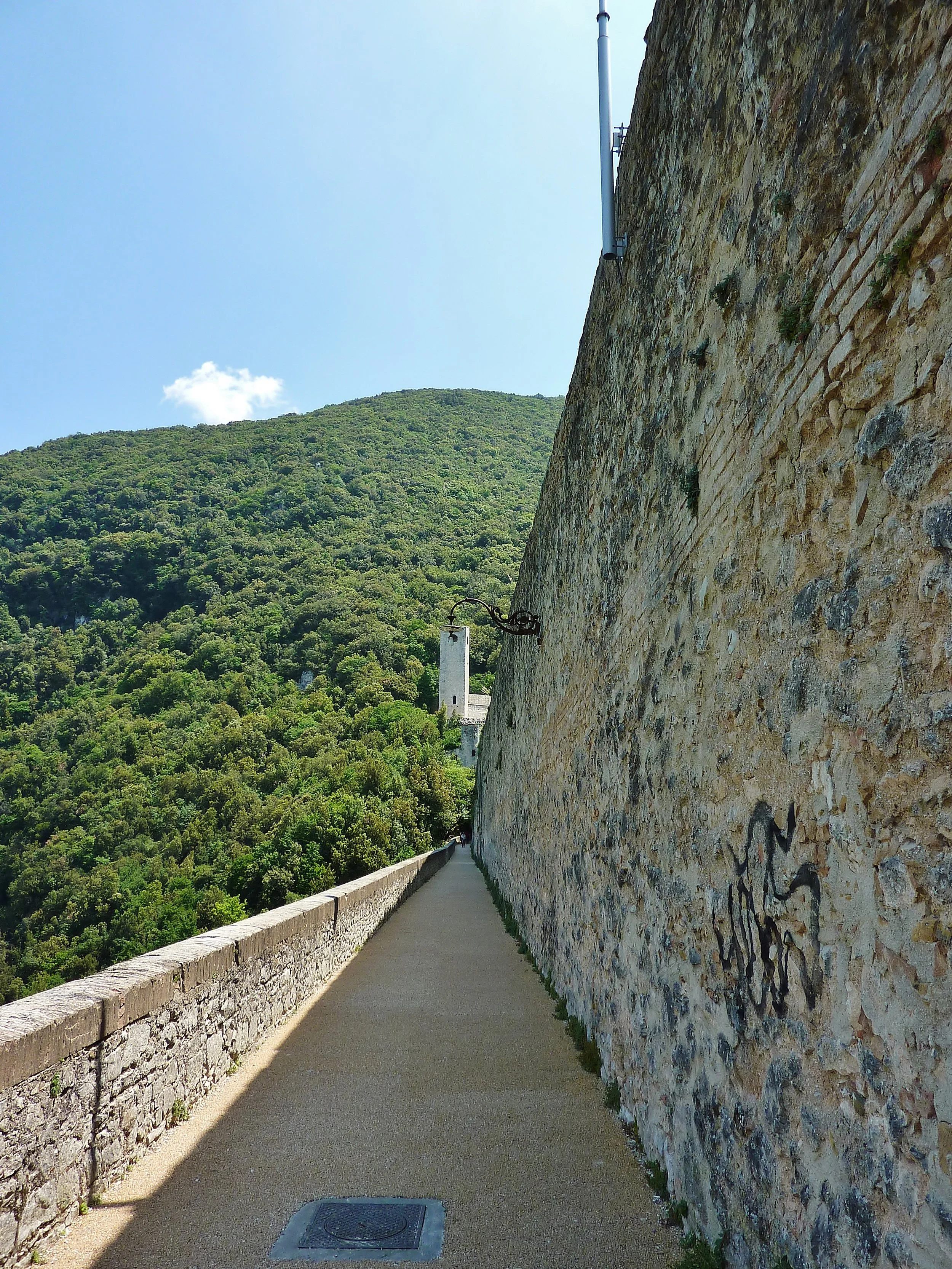
The Ponte’s walkway toward the Fortilizio dei Mulini - the aqueduct channel is above
Some say the bridge was built in the late 13th century on the remains of an older, ruined Roman aqueduct. Others assert that Gattapone, Cardinal Albornoz’ architect, built it to provide water for the fortress. But, mysteriously, while records of the Rocca’s construction survive, none do for the bridge; and it seems unlikely that Cardinal Albornoz would forget to mark the bridge with his insignia.
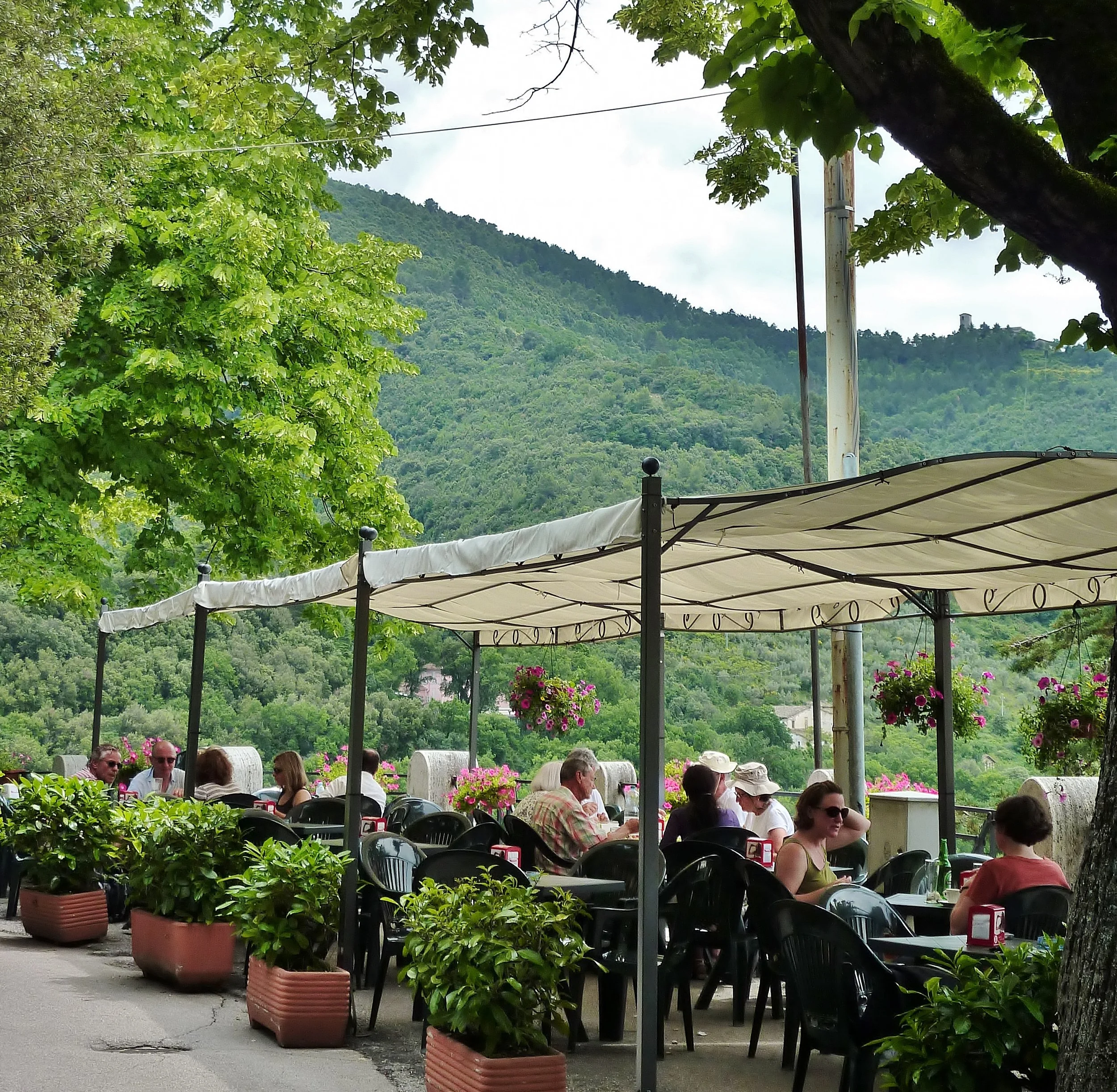
Lunch by the bridge
But the bridge is indisputably there, graceful and solid, intact despite earthquakes and the ravages of time. You can walk across it from the town, and explore the shaded pathways in Jupiter’s grove. Or on a balmy day, a pleasant café beside the valley invites you to have an alfresco lunch or drink, and contemplate another mystery: why is it called the Bridge of the Towers? After the stubby towers of the Rocca? Or the lonely watchtower of the Fortilizio dei Mulini across the valley? Perhaps the bridge builders, whoever they were, thought their soaring piers and arches were towers enough.
© Text © 2015 by Joe Gartman; Photographs © 2015 by Patricia Gartman. First published in Italia! Magazine, May 2015