In the Riddler’s House
We called at Giorgio de Chirico’s house in Rome one April afternoon. It’s in Piazza di Spagna, not far from the Spanish Steps. In the square, the Fontana della Barcaccia was being restored, hidden by a circle of plywood panels. I was disappointed because the fountain always makes me smile – it looks like Captain Nemo’s lifeboat sinking in a bathtub. The piazza seemed strangely forlorn, despite the usual crowd of tourists. Perhaps it seemed that way because I was imagining how it would look to de Chirico.
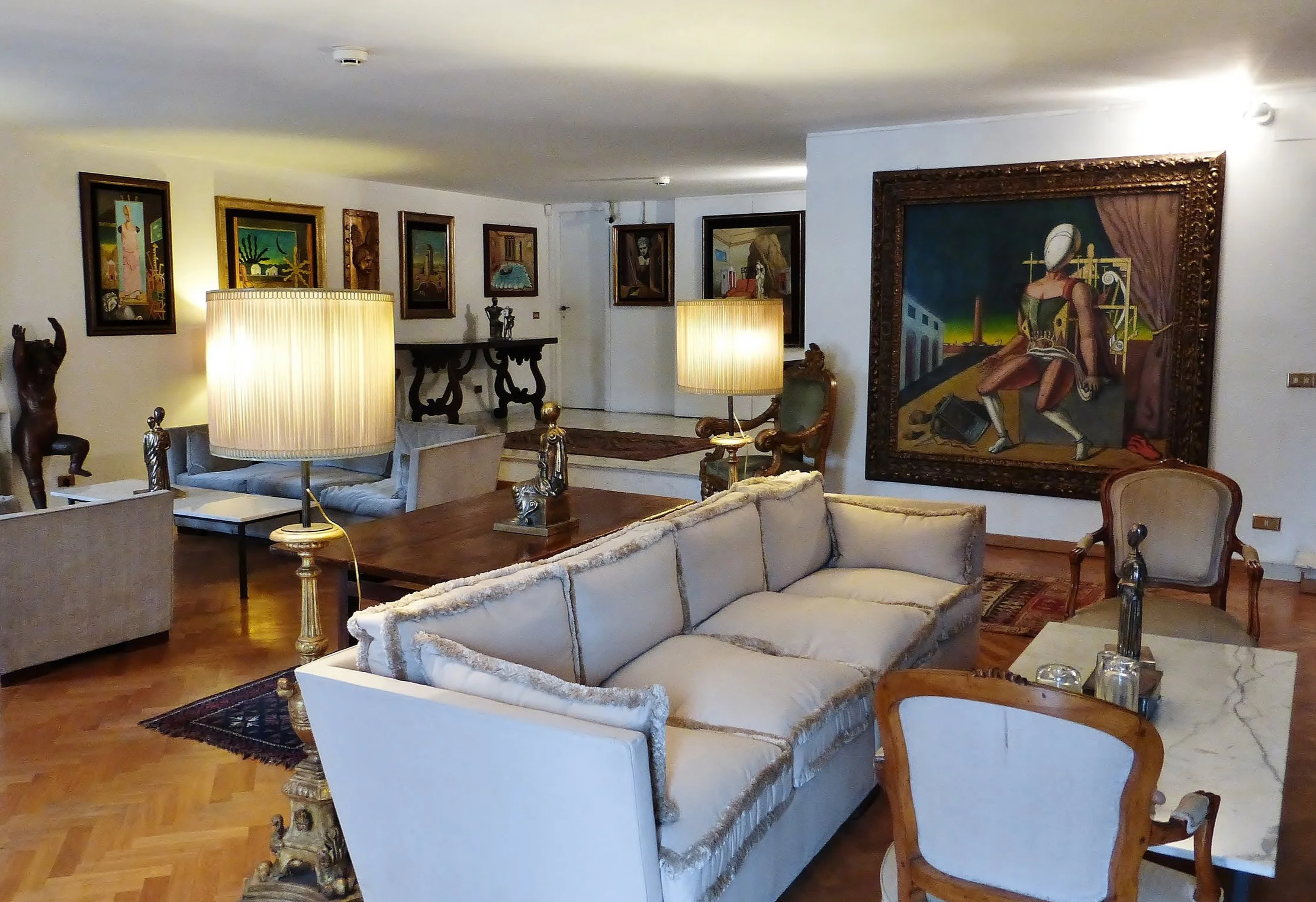
De Chirico’s apartment in Piazza di Spagna, Rome
Giorgio de Chirico was a protean painter, whose art changed greatly during his long career. He is most famous, though, for his early “metaphysical” paintings, which inspired scores of surrealists including Salvador Dali and Rene Magritte. De Chirico’s works before about 1920 are powerful and unsettling images. He often titled these paintings “Enigmas”, meaning things inexplicable and mysterious: riddles, in short. The images – long shadows across empty city squares, looming architecture, solitary, silent, faceless figures, broken statues, empty windows – all create a disturbing sense of foreboding, a feeling that we are seeing the familiar world as another reality, just beyond or beneath the everyday.

The Neometaphysical Room
De Chirico was born in 1888, in Greece. He travelled widely: Munich, where he attended the Academy of Fine Arts and also encountered the writings of Schopenhauer and Nietzsche; Milan, Turin and Florence, where he admired the art of the Renaissance; Paris, where he exhibited at the Salon des Indépendants.
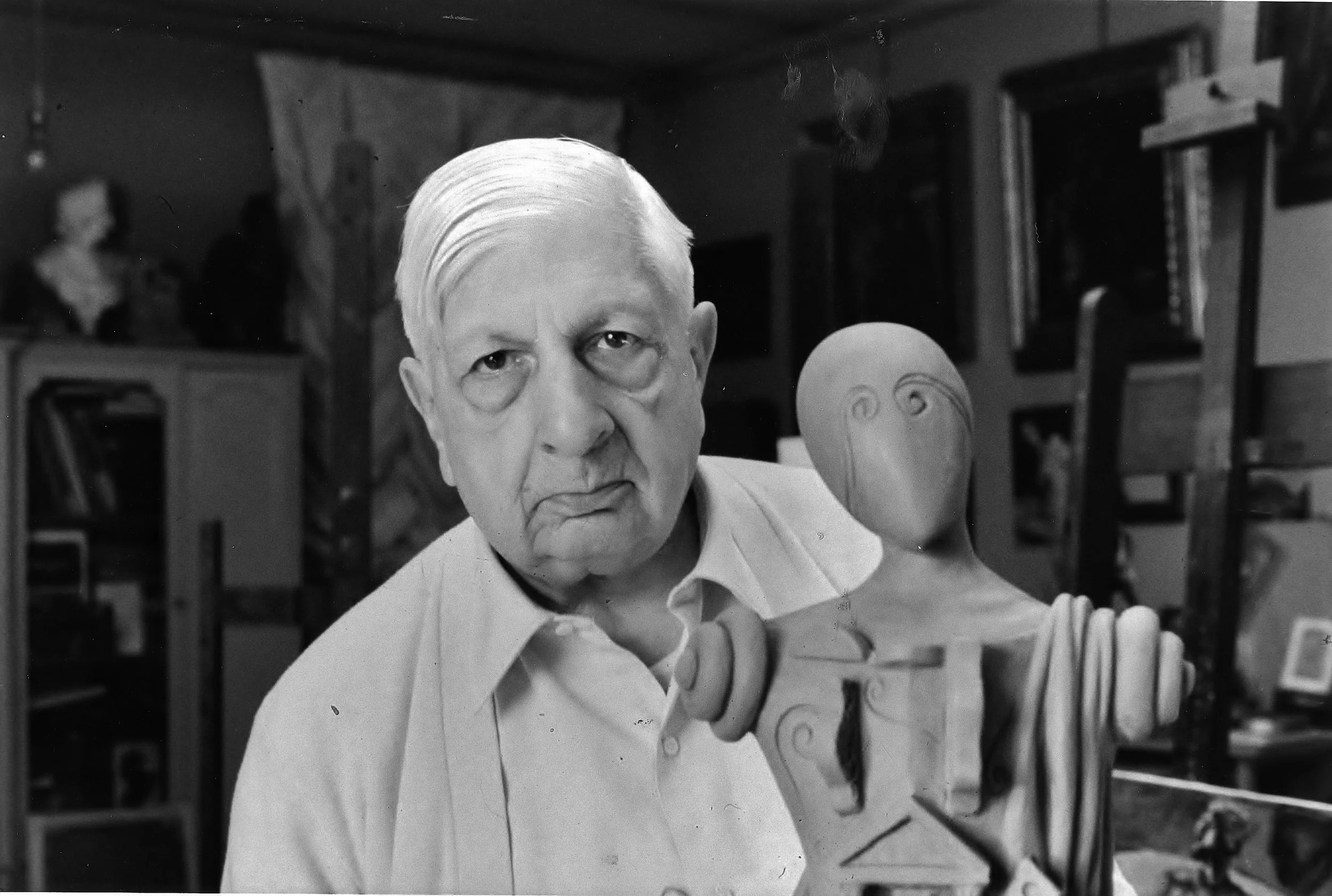
Giorgio de Chirico, with a self-portrait, perhaps?
He joined the Italian Army at the outbreak of WWI, and worked in a military hospital in Ferrara. In postwar Paris he was the darling of the modernists, including (besides Dali and Magritte), Max Ernst and Yves Tanguy. Gradually, though, something changed. He became disenchanted with modernism, and called for a return to classical artistic virtues. His paintings began to feature careful still-lifes, portraits of his beautiful second wife, Isabella Pakszwer Far, self-portraits, and other works that might seem conventional – at first glance. Critics and former followers deserted him. Perhaps to tweak his critics, or perhaps to earn money, he turned out paintings in his earliest metaphysical style, back-dated them, and put them on the market.

Autumnal Meditation, by Giorgio de Chirico, 1958/59, © José Luiz Bernardes Ribeiro CC BY-SA 4.0
De Chirico and Isabella settled in Rome in 1948, taking the top 3 floors of a 17th century palazzo at Piazza di Spagna 31; and there he lived until his death in 1978. The Fondazione Giorgio e Isa de Chirico was created by Isabella before she died in 1990, and the foundation operates the Casa-Museo de Chirico, where curious art-fanciers can see where the godfather of Surrealism lived. The beautifully maintained mid-twentieth century home is hung with works mainly from his later period. The “Neometaphysical Room” contains marvellously rendered, dream-like images painted in the last decade of his life.

Giorgio de Chirico’s studio
His studio, maintained just as he left it, is especially moving to visit. And lately his reputation seems to be as mercurial as he was. During his life, his classically inspired later works were called maudlin and saccharin. Now, some post-modern critics and artists call the same works brilliant examples of parody and irony. I think de Chirico might be pleased that he is still an enigma, and his work remains a riddle.
© Text © 2016 by Joe Gartman; Photographs © 2016 by Patricia Gartman. First published in Italia! Magazine, April 2016