The Roar of Waters
You want to rest, perhaps, on the marble bench you find beside a little stream. Beyond, high cliffs rise, veiled by green trees. But someone has carelessly thrown an old-fashioned cape over the seat, and, what’s more, left an open book next to the cape. As you approach, you realize the cape and book are illusions. They are cast bronze, with a hint of green patina. Naturally, you begin to read the exposed, somewhat weathered, pages of the book: The roar of waters! – from the headlong height Velino cleaves the wave-worn precipice …

Lord Byron’s Bench
That first line is a bit mysterious. It’s true there is a trickle of water dropping listlessly over the lip of the highest cliff, but a roar? The author’s name, engraved at the bottom, is George Gordon Byron. Well, that explains it, you think. Mere romantic exaggeration.
It’s a sunny day in May, and you notice there are people gathering in the park beside the stream: families with hampers and romping children, young couples hand-in-hand, pensioners basking at the tables fronting an open-air café. Perhaps you fancy a glass of Umbrian wine, and stroll toward the bar. Behind you, faint at first, then growing, insistent, there’s a sound. You turn. The trickle from the cliff has become a stream, which as you watch, swells to a torrent. Two lower cliffs are suddenly white with tumbling cataracts of their own. Water roars, mist rises to the sky, and a rainbow appears.
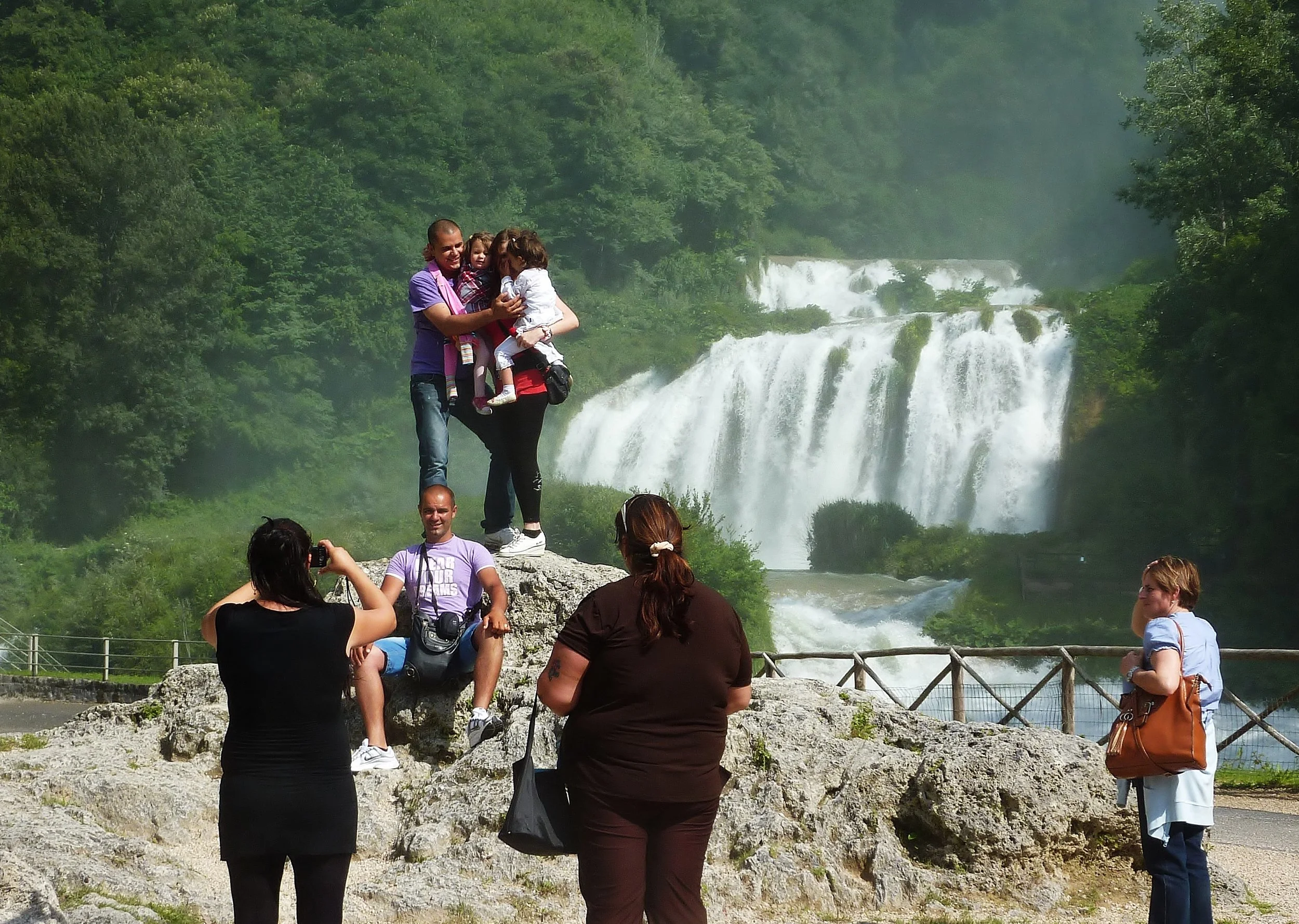
Family fun at the Cascata
Like Lord Byron, you have stumbled upon the Cascata delle Marmore, in southern Umbria, less than eight kilometres from the industrial town of Terni. In fact, Terni would not have been nearly as industrial or as prosperous as it is, without the falls, whose rushing waters historically provided power to the town’s steel plants and other works. And the Brigadoon-like appearance and disappearance of the falls is not the product of enchantment; it is the work of the operators of the Galleto power plant, which is an important producer of hydroelectric power. Since the 1920s, the waters have been diverted from their ancient course to power the plant’s generators, but twice a day (oftener on weekends) are allowed to cascade as of old, for an hour or two, to delight the park’s visitors.
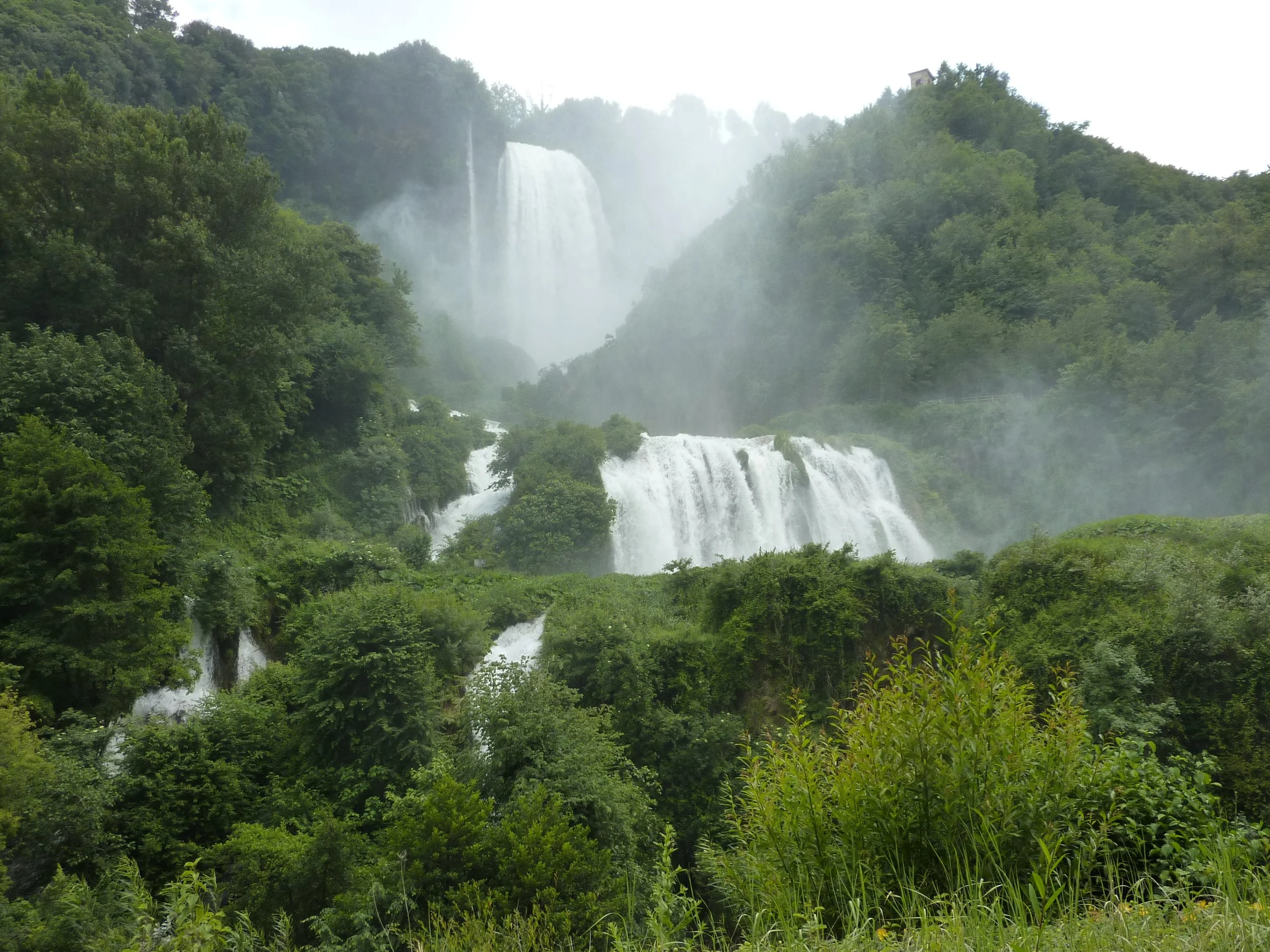
The Falls in full flow
The waters roared steadily in Byron’s time, of course. They even roared for Virgil, who also visited and wrote of them. They are the highest man-made falls in the world at 541 feet. Man-made, you exclaim – in Virgil’s time? But that was 2000 years ago!
Ah, they were clever, those Romans…
In 271 BC, three and a half centuries before the Colosseum was built, the Roman Consul Curius Dentatus ordered the River Velino’s course diverted into the valley of the Nera River, to drain a malarial wetland surrounding the town of Rieti. His engineers succeeded, and the falls plunged – with a roar – into the valley below. Unfortunately, the swollen Nera periodically caused flooding in Terni. There was even a lawsuit about it, two centuries later. (Does anything ever really change?) Cicero represented Rieti and the falls. Apparently, he won.
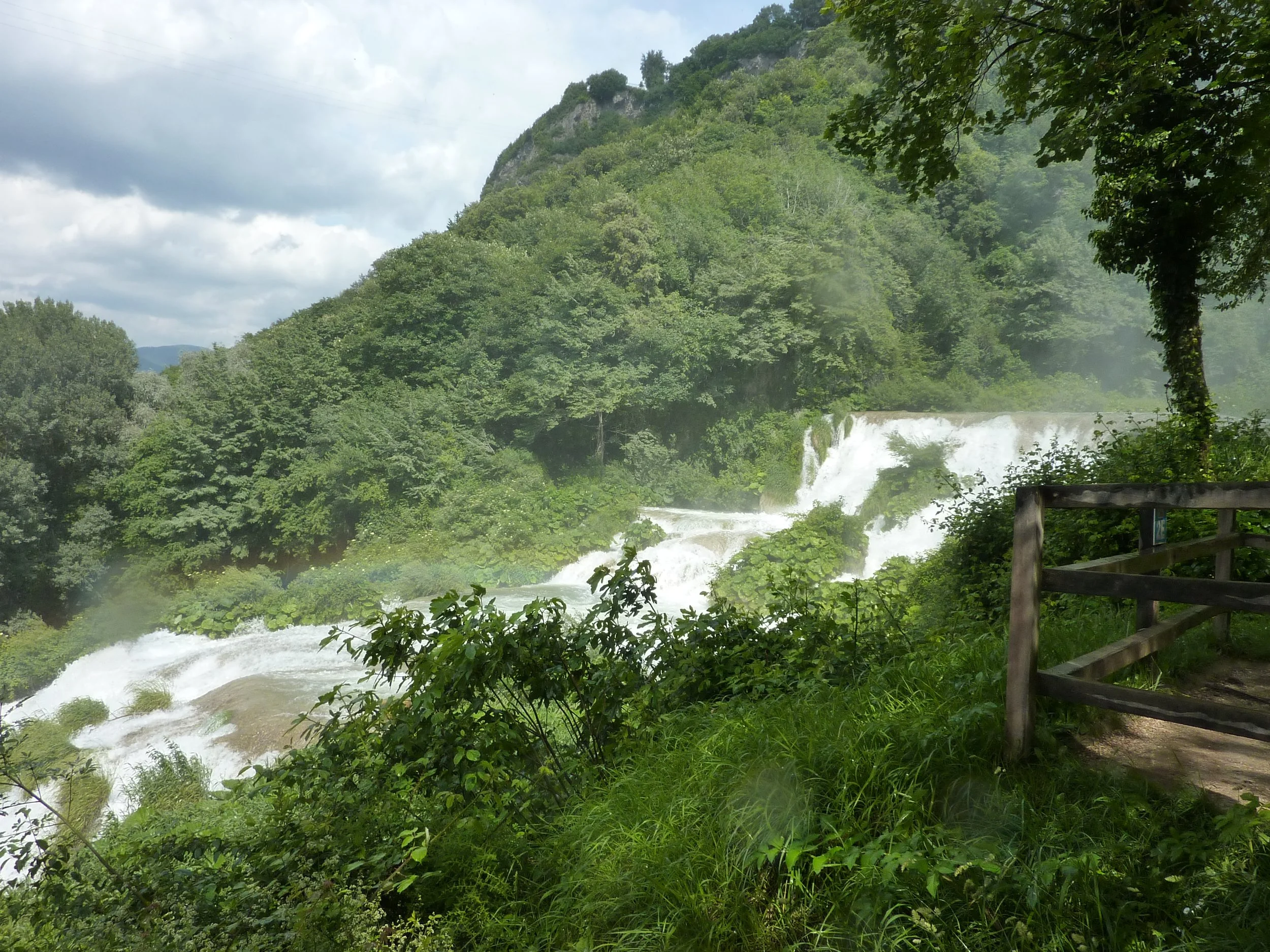
The lower reaches of the falls, as the torrent abates
© Text © 2014 by Joe Gartman; Photographs © 2014 by Patricia Gartman. First published in Italia! Magazine, December 2014