The Royal Huntsman
Years ago, at the Prado Museum in Madrid, I saw a painting of an elderly, lanky fellow wearing an ill-fitting hunting coat and a tricorn hat. He was standing in a country landscape, resting the butt of his flintlock on the ground next to a sleeping dog curled at his feet. His face was wrinkled and weather-beaten, and his nose was comically large, with a bulbous tip. He seemed to be looking directly at me with an affable, easy-going smile. I thought he looked like a local rustic out after partridges, until I noticed a silk sash under the deplorable coat.
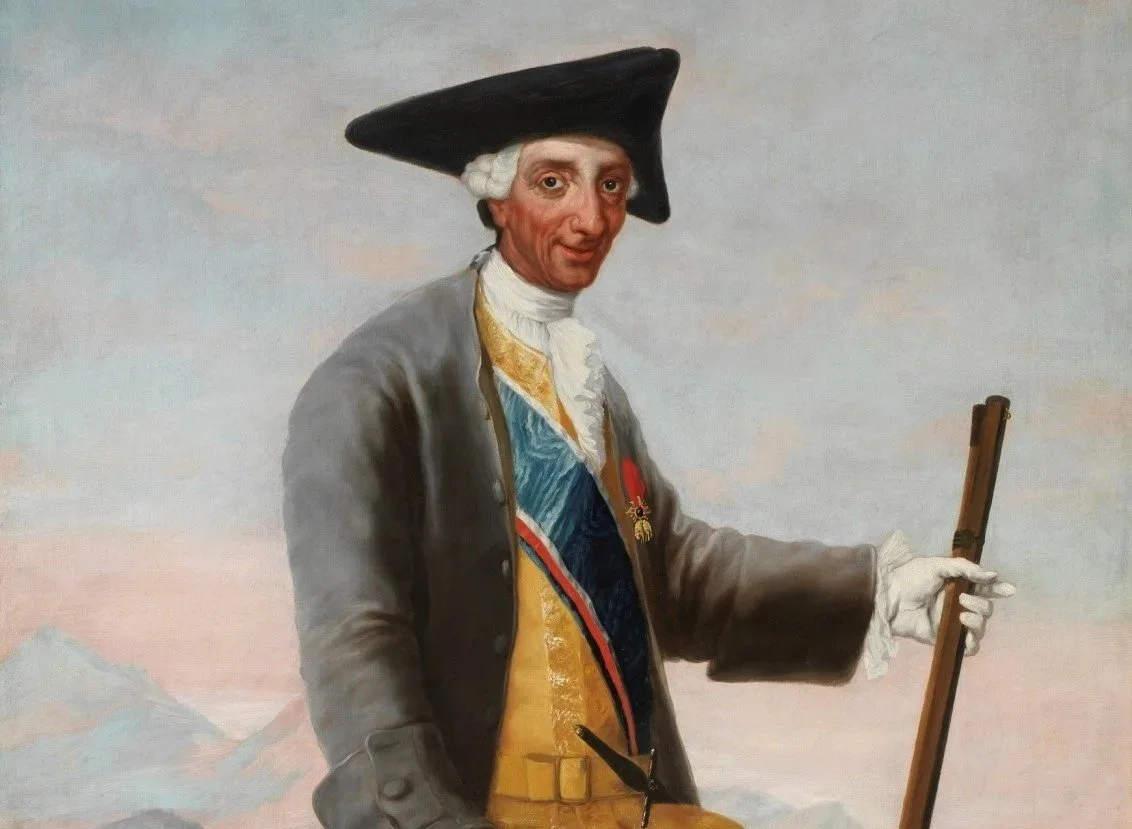
Carlos III, Rey de España
In fact, he was Charles III, King of Spain, painted by Francisco Goya. I remembered the picture as we planned a recent trip through Campania and Puglia. Since Charles had been King of Naples before inheriting the Spanish crown, I consulted a few history books.
He was the Duke of Parma in 1734 when, at the age of 19, he led a force of 40,000 soldiers borrowed from his parents, King Philip V of Spain and Queen Elisabetta Farnese, against the Austrian rulers of the kingdoms of both Naples and Sicily, and won. I’ll spare you the details, but he became King Charles VII of Naples and Charles III of Sicily.
He proved to be a prodigious builder. Besides many public works, by 1738 he had also commissioned the creation of the Teatro San Carlo and the Royal Palace of Capodimonte in Naples, as well as the Royal Palace in Portici. He soon acquired a wife, as well: Maria Amalia, daughter of the Elector of Saxony. Elisabetta Farnese made the arrangements. They were married by proxy before they ever met, but it was a happy union, despite his unfortunate nose. She learned to ride and hunt with him, and, once she had borne him a male heir, he appointed her to his council of state.

Maria Amalia, Reina de España
Our trip included Caserta, to see Charles’ most monumental and most daring project: a new Royal Palace and city, in which, like Louis XIV’s Palace of Versailles, all the functions of government could be housed, and where his court would be more secure from naval attack than in Naples, and safer from a catastrophic eruption of Vesuvius as well. (The Portici Palace sat atop the pyroclastic flow that buried Herculaneum.)
Fron the train station’s exit, you can’t miss the Royal Palace, looming 400 metres away, with a façade 5 stories high and 250 meters wide: the Reggia of Caserta, the largest Royal Palace in the world, bigger than Versailles. The main building is 120,000 square metres, with 1200 rooms, 1026 chimneys, and over 1700 windows, all in the finest of late baroque design by Luigi Vanvitelli, the most famous architect in Italy. I haven’t room to do it justice – you’ll have to see it yourself.
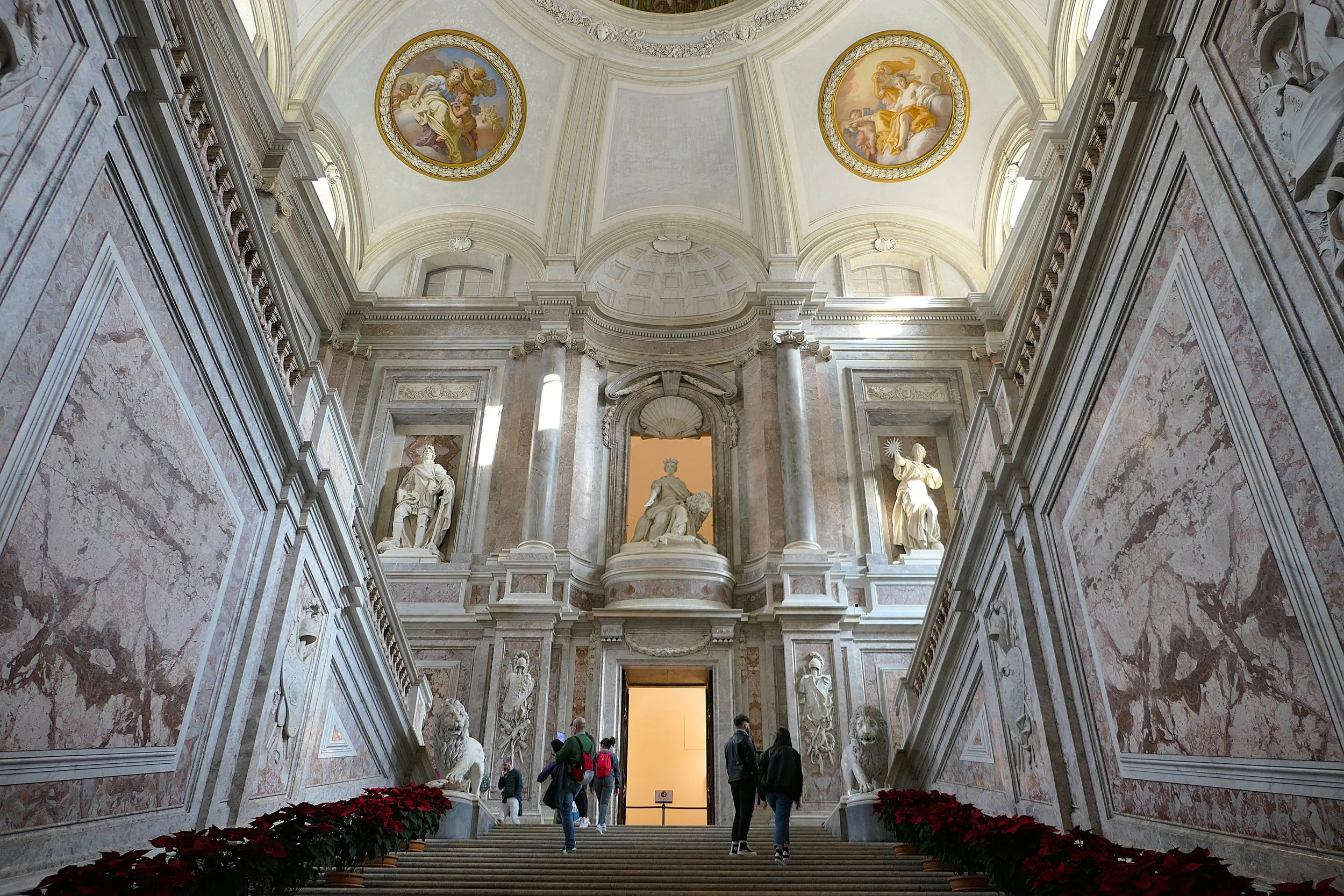
Staircase from the ground-floor promenade to the Royal Apartments in the Reggia di Caserta
But Charles didn’t commission a mere palace from Vanvitelli. He wanted a new city at Caserta, based upon Enlightenment principles; and to provide the city, the palace, and its gardens with plentiful water, Vanvitelli created a new aqueduct to carry water from springs 38 kilometres east of Caserta, to the palace gardens, from which it would be distributed as required. In the process Vanvitelli constructed a spectacular aqueduct bridge, the Ponti della Valle, across the Maddaloni Valley. Today, the water still cascades down the slope of a small hill, into the gardens, feeding a long flowing avenue with fountains, pools, and monumental sculpture, that descends through the palace gardens, 3 kilometres long, toward the palace. It’s called the Via d’Acqua. We took a little shuttle bus to the top.
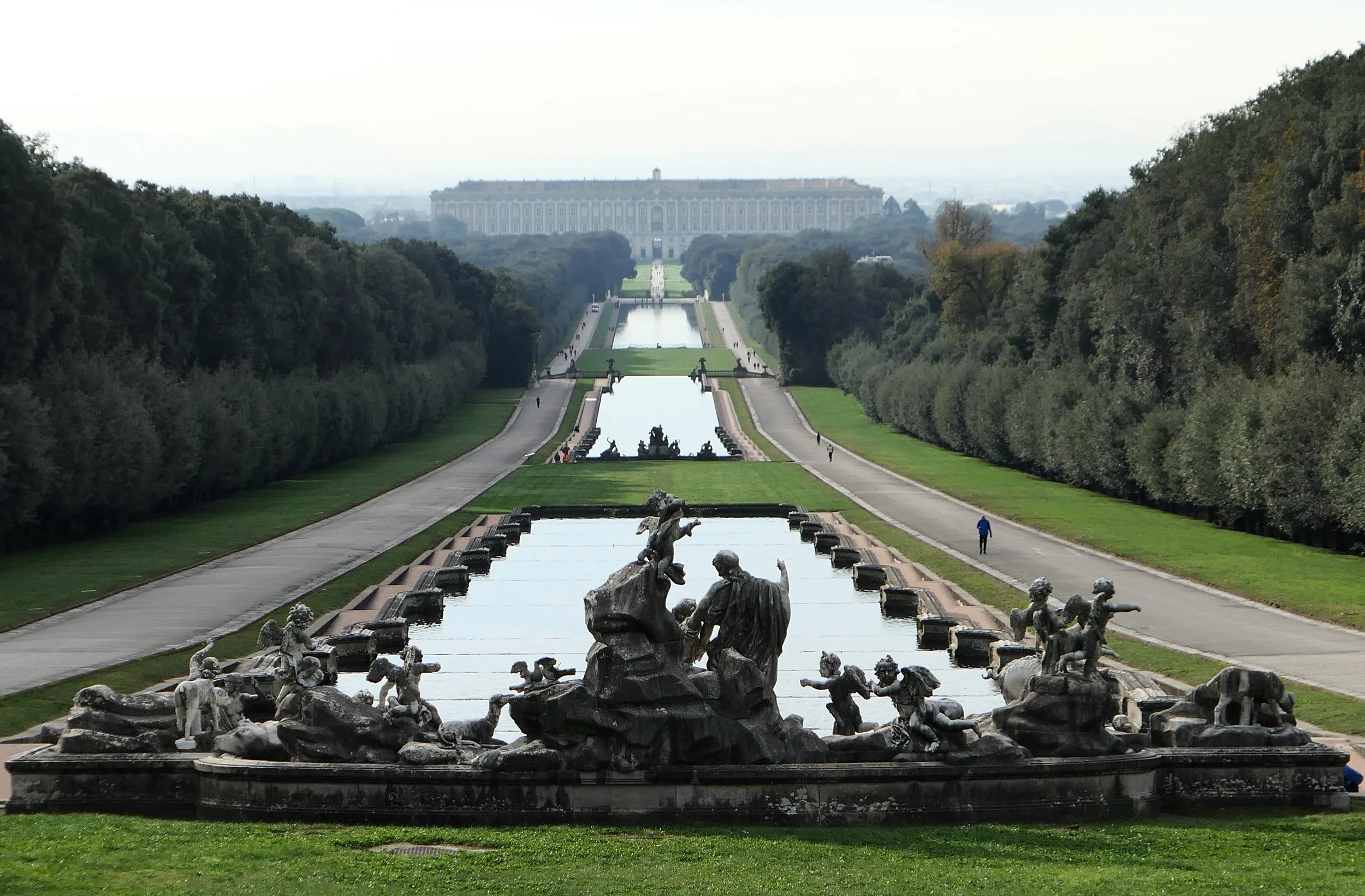
View of the Reggia from midway up the Via d’Acqua in the Palace gardens
From there, the faraway Reggia was so small, at the bottom of the vast palace gardens, that I could blot it out of sight with my hand, and I wondered at the hubris of making a royal garden so huge that the royal palace is lost in it.
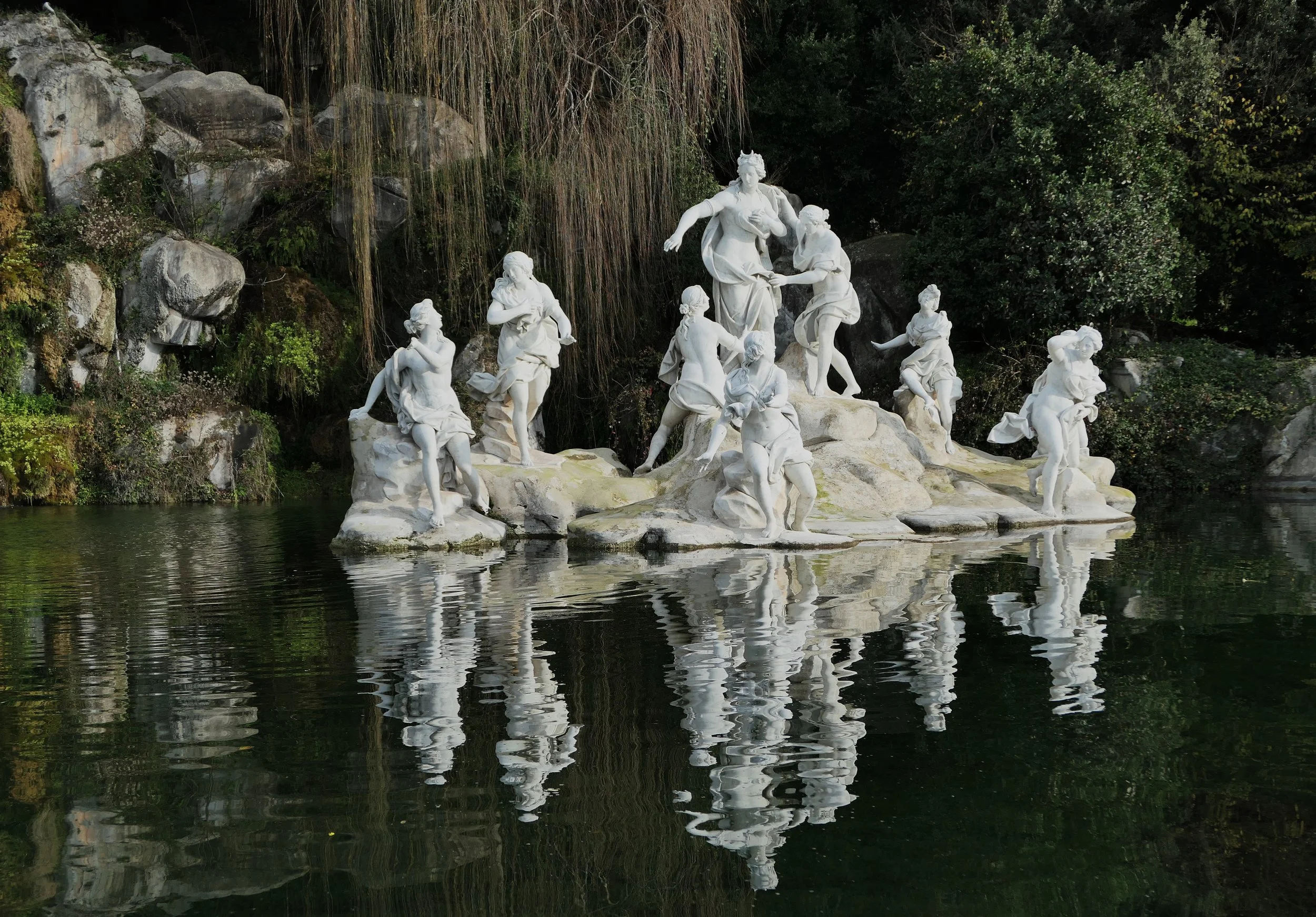
Diana and her attendants surprised while bathing
The waterfall feeds the first of the Via d’Acqua’s fountains, filling a shaded pool. Two marble “islands” in the pool support a life-size sculptural retelling of the story, from Ovid, of the goddess Diana, bathing with her retinue in the pool. The unfortunate young hunter, Acteon, who accidently stumbled upon the scene, is shone already partially transformed into a stag, being devoured by his own dogs, as punishment for gazing upon the goddess, and I wondered at the hubris of bathing goddesses.
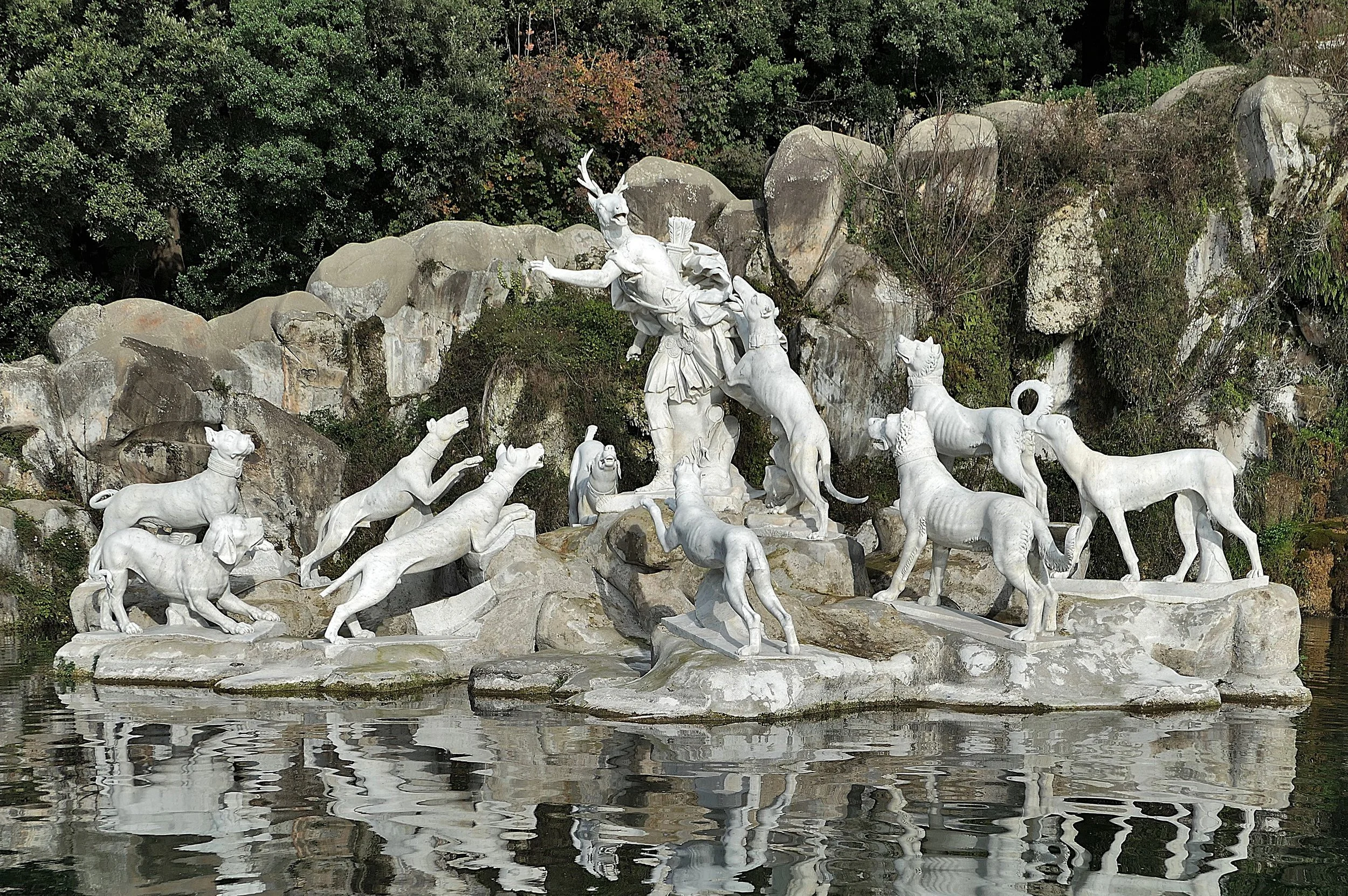
Acteon partially transformed into a stag, attacked by his own dogs
At the next pool, Venus is imploring her own handsome hunter, Adonis, not to go hunting, because she’d dreamed of his death the night before. A wild boar with fearsome tusks hints at the outcome, and I wondered whether Maria Amalia ever lost sleep over Charles’ bold plans.
We soon reached another fountain, which stretched across a wide pond representing the Aeolian Sea. Here, in a scene from Virgil’s Aenid, Aeolus, god of the Winds, tries to destroy the Trojan ships as Aeneas attempts to reach Italy and found Rome. Further on, we passed a fountain in which marble dolphins with absurdly gaping mouths discharge floods of water, but I was still musing upon the fact that Charles never built his new, enlightened city, nor spent a single night in the Reggia. He inherited the throne of Spain from his half-brother in 1759, and abdicated the thrones of Naples and Sicily to his son, Ferdinand IV. In 1766 his beloved Maria Amalia died. Charles lived 22 more years.
Ferdinand never completed his father’s grand plans for Caserta, as the Age of Enlightenment darkened into the French Revolution and the Napoleonic wars. Still, the chap in Goya’s portrait seems oddly cheerful. Perhaps Charles had a partridge in that game bag on his hip.
© Text © 2025 by Joe Gartman; Photographs © 2025 by Patricia Gartman. First published in Italia! Magazine, June/July 2025