When the Statues Spoke
There is a battered and broken statue in a little square not far from Piazza Navona, in Rome. Although the statue probably once depicted Menelaus (of Trojan War fame), today it is just an armless figure with an unrecognizably weathered face. It’s likely a Greek work from the 3rd century BC, unearthed in the 15th century near where it now stands.
Since the local citizens soon gave the figure a name – Pasquino – and a personality, I think I should now refer to the statue as “he”. It’s said that he was named after a neighbourhood barber (or perhaps a tailor), who was often called to the Vatican to adjust the tonsures or robes of highly-placed clerics there. Back home, he regaled his friends with gossip about the foibles of the high and mighty.

Pasquino
In the early 16th century, Cardinal Carafa celebrated St. Mark’s feast day by decorating Pasquino with Latin epigrams. No doubt he regretted it later, because local Roman cittadini took his whimsical notion as a cue to decorate Pasquino year-round with poems, doggerel, puns, and scurrilous insults, mostly directed at the Cardinal’s colleagues. The messages were passed around, copied, and hugely enjoyed all over Rome.
It was Pasquino who suggested that Pope Alexander VI’s mistress, the beautiful Giulia Farnese, should be called “the Bride of Christ.” Another Pope was rumoured (falsely) to have fathered a dozen natural children. Pasquino suggested that he should be honoured as “the Father of his Nation”. And, of Pius V, whose Inquisition fiercely punished accused heretics, Pasquino remarked: “Pius burns Christians like wood, as if it were winter, to get used to the fires of hell.”

Marforio
Of course, Pasquino’s barbs annoyed their powerful victims, and a guard was posted in Pasquino’s piazza. Naturally, other statues were soon decorated with impertinent epigrams. One of them was Marforio, a giant reclining marble figure of a river god. He is ancient, like Pasquino, but in much better repair. You can find him nowadays in Palazzo Nuovo, one of the Capitoline Museums, but he takes his name from the temple of Mars in the Forum of Augustus, where, as befits a river god, he poured water into a basin until 1588.
After the authorities realized the futility of guarding all the statues in Rome, Marforio and Pasquino became famous conversationalists. During Napoleon’s occupation of Rome, when Roman art was being sent to Paris by the shipload, they had this exchange: Pasquino, tutti I francesi sono ladri! (“Pasquino, all the French are thieves!”) Non tutti, Marforio, ma buona parte. (“Not all, Marforio, but a good part” – a pun on Napoleon’s surname.)
In time, Pasquino’s barbs inspired a new word for anonymous satirical lampoons: pasquinades.

Babuino
There are four other statues that were part of the “congress of wits”, as the talking statues of Rome were called. One, like Marforio, presides over a fountain. He’s called Babuino – “baboon” – because he’s not particularly attractive. But for centuries, well loved by his neighbours, he reclined at ease beside the street named for him, Via Babuino. He mysteriously disappeared in 1870. Hidden away in nearby Palazzo Cerasi, he didn’t return until 1927. He is actually an ancient statue of Silenus, a famously drunken companion of Dionysus.
Abbot Luigi is a dignified fellow, dressed in a toga. He was found near the Theatre of Pompey, and dates to the 1st century BC. Today he stands in Piazza Vidoni, beside the Basilica di Sant'Andrea della Valle, the setting for part of Puccini’s Tosca. Besides hanging salty sayings around Luigi’s neck, Romans have long delighted in stealing his head. On one such occasion, his placard (loosely translated) said: “Whoever it was took my head, better bring it back quick, or they’ll make me part of the government!”

Abbot Luigi
Another talking statue – actually a small fountain – is Il Facchino, “the Porter”. Snugly fitted into a wall niche, in Via Lata, just off Via del Corso, he carries a small cask from which water spouts into a basin. He’s a humble fellow, wearing a peasant cap and an open-collared shirt. Although he’s the youngest of the talking statues, carved in 1580, his face is largely worn away; and he actually represents a water-seller from the years before the Roman aqueducts were restored in the 15th century.

Facchino
Madama Lucrezia is the only female member of the “Congress of Wits”. She’s the top half of a colossal statue of an Egyptian goddess, first excavated near the Pantheon. Now, though, from her perch in Piazza di San Marco, she has a splendid view of the Victor Emmanuel II Monument. She’s named for a previous owner, Lucrezia D’Alagna, mistress of the King of Naples.
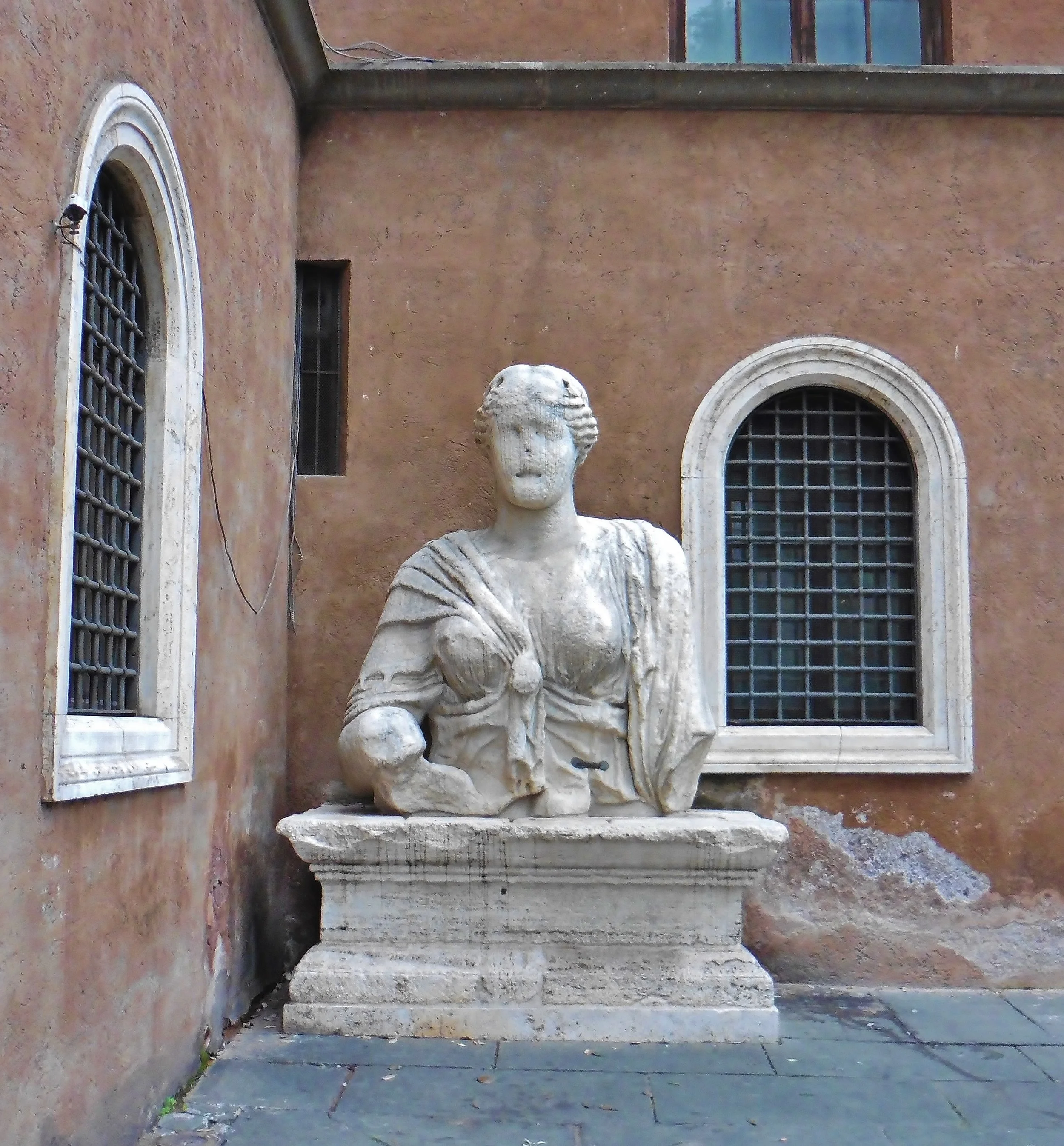
Madama Lucrezia
In the early 17th century, Pope Urban VIII (Maffeo Barberini) had 200 tons of bronze removed from the porch of the Pantheon, either for cannon or Bernini’s Baldocchino in St. Peter’s (the huge bronze canopy over Peter’s tomb). This inspired Lucrezia or perhaps Pasquino (sources differ) to immortalize such shameful vandalism with the most famous pasquinade of all:
Quod non fecerunt barbari fecerunt Barberini – “What the Barbarians didn't do the Barberini did".
© Text © 2017by Joe Gartman; Photographs © 2017 by Patricia Gartman. First published in Italia! Magazine, April 2017