Trading Up
You know, of course, that St. Mark the Evangelist is the patron saint of Venice, and has been since 828, when two Venetian merchants stole his body from the Sanctuary of Alexandria, smuggled him aboard a waiting ship (in a wicker basket covered with salted pork, to confound the Muslim customs officials), and brought him to Venice. But, you may ask, didn’t Venice already have a patron saint before these pious burglars showed up with Mark’s body?
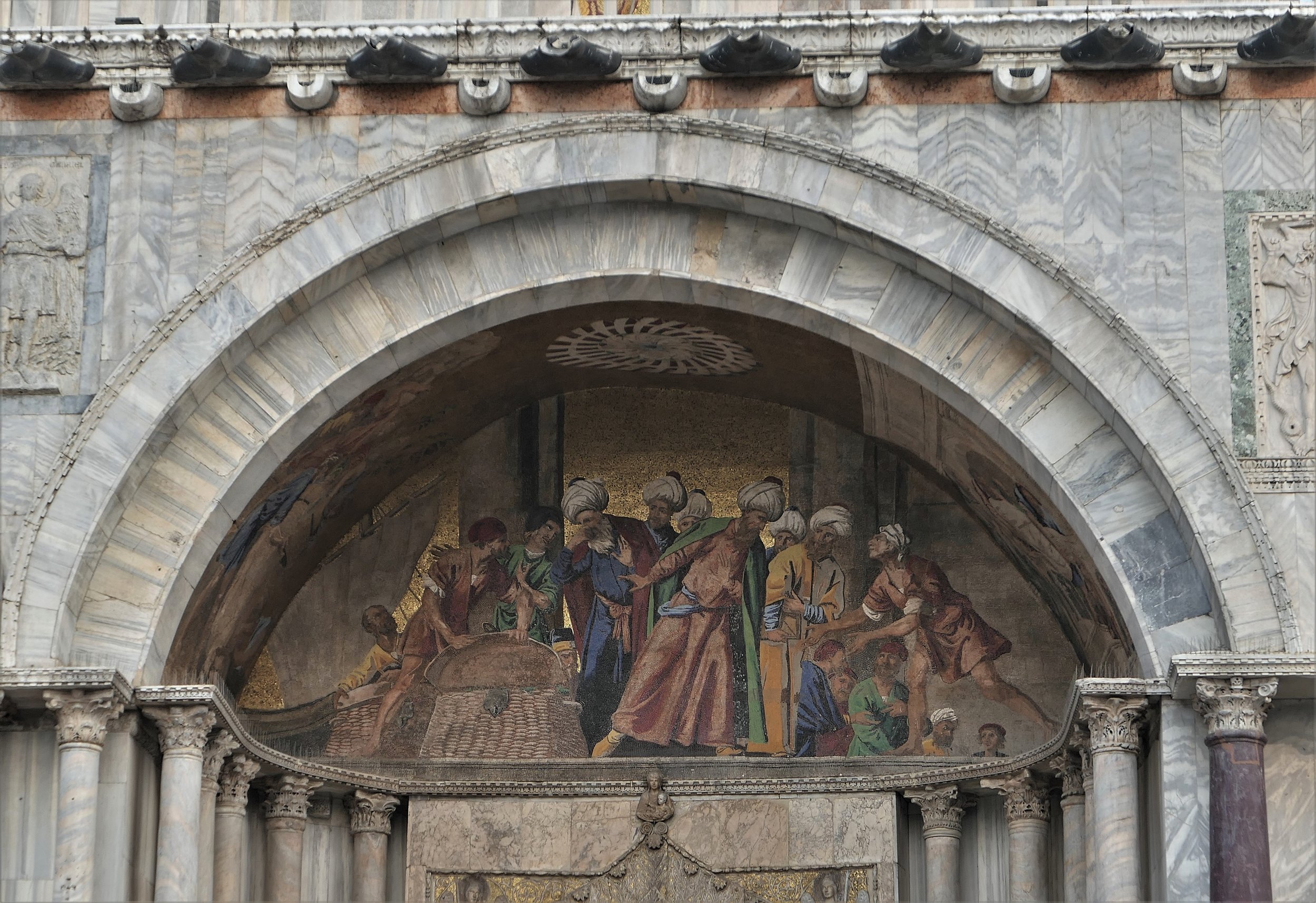
Lunette over an entrance to St. Mark’s Basilica, showing the smuggling of St. Mark’s out of Alexandria
The answer is yes; and next time you come to Venice, you can meet him in person. No doubt you’ll visit the Doge’s Palace. After entering, you’ll soon find yourself in the palace courtyard. At one end you’ll see a fantasy of spires, arches, statues, and a clock – the so-called “Foscari Portico” – with the tops of the Basilica’s domes beyond. To the right of the Portico, you’ll see a staircase ascending to a second balcony, or loggia; it’s the famous “Giants’ Staircase”, so named because the stairs are flanked by monumental statues of Neptune and Mars.
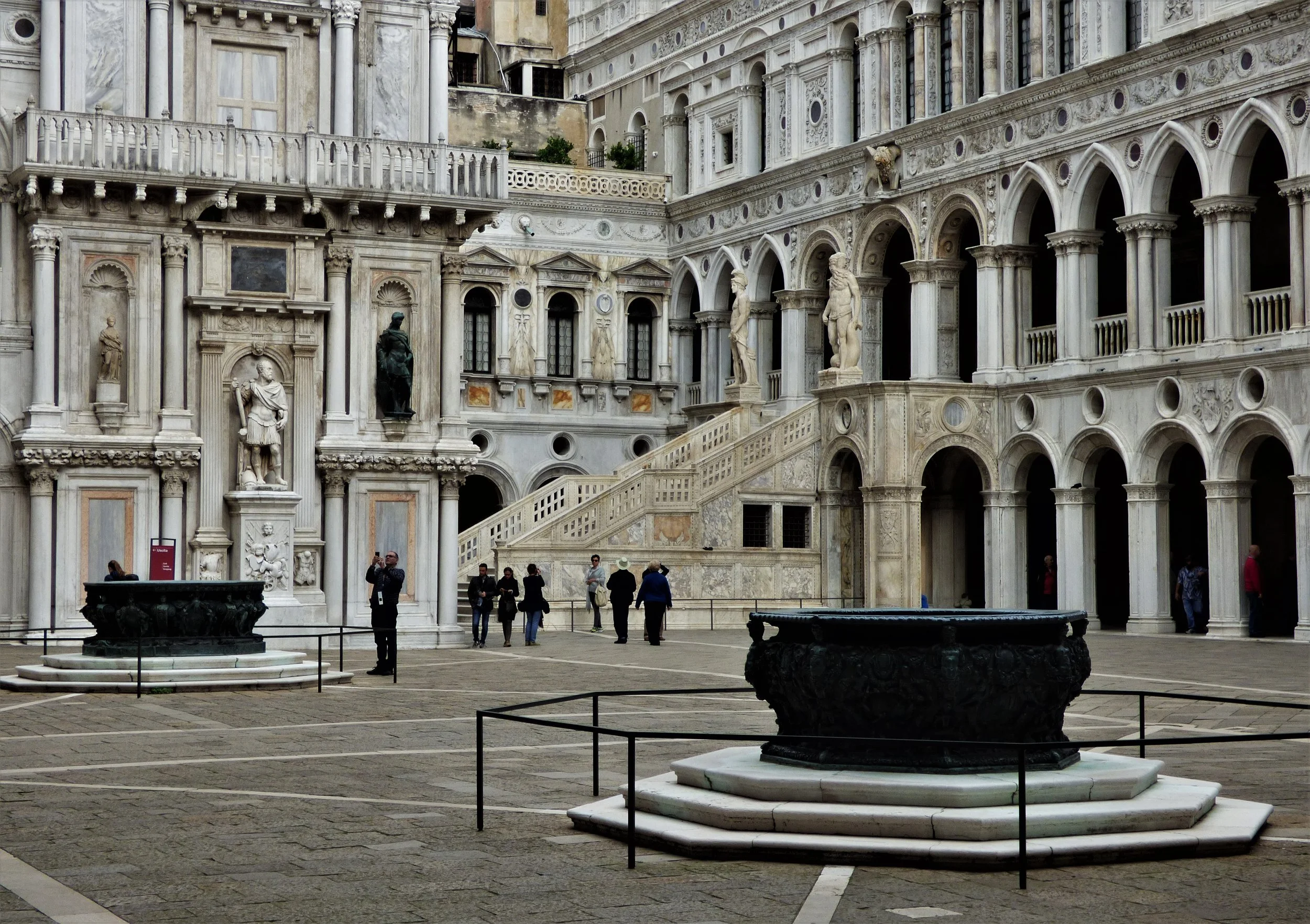
The Foscari Portico, with the Giant’s Staircase to the right
Make your way between the end of the Foscari Portico and the Giants’ Staircase. Beyond the staircase, beneath the vaulted ceiling of a ground-floor loggia, you’ll find a military-looking gent fashioned of several mis-matched pieces of marble. He’s wearing a rusty iron sword on his hip and a rusty iron halo on his head, and he holds a long spear with one hand and a shield with the other. And he’s standing on a very discouraged-looking marble crocodile. Meet St. Theodore, or, in Venetian, San Todaro.
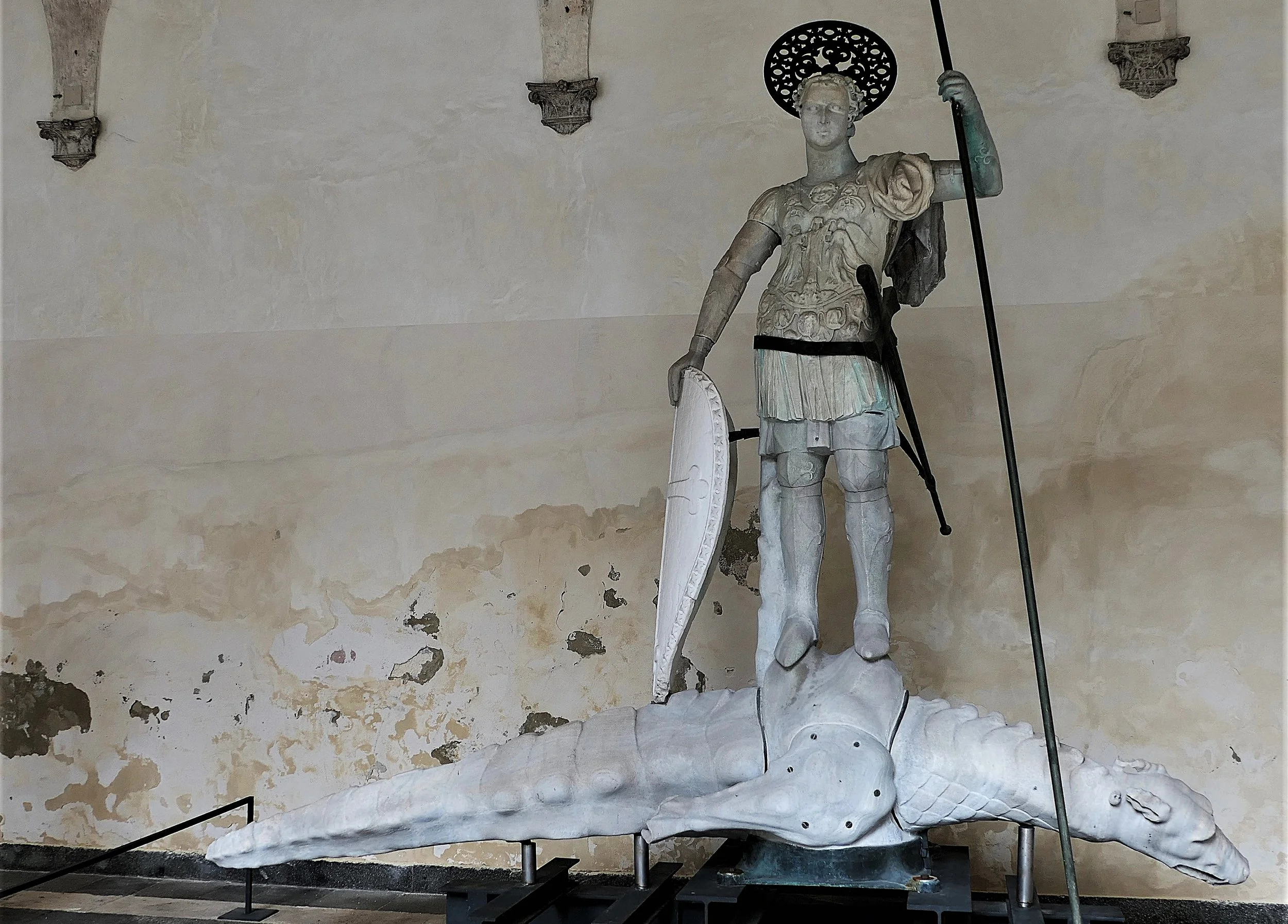
St. Theodore (San Todaro) - the Original
I must admit the first time I encountered him, I was perplexed. Both he and the crocodile looked so forlorn and neglected, I assumed they were forgotten architectural bric-a-brac stored for convenience in an out-of-the-way spot. And then I suddenly realized I’d seen this sculptural ensemble before, but at a distance – on the top of a granite column at the end of the Piazzetta. (The soldier and the crocodile atop the column are replicas; the originals, from the 12th century, are tucked away here, behind the stairs.)

The Columns on the Piazzetta, with San Giorgio on its foggy island in the Lagoon
The Piazzetta, of course, is that narrow extension of Piazza San Marco that ends at the lagoon edge. There are two columns at the end of the Piazzetta, in fact: one on either side. The one on the left as you face the water is topped with a bronze, winged lion. The winged lion is an attribute of St. Mark, and, of course, the time-honoured symbol of Venice; though this particular lion is even older than the city itself. He’s undoubtedly part of Venice’s vast wartime plunder, and probably once decorated a temple to the pagan god Sardon in the ancient city of Tarsus, (in today’s southern Turkey) around 300 BC.
So, who was St. Theodore? Why was he demoted in favour of St. Mark? And why is he surveying Venice from such a lofty perch?
St. Theodore’s identity is a complex subject. There was a St. Theodore Tiro, who, as a new recruit in the Roman army back in the late 3rd or early 4th century, refused to worship Roman gods. According to the legend, his commander, who didn’t want to lose a promising soldier, told him to take a few days to think things over. Theodore promptly went into a nearby town, Amasea, (also in today’s Turkey, near the Black Sea) and burned down the Temple of Cybele. He was punished by being tossed into a furnace, and quickly became a popular martyr. About this time, another soldier, Theodore Stratelates (Theodore the General), was martyred. He notched some impressive miracles, too, perhaps including killing a dragon, (some stories speak of a water-dragon!) before he was beheaded by the Emperor Licinius. Over time, their legends merged, so I can’t tell you which St. Theodore became San Todaro.

Doge Francesco Foscari & another version of the Winged Lion, above the entrance of the Foscari Portico
Despite Theodore’s many virtues, when Mark’s relics reached the city, the 9th century Venetians could hardly ignore the benefits of trading up from St. Theodore to St. Mark. Venice had only recently cast off Byzantine rule, and the Venetians were uncomfortable with Theodore’s great popularity in the Eastern Orthodox Church, the state religion of Byzantium. By contrast, Mark was St. Peter’s disciple, and St. Peter, of course, was the first Roman Catholic Pope. So, choosing St. Mark as the city’s patron emphasized Venice’s liberation from Byzantium and closer ties to the Roman Church. Besides, Mark the Evangelist was venerated throughout the Christian world; his patronage sent the city’s prestige soaring. His relics, housed in a new church – which eventually became St. Mark’s Basilica – attracted pilgrims by the thousands – pious tourists, with money to spend.
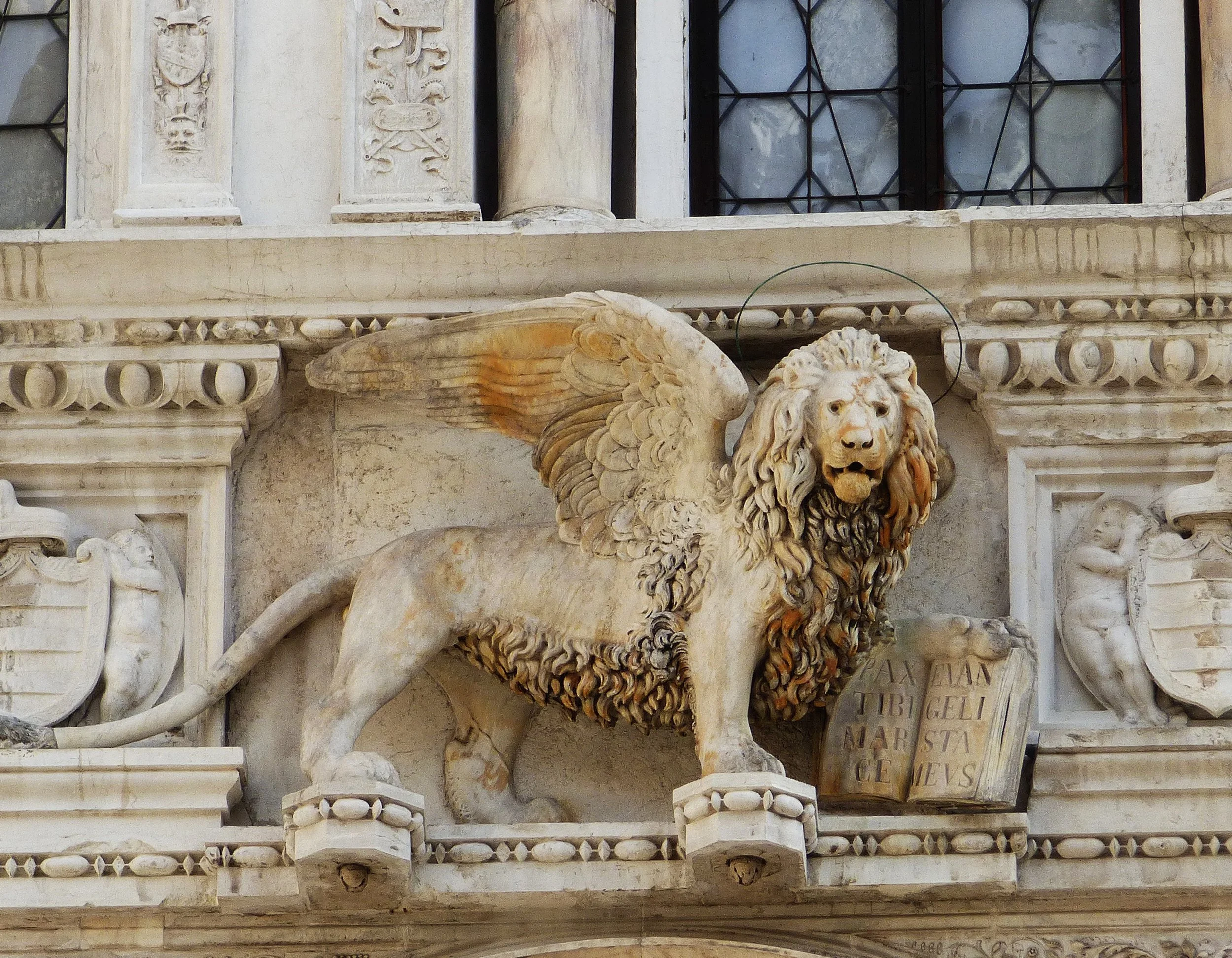
Pax Tibi Marce Evangelista Meus - “Peace be with you, Mark, my Evangelist”
And Venice, now independent, skilfully leveraged its new affluence, building a great fleet of the finest ships, both mercantile and military. With them, the city became, over time, the most successful maritime trading nation in Europe, and a model of stable republican government.
Why is St. Theodore’s statue, or at least its replica, still atop his column after all this time, crocodile and all? Because, in truth, despite all the theological quibbling, he never ceased being Venice’s protector, whether official or not. St. Mark’s eminence overshadowed him, of course, but Venice didn’t forget him. He is still Il Primo Patrono, who saw the city through its dangerous youth. So, when the two columns arrived as booty from the east, the Venetians placed Mark’s lion atop one, and San Todaro, the faithful watchman, atop the other.
© Text © 2025 by Joe Gartman; Photographs © 2025 by Patricia Gartman. First published in Italia! Magazine, October/November 2025