The View from the Rocca
There’s a small town in the very centre of Italy, perched on the top of a rocky hill and overlooked by a great 14th century fortress. It has splendid views, well-preserved medieval houses, cobbled streets, and a historic past; and although it provided the name for a series of best-selling fantasy novels, several television programs, and a film trilogy, it has relatively few tourists.
Umbria, as you no doubt know, is studded with picturesque hill towns, and a few of them are particularly, and rightly, celebrated. Assisi, for example, contains the great, art-filled Basilica named for its native son, St. Francis. Orvieto‘s spectacular gothic cathedral, Gubbio’s Corsa dei Ceri, Spello’s flower festival, Spoleto’s tower bridge, Todi’s perfect main piazza, Montefalco’s panoramic views, and Perugia’s Universities, chocolates, and historic fountain, are all powerful lures for visitors.
Narni. It was called Narnia on ancient maps, which is where C.S. Lewis first saw the name he gave to the magical land beyond the wardrobe door in his Chronicles of Narnia. The old maps he saw would certainly have shown the Via Flaminia crossing the narrow River Nera gorge just outside of town on the four colossal arches of the Ponte Augusto. The bridge was built in 27 BC; only one arch survives today, but, standing under it, you might, in imagination, hear the rumble of wagon wheels and the tread of boots on the stony roadway far above.
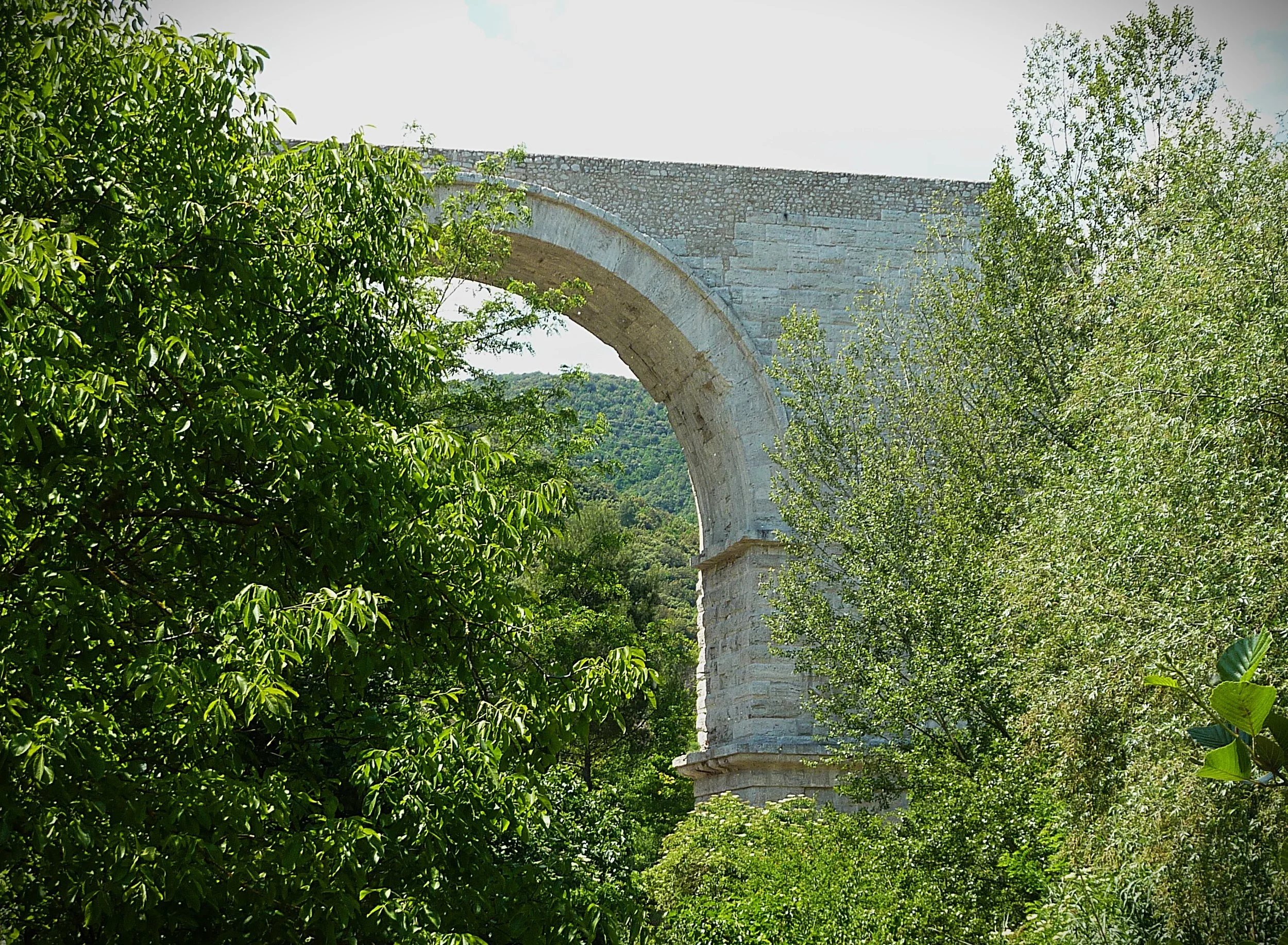
All that remains of the Ponte Augusto
As for history: on one edge of the central square, Piazza Garibaldi, there is a small bronze bust on a brick pedestal, partially hidden by a tree. You could easily miss it unless you know it’s there. The subject is an elderly, worried-looking chap wearing a toga. He’s the Emperor Nerva, and he was born in Narni, back when it was still called Narnia in 30 AD; he ruled for only 16 months but made a mighty contribution to Rome: before he died, he adopted Trajan as his son. Upon Nerva’s death, Trajan became Emperor; Trajan adopted Hadrian, Hadrian adopted Antoninus Pius, Antoninus Pius adopted Marcus Aurelius, and each in his turn ruled the Empire, keeping Augustus’ Pax Romana (the Roman Peace) going until Marcus died in 180 AD.
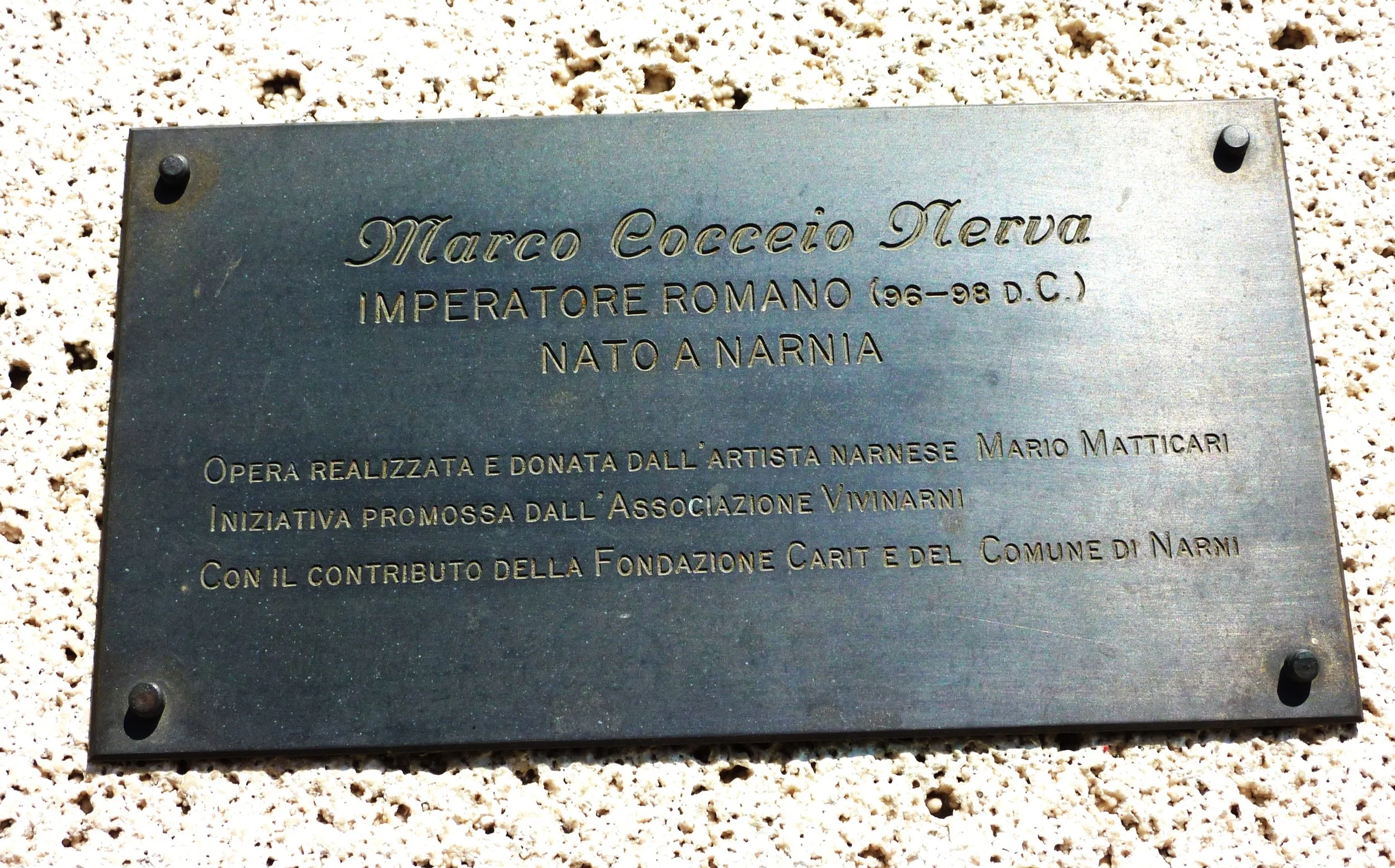
A Plaque in the Piazza for Emperor Nerva
Nerva’s not the only notable son of Narni. A stone plaque identifies the boyhood home of Erasmo of Narni, the son of a baker who became one of Renaissance Italy’s greatest Condottieri. The plaque quotes him: Narnia mi Genuit. Gattamelata fui. “Narnia gave me life. I was Gattamelata”. Gattamelata – the “Honeyed Cat” – helped save Venice from the Visconti of Milan, and his famous equestrian statue by Donatello stands majestically beside the Basilica of St. Anthony, in Padua.
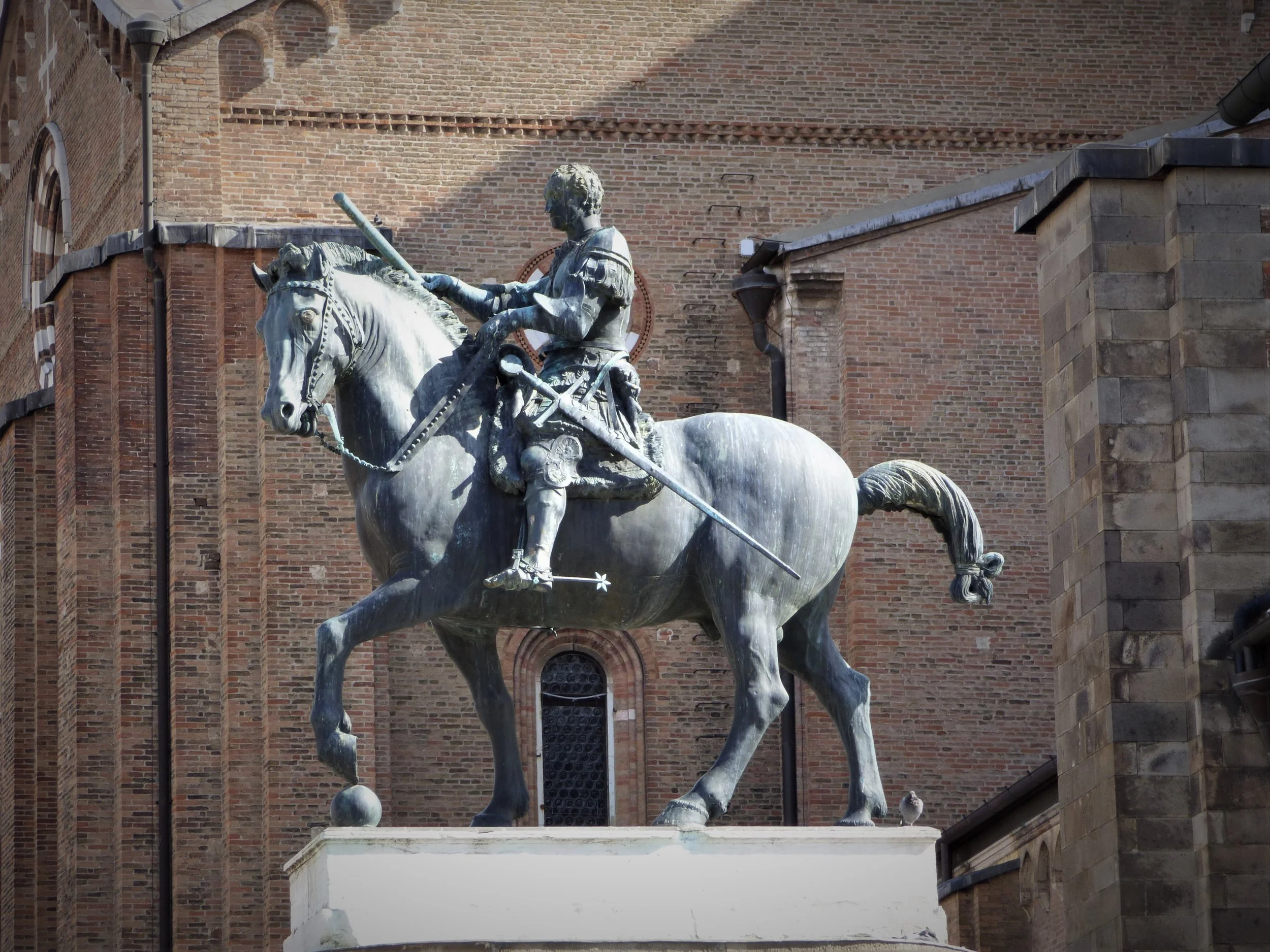
Statue of Narni’s “Honeyed Cat” - Gattamelata - by Donatello, in faraway Padua
Beneath Narni’s cobbled lanes are the remains of an ancient cistern, a Roman aqueduct, frescoed chapels from a 12th century monastery, a sinister prison cell with graffitied walls, and a grim torture chamber used by the Inquisition back in the 16th century. And on the very heights of Narni’s hill, the walls and towers of the Rocca Albornoziana rise, stern and forbidding. From this fortress, Narni and its surroundings are like a diorama on a tabletop, a miniature village in a miniature landscape, in which nothing of consequence can happen unobserved.
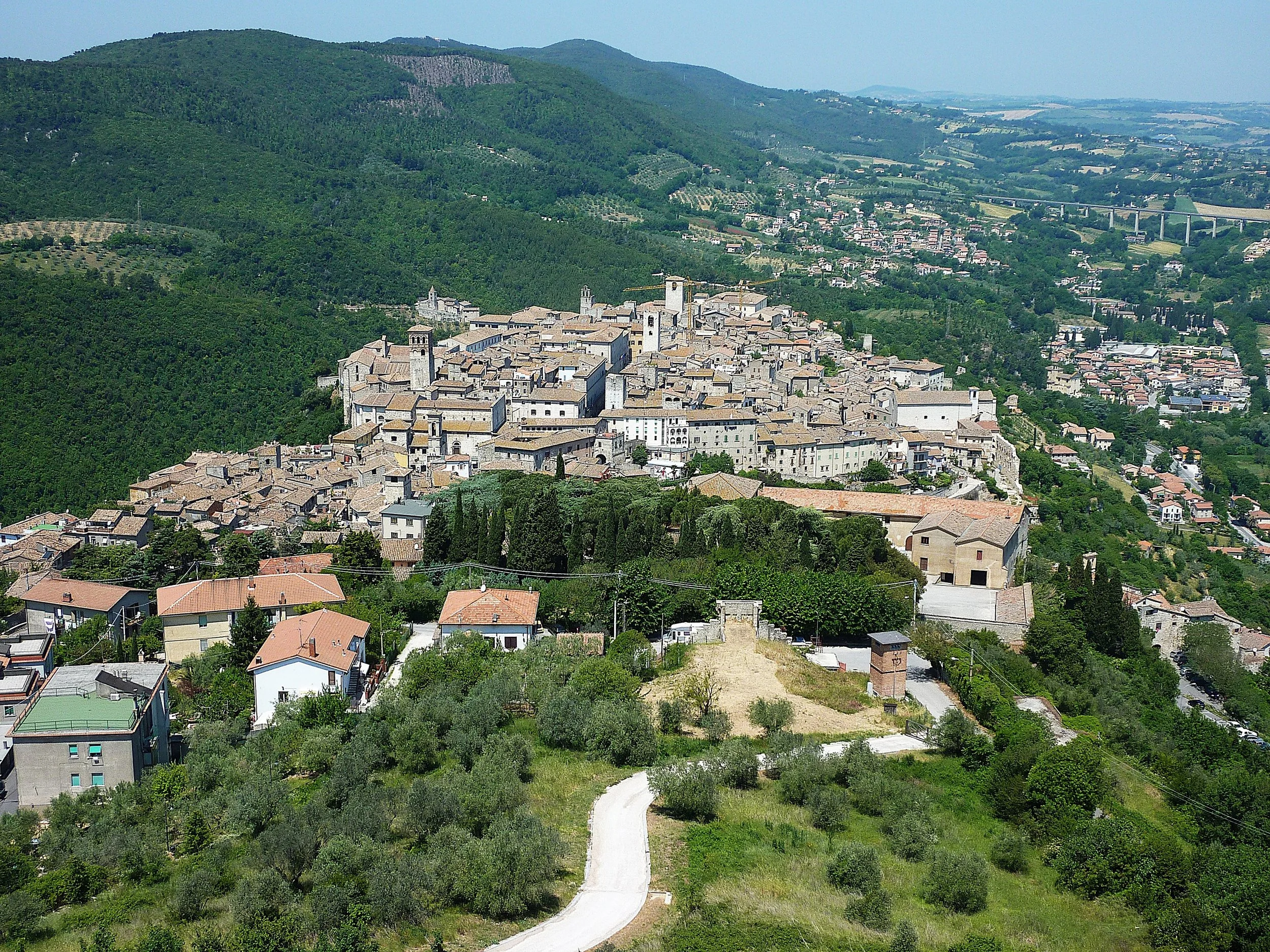
Narni, seen from the Rocca Albornoziana
Narni’s not unique in having a Rocca Albornoziana looming above it, though. Strung loosely along the route of the ancient via Flaminia, north from Rome and across the Apennines to the Adriatic, other towns of the Papal States – Orvieto, Spoleto and Assisi in Umbria, Sassaferrato and Urbino in le Marche – all have their own Rocche Albornoziane, all put there by the same man, and all to keep a suspicious eye on the townsfolk.
It all began when the Papacy abandoned Rome in the early 14th century. By that time the popes had ruled over the Papal States – much of central and northern Italy – for around 500 years; but now the Roman church was embroiled in a power struggle with Philip IV of France, who, after the death of Pope Benedict XI, managed to force the election of Clement V as Pope. Clement was a Frenchman, Bertrand de Got, and he refused to move to Rome; so the Papal court moved to Avignon and stayed there for 67 years, during which time seven French popes reigned and Rome’s political importance dwindled. That suited the French Monarchy, but with the Papal court far away in Avignon, various rebellious towns in Italy, including Narni, and powerful families like the Malatesta of Rimini and the Montefeltro of Urbino, began to shrug off the church’s control.
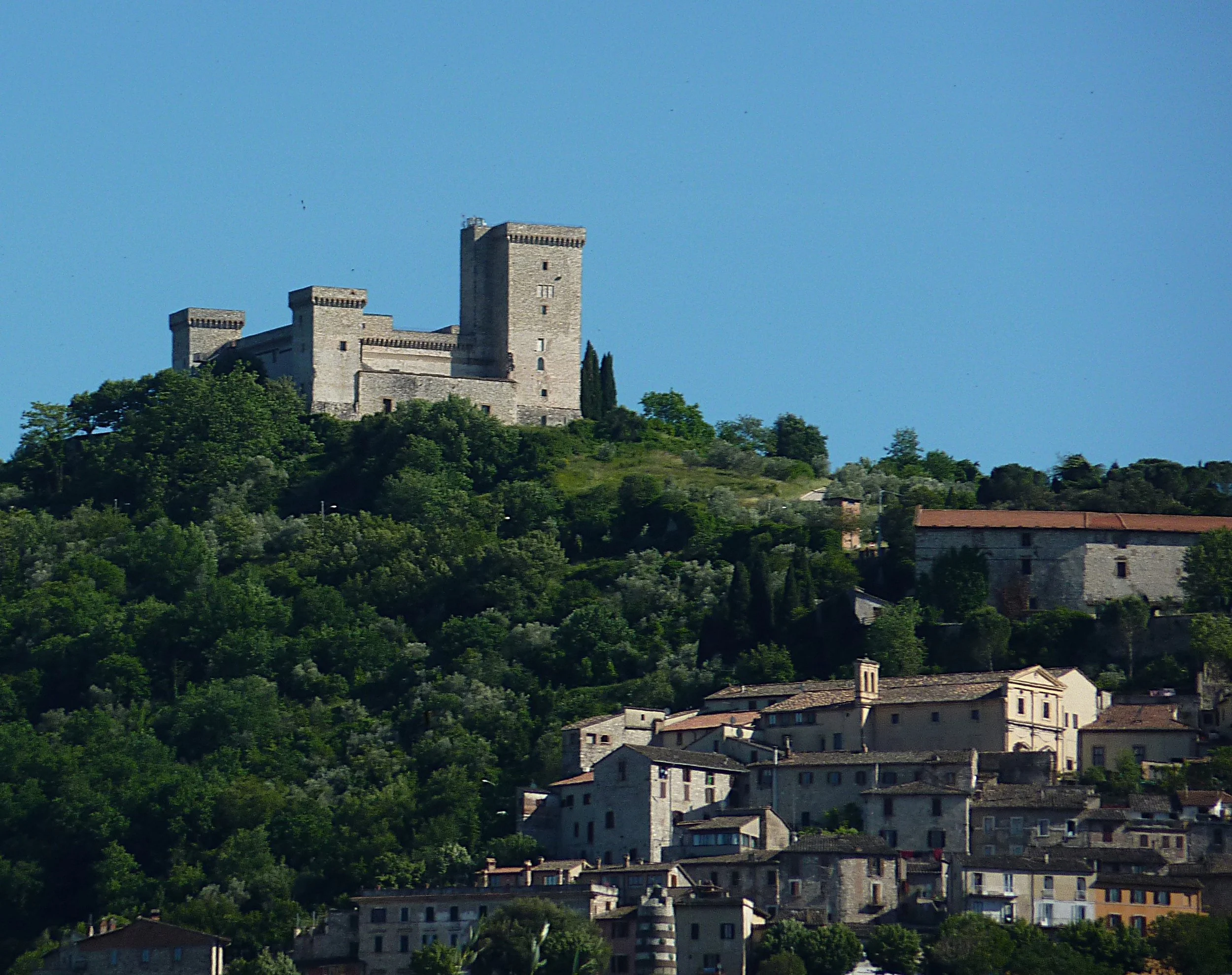
The Rocca keeps a watch on the once-unruly town of Narni
In 1353, Pope Innocent VI picked a “Papal Legate” to go to Italy and restore papal authority; he also thoughtfully sent an army, and the man he picked to lead this “legation” was Cardinal Egidio Albornoz, a tough Spanish churchman who’d fought against the Moors as part of the Spanish Reconquista. In almost ten years of warfare, Albornoz managed to bring most of the Papal territories back under the church’s rule, and, to enforce that rule on the troublesome towns of Umbria and the Marches, he built his menacing fortresses on the rocky heights above them. The view from Narni’s Rocca today, looking down toward the medieval rooftops clustered on their hilltop, with green, wooded hills to the west and patchwork fields eastward toward Terni, is peaceful and serene; but it wasn’t always that way, as Cardinal Albornoz would be the first to tell you.
© Text © 2022 by Joe Gartman; Photographs © 2022 by Patricia Gartman. First published in Italia! Magazine, October/November 2022