Zanardelli’s Folly
Our apartment on Via Andrea Doria was near the Vatican, and only a step or two from Cipro Metro station; but to reach the area around Piazza Navona and the Pantheon, it was easier to take bus 492. Or rather, it was easier if the bus arrived on time – or at all. Line 492 was notoriously unreliable. I can still remember the thrill of joy I always felt when the bus would lumber around the corner, forty-five minutes late, onto Via Candia, and proceed with all the urgency of a tree sloth toward the bus stop.
One of the bus stops on my journey was “Zanardelli”, and I used to wonder idly who or what Zanardelli was. When I finally did google the name, I was embarrassed to find that “Zanardelli” didn’t reference some obscure historical footnote, but an important 19th century politician; in fact, he was once Prime Minister of Italy. Not only that, he left a very emphatic mark on the cityscape of Rome, one that visitors to Rome cannot miss, even if they want to. Because when King Victor Emanuel II died in 1878, it was Minister of the Interior Giuseppe Zanardelli who proposed a grand monument to honour the king’s memory.

A design competition for the monument was announced, and hundreds of architects from Italy and elsewhere entered. The winner was one Giuseppe Sacconi, whose neoclassical design was inspired by the 2nd century BC Pergamon Altar from Asia Minor. Excavators destroyed the medieval Franciscan monastery of Aracoeli, and many other historic buildings, to prepare a huge site next to the Campidoglio.
The enormous structure has several names, including the Vittorio Emanuele II Monument, the Vittoriano, and the Altare della Patria. It is 135 metres wide, 130 deep and 80 metres high. A central monumental staircase rises to the first of two wide terraces. Giant buttresses on either side are adorned by sculptured fountains. More stairs lead to a second terrace. And, reached by a glass-enclosed panoramic lift, there is still a third terrace on the roof. At either end, there are great bronze sculpture groups, called quadrigas, each depicting the goddess Victory, wings spread, driving a bronze four-horse chariot. The quadrigas are atop the two elevated propylaea (temple entrances) above the monument roof. There are splendid views of Rome from all three levels. You can look down on Augustus’ forum, Trajan’s Market, Trajan’s column, the Colosseum, and more; or you can gaze outward over the whole sweep of the city’s domes and rooftops.
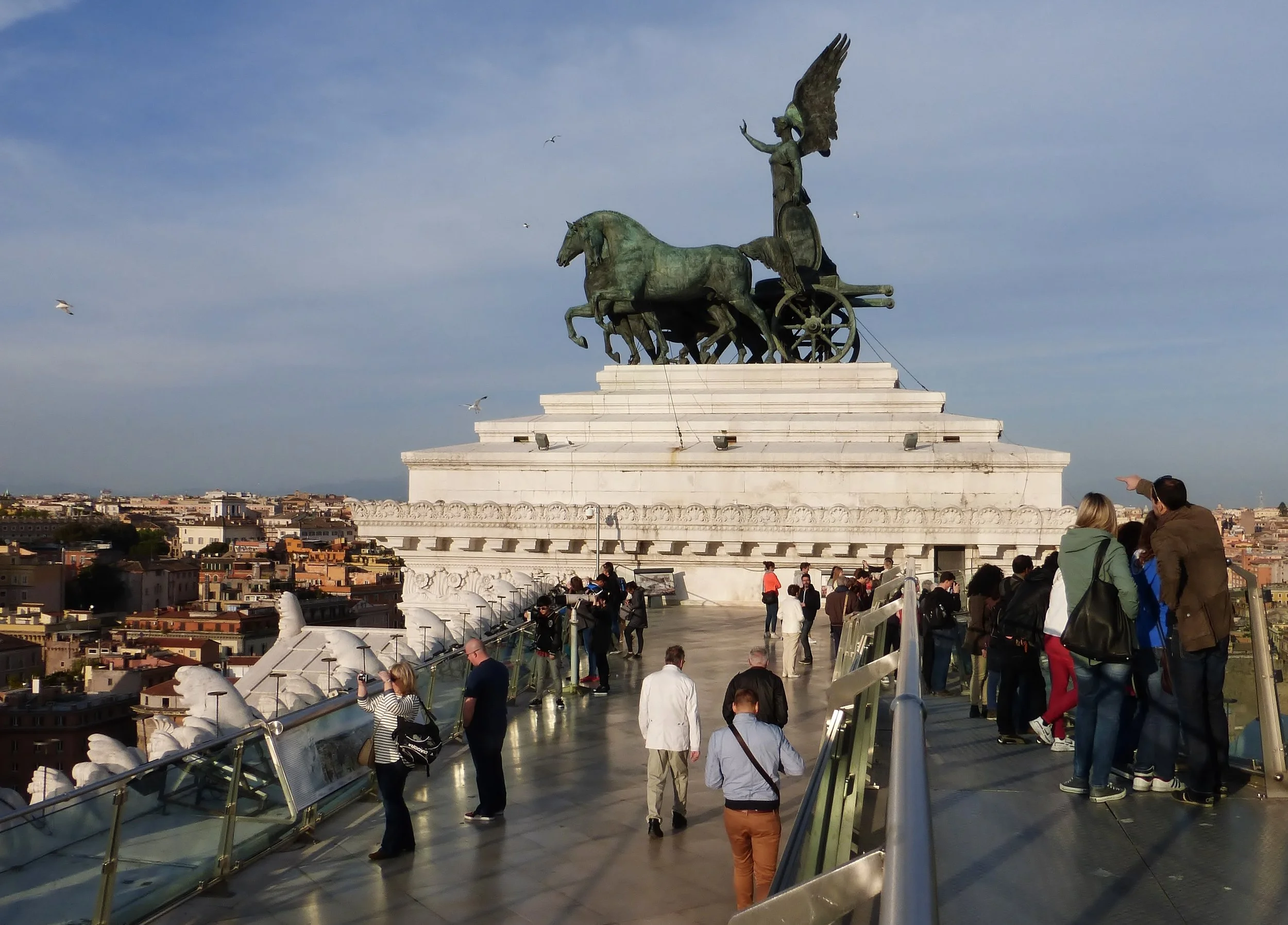
One of the Quadrigas decorating the roof
The first terrace contains an elevated “Altar of the Fatherland”, where sentries guard the Tomb of the Unknown Soldier. A massive semi-circular structure looms above. From this structure, whose surface contains an elaborate carved frieze and a relief of the Goddess Roma, a great bronze equestrian statue of Victor Emanuel II rises on its plinth. The statue is 12 metres tall and 10 metres wide. So large, in fact, that in 1910, during a visit to the construction site, King Victor Emanuel III and twenty of his friends ate lunch at a table inside the hollow bronze torso of his father’s steed. Everything about the monument is huge, including the number of sculptural decorations, many of which are personifications of Italian virtues, such as unity, strength, law, or sacrifice.
It’s a great favourite with tourists from all over the world, who swarm over the building and seem to enjoy themselves mightily – and why not? After all, Victor Emanuel’s monument is certainly easy to find, spectacular, historic, photogenic, and free. But some Romans, and many European and American expats, regard it with disdain.
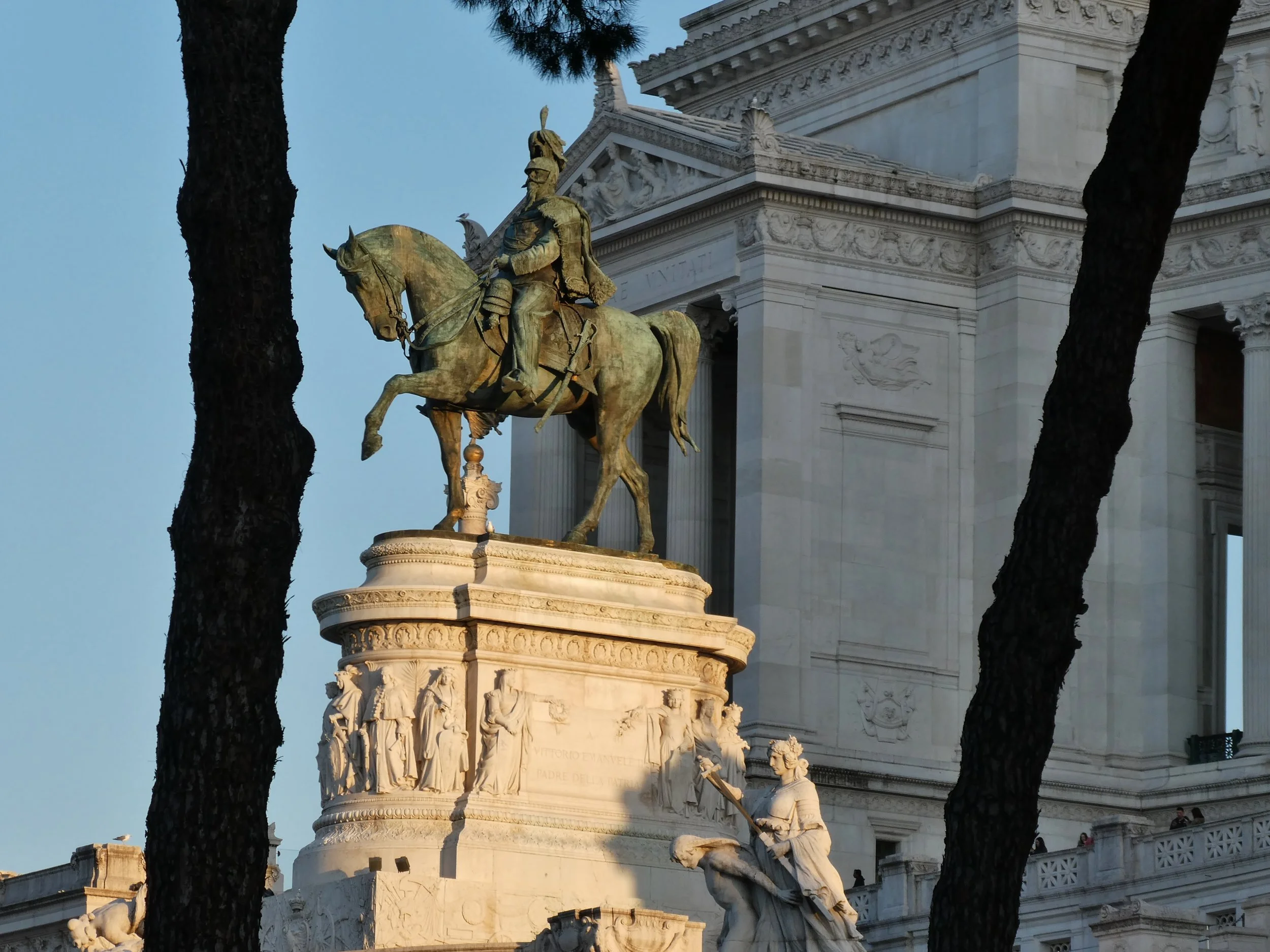
Colossal equestrian bronze statue of Victor Emmanuel II
Their dislike may be philosophical – because the monument celebrated an ancient urge to imperial glory, that later helped lead to the catastrophe of Mussolini and fascism. Perhaps they see its construction as vandalism of the historic fabric of the city, even of the Capitoline Hill itself. Or the criticism may be more concerned with aesthetics: it’s too big, too pompous, too white, too numbingly neoclassical, etc. It’s derisively called the Wedding Cake, the Denture, or the Typewriter. (While the left-hand quadriga may resemble the carriage-return on an old Olivetti, the typewriter analogy is obviously not long for this world, and good riddance, I say.) Someone once remarked that the best thing about the view from the Vittoriano is that it’s the only view in Rome that doesn’t include the Vittoriano.
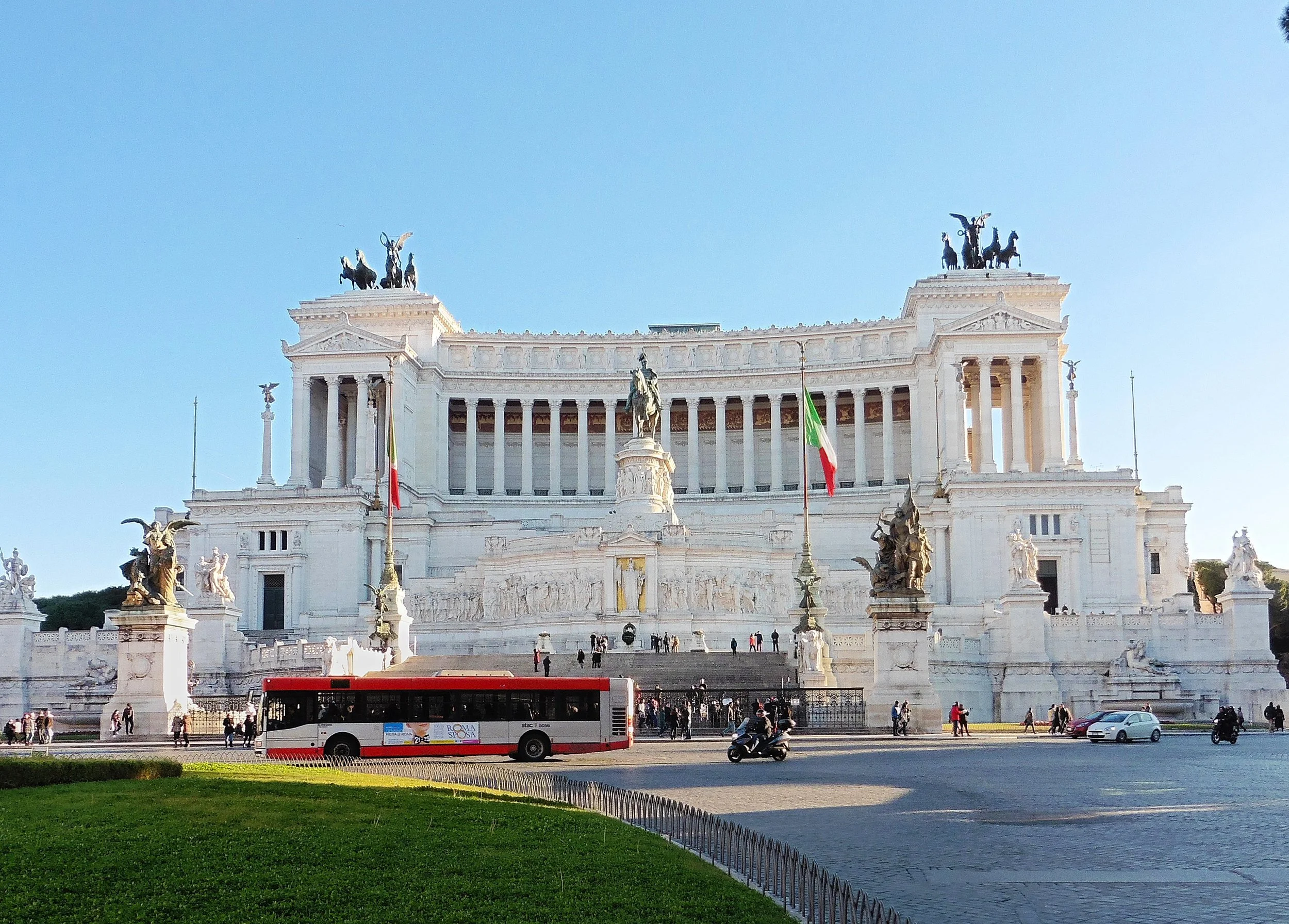
Typewriter? Wedding Cake? Denture?
But how harshly should we judge the Italian patriots who made it? They were celebrating a great achievement – the creation of one nation from a collection of smaller city-states and principalities, perennially ruled from abroad, or by the church, or used as pawns in proxy wars between major European powers. They were celebrating a hoped-for unity, perhaps never to be achieved. Shall we condemn them, because of our melancholy burden of hindsight? And I wonder how snarky future generations will be about our glorious creations?

Tourists enjoying a winter day on the First Terrace
The Vittoriano is worth an extended visit, for the views and people-watching, of course, but also for memories of a world that vanished, not so long ago. Inside, there is a wonderfully old-fashioned Museum of the Risorgimento, where few of the tourists on the terraces ever venture; and, since 1921, the tomb of the Unknown Soldier has been there as well, marked by an eternal flame and an honour guard, in solemn remembrance of those who died in World War I.
Still, Minister Zanardelli, if you can read this up there in Paradise – did you have to insist on using that dazzling white Brescian marble from your hometown?
© Text © 2020 by Joe Gartman; Photographs © 2020 by Patricia Gartman. First published in Italia! Magazine, March 2020